
Connect what is already there
Work across the systems behind support, identity, and client operations.
PRMT uses PromptQL to bring client knowledge and service workflows together, so its IT services team can see what needs attention, act across systems, and keep expertise with the business.
It's our operating layer, our AI layer, our model layer...our Chief Everything Officer.
PRMT is a managed IT services and cybersecurity provider. Its team keeps other companies’ employees, devices, and systems working, from onboarding new hires to resolving support issues.
Each client has different tools, access rules, and ways of working. PRMT already used AI and automation, but its knowledge platform couldn’t reliably pull together client information. The team didn’t adopt it, so people still had to connect the dots across systems. PRMT needed that context to travel with the work, without depending on one person’s memory or availability.
PromptQL brings PRMT’s client work into one view, so the team can see what needs attention without piecing the picture together across spreadsheets and separate platforms. They can ask what is missing, understand the context, and act on the next step.
Onboarding is one example. PRMT built a command center in PromptQL to track the equipment, accounts, and application access a new hire needs, so the team can see what is ready before day one.
Before PromptQL, a normal day was touching 20–30 tickets. Having a million tabs open. Constantly being interrupted. Things falling through the cracks.
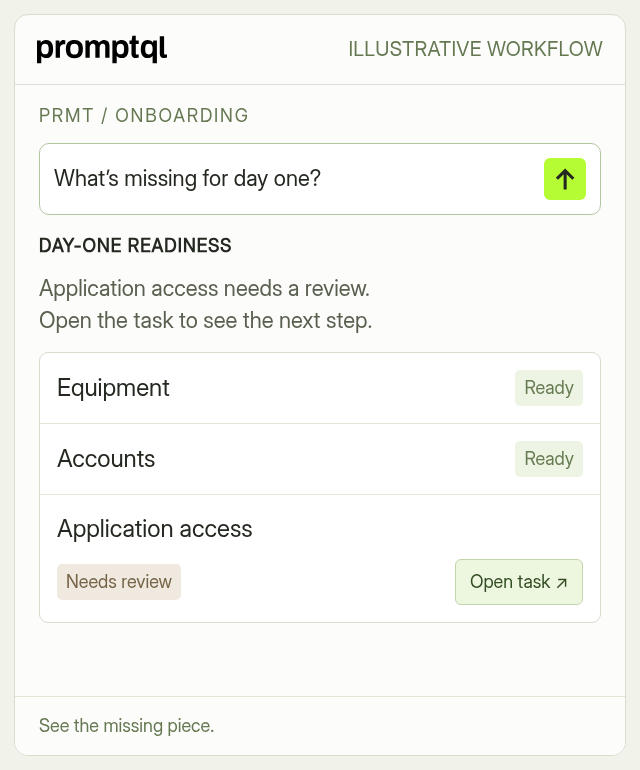
PromptQL connects PRMT’s team to its existing service systems. The wiki supplies client context and playbooks. Connected APIs let the team investigate an issue, take action, and update existing systems.
Literally, we became AI native in weeks, using PromptQL.
Almost immediately, PRMT automated its most frequent client requests, follow-up replies included. AI wasn’t just answering questions anymore. It was doing the work. Need a dashboard or workflow? The team asked PromptQL instead of scoping a separate engineering project. That freed up time for what matters most: critical work and client relationships.
The change goes beyond any single workflow. The team also needs to know how each client works. PRMT captures client context and operating playbooks in PromptQL so that knowledge can be reused by colleagues, rather than staying in the head of the person who first handled the work.
When someone leaves or changes roles, the knowledge already captured remains available to the people who need it. The next person can pick up the context instead of starting from scratch.
We built our command center in PromptQL, and now we have a single view of all our clients, all the readiness provisions that need to happen.
In use at




The goal is not to take people out of client service. It is to give them the context and tools to do the work.
Work across the systems behind support, identity, and client operations.
Keep client-specific knowledge in the right scope so the team can work with the relevant context.
For selected workflows, PromptQL prepares a plan and a person reviews it before execution.