
Defusing slop grenades and other multiplayer AI stories beyond group chat
Personal AI agents improved individual workflows significantly. I don't have to go to multiple tools to gather information and do work.
Similarly, multiplayer AI agents should improve team workflows. Like individual workflows that are handoffs between a human and their tools, a team workflow is essentially a set of hand-offs between multiple people (and their tools). These hand-offs are done in unstructured ways (conversations, meetings) or structured ways (SaaS tools, reports, maker-checker workflows, ticketing).
Yet, unlike a simple conversational agent like ChatGPT (or now Muse), that had a 10x benefit for the personal AI, putting an AI agent in a group chat hasn't quite had that same level of impact.
To understand why, and to create a checklist of what will make AI truly multiplayer, I'm listing out a few examples of hand-offs in team workflows that need to get better. And if these get better, I think the physics of team work can change by the same degree that individual work changed.
1. Defusing slop grenades
Starting with something simple. A document or a PR that takes seconds to generate can cost everyone else hours to review. A multiplayer AI should let recipients question a slop artifact's sources and assumptions, so that effort of consuming AI generated content eases.
Eg: I once received a sloppy pitch deck. The business idea is solid and time is short for founders. So I understand why. But if I could just ask the AI that made the deck some questions and assimilate? Everyone saves time!
2. My prompt; your data
I have the question, but you have the relevant data or access. A multiplayer AI should allow us to work together without turning either of us into a clipboard meat-proxy.
Eg: An engineer wants to connect a regression analysis work to private customer data that an FDE has access to.
3. Communicating visually
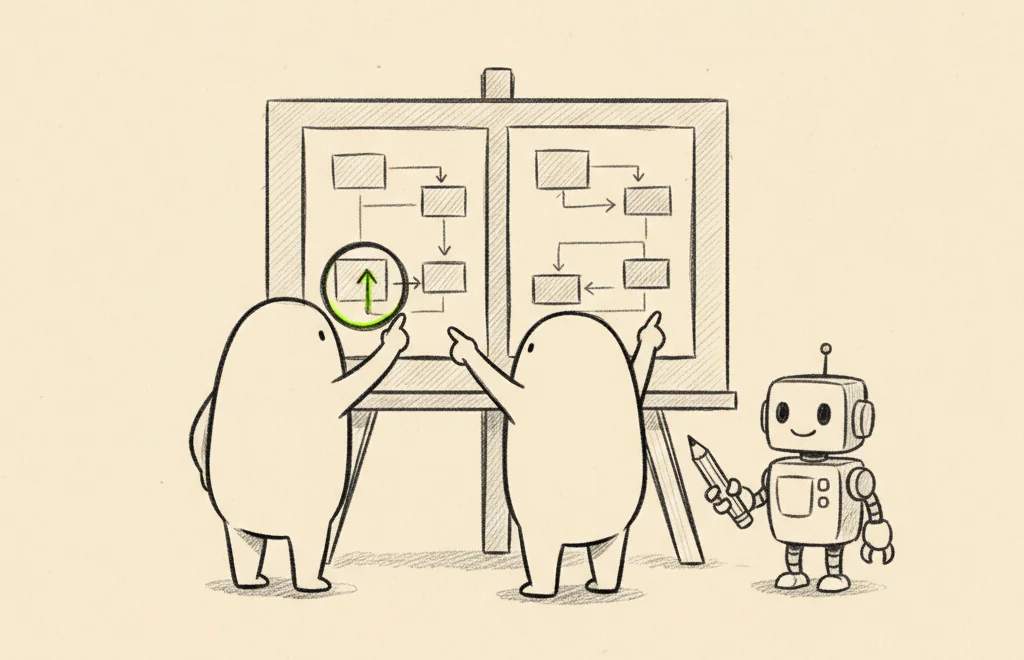
Explaining complex ideas and reaching consensus is hard. A multiplayer AI can present options and collect feedback visually, making it easier for a group to understand the trade-offs, surface disagreements, and decide.
Eg: We discuss design trade-offs on a live architecture diagram of the PR instead of looking at raw code.
4. Alternatives to collaboration & SaaS apps
Building the right collaboration surface for a team needs manual setup. A multiplayer AI can do that initial setup and regular maintenance for the team. Examples:
- Planning: Generate a sprint specific trello board vs setting up a board.
- Docs: A collaborative spec that everyone can comment on together.
- Design: Comment on the visual or wireframe directly.
- BI & Dashboards: Iterate or drill-in directly from where the dashboard is built.
5. Fork a bot
A+ teams are amazing to work with because of how much I get to learn from others. A multiplayer AI helps me pick up someone else's work and explore a different direction, or build on top of what they've already done.
Eg: What if we tried a different approach for this step? Let me play around with it.
Two problems seem to be underneath all of these situations:
- Being able to seamlessly switch between a shared chat and a shared app form factor
- Security and access control to allow multiple participants to bring their own context, data and tools into a shared conversation
But more importantly, and regardless of the technology problems, I think the behavior shift required to adopt a true multiplayer AI system is very hard.
People when working together like creating buffers between themselves. As humans we need the ability to maintain a dissonance between what we say and what we do. A true multiplayer AI system requires us to sacrifice this coordination theatre, and perhaps, we're not ready for this level of intensity and rawness in working with each other.