A regulator, a customer, or your own security team asks one question after an AI system gives a wrong answer: what exactly led to it? If your logs only show a prompt and a response, you have nothing to hand over. Everything in between, the tool calls, the reasoning, the decision to proceed, is gone.
That gap is what an audit trail closes. It turns "we think the AI did the right thing" into a record you can actually verify. Below is an 8-step process for building one, plus how each piece maps to the regulations that will soon require it.
Key Takeaways
- An audit trail for AI-generated answers records the reasoning path and every action taken, not just the final output, and proves the record hasn't been altered.
- Start with the mandatory fields (identity, action, outcome, trust level, content hashes) before writing any logging code.
- Hash-chain and sign every record so tampering is detectable, and separate data by tenant so auditors can query without exposure.
- The EU AI Act's automatic logging requirement for high-risk systems now applies from December 2027 (standalone systems) and August 2028 (embedded systems), following a 2026 delay, so building this now puts you ahead of the deadline rather than scrambling to meet it.
What Is an Audit Trail?
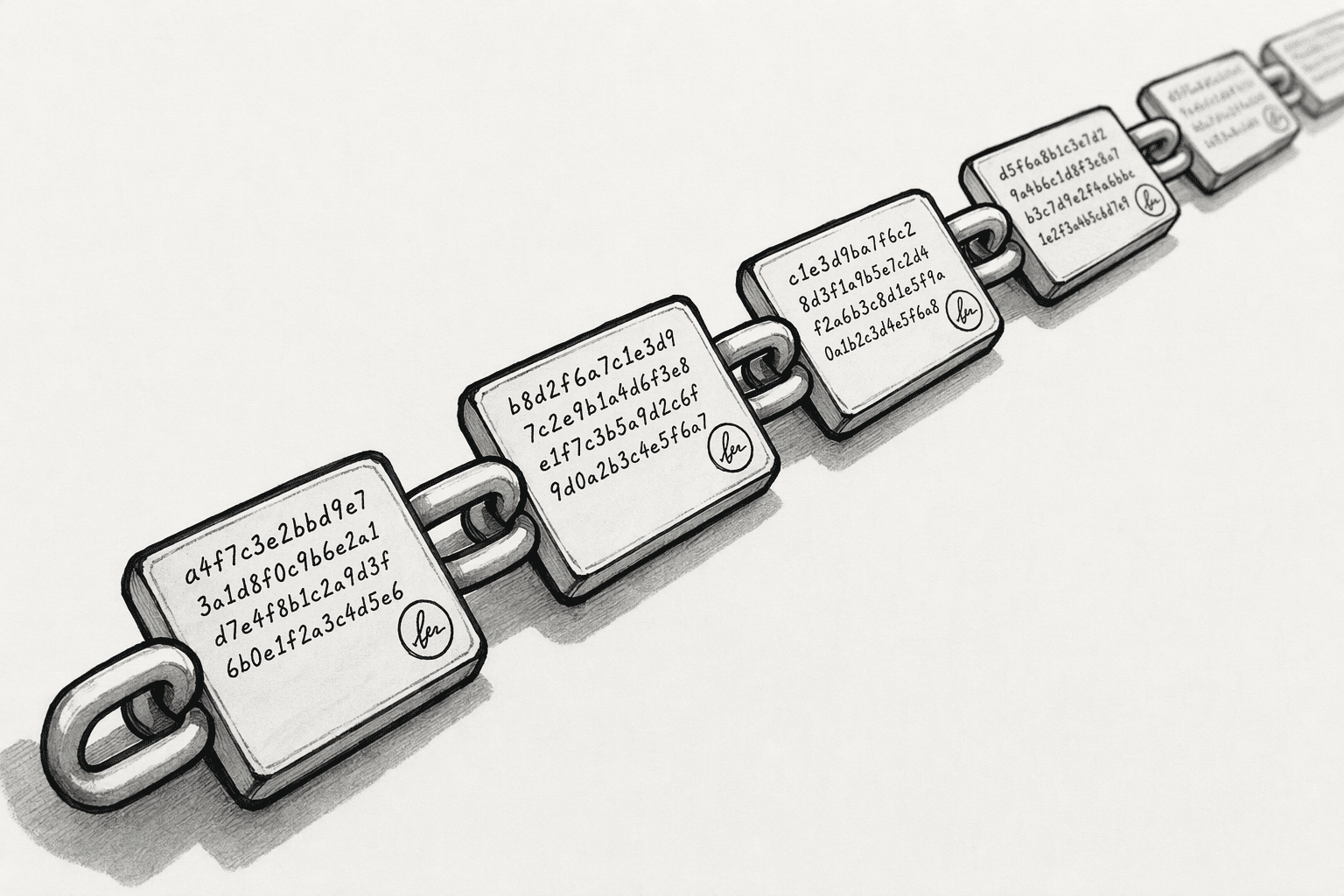
An audit trail is a tamper-evident, chronological record of every action a system takes, from the input it received to the output it produced, that lets someone outside the system reconstruct exactly what happened and confirm the record itself hasn't been changed.
For AI-generated answers specifically, that means capturing more than the final response. It means capturing what the AI planned to do, which tools it called, what data it touched, and whether a human stepped in, all linked together so a missing or edited entry stands out immediately.
The table below shows why a standard application log falls short of that bar.
| Capability | Standard Application Log | AI Audit Trail |
|---|
| Records the final output | Yes | Yes |
| Records the reasoning and plan before execution | No | Yes |
| Detects tampering after the fact | No | Yes |
| Cryptographically signed for non-repudiation | No | Yes |
| Holds up as compliance evidence | Rarely | Yes |
Each row above is a capability you have to build deliberately. None of them happen by default in a standard logging setup, which is exactly why the next section walks through building each one, in order, starting with the fields your records need to capture.
How to Build an Audit Trail for AI-Generated Answers
Work through these eight steps in order. Each one builds on the step before it, so skipping ahead usually means redoing work later.
Step 1: Define What Your Audit Trail Must Capture
Before you write a single log line, list the fields your records need. Skipping this step is the most common reason teams end up with logs an auditor rejects for missing basic information.
At minimum, capture:
- Identity and classification: which agent took the action, what type of action it was, the outcome, and the trust level it was operating at.
- Content fingerprints: a SHA-256 hash of the prompt and tool inputs, rather than the raw text itself.
Hashing instead of storing raw content is a deliberate choice. GDPR's right to erasure means you may need to delete the original prompt later, and a hash is irreversible, so you keep proof that a specific input led to a specific result without holding onto the sensitive content itself.
Step 2: Check Whether Your AI System Is Deterministic or Black-Box
Run a simple test: give your system the same input twice and compare the outputs. The answer decides what you can honestly claim to an auditor.
- If the outputs match every time, and your model runs on open weights, at temperature zero, with a fixed tokenizer and inference engine, you can support decision reproducibility: a third party can rerun the computation and get the same result.
- If the outputs can vary, which is true for most hosted, black-box, or tool-calling models, you can only support record reproducibility: your trail proves the recorded events happened, but not that the output was the only one possible.
Write your compliance claims to match whichever category you fall into. Claiming reproducibility you can't back up is worse than not claiming it at all.
Step 3: Chain and Sign Every Log Entry
This is what makes a log tamper-evident instead of just a list of events. Build it in this order:
- Hash every field of each record (identity, action, outcome, context) into a single SHA-256 digest.
- Link each record to the one before it by embedding the previous record's hash. Order records by a server-assigned timestamp, not a client-provided one, so gaps are visible.
- Lock concurrent writes so two events can't be inserted at the same position and fork the chain.
- Sign each record with an asymmetric key (ECDSA P-256 is the common default; ML-DSA-65 adds post-quantum resistance for records that need to stay verifiable for years).
- Verify the chain on every read, flagging a mismatch if a record's content changed, or a break if its link to the previous record no longer holds.
Once this is in place, any alteration to the trail leaves a visible mark instead of disappearing quietly.
Step 4: Log the Reasoning Path, Not Just the Final Answer
Most logs only capture what happened after the fact. Write the record of what the AI intended to do before it acts, especially for anything that changes external state: a database write, a payment, a delegation to another agent. This is what turns your trail from a record of observations into evidence that a check actually happened before the action ran. To do this well:
- Group each session under one ID, with tool calls and sub-decisions recorded as linked child events underneath it.
- Store a hash of the reasoning chain rather than the reasoning text itself, so you can later prove the reasoning existed without exposing it.
- For any action that moves money, deletes data, or deploys to production, write the pre-execution record first and the outcome record second.
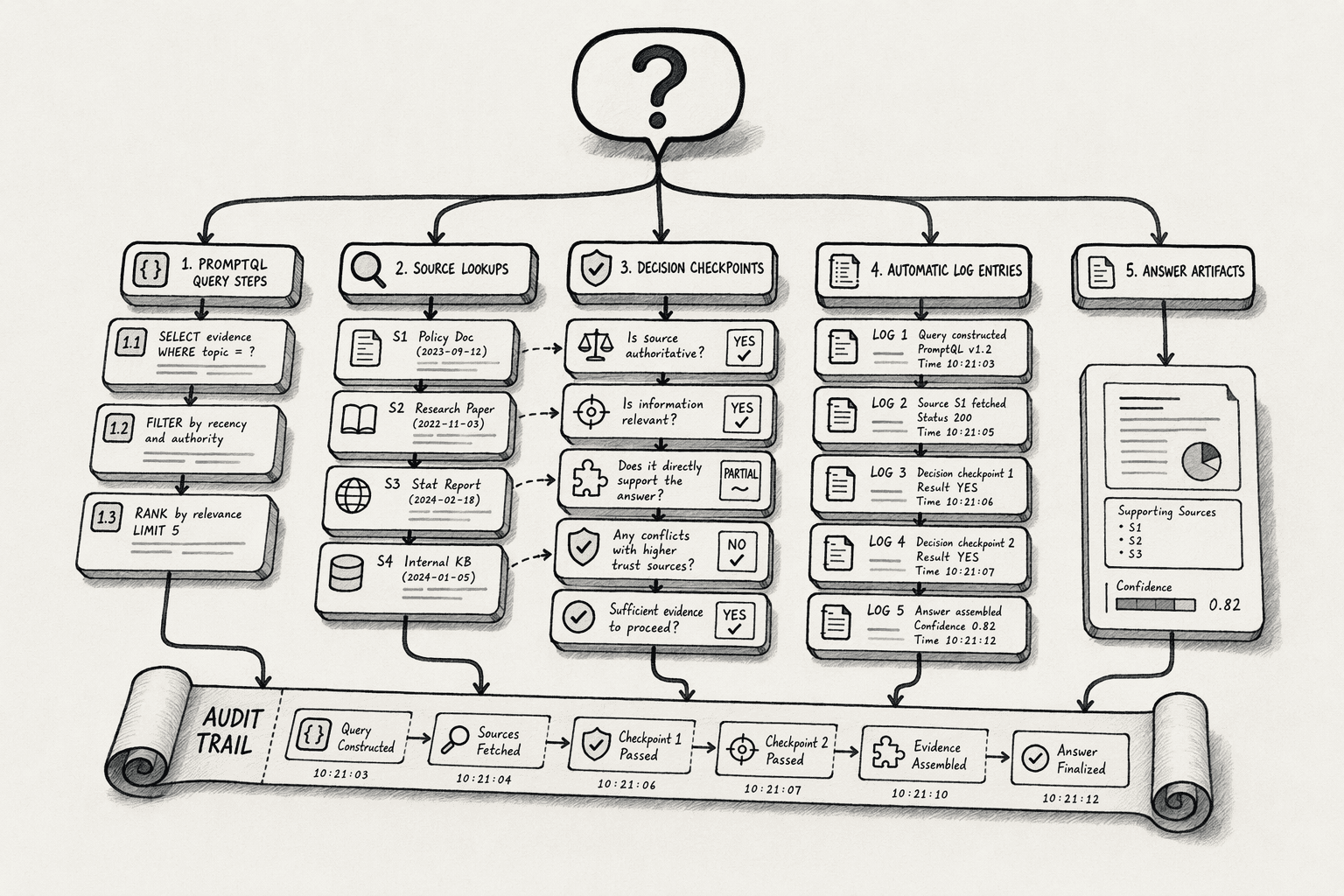
This is exactly what PromptQL's reasoning trace does automatically. Every step PromptQL takes to answer a question, what it queried, what it considered, what it decided, is logged as it happens, not reconstructed afterward. If you're already evaluating AI agent tools with strong audit trail depth, this is the property to check for first.
Step 5: Remove Standing Credentials from Your Logging Pipeline

An API key sitting on a developer's laptop is one of the easiest ways for an audit trail to be forged or bypassed. Close that gap directly:
- Issue device certificates through your MDM instead of distributing API keys.
- Route every connection that writes to your audit store through a proxy that authenticates the device first, so no client ever needs to hold a credential.
- Check that no logging code path can write directly to the store without going through that proxy.
Where possible, have a component other than the agent itself write the record. An agent that logs its own actions can, in principle, omit or edit them; an independent recorder can't be told to look away.
Step 6: Separate Data by Tenant and Enforce Access at Query Time
A single shared table of events breaks down fast once more than one team or customer's data lives in it. One bad query can leak across tenants, and one bad ingest job can pollute every trail at once. Set this up in three parts:
- Give each tenant its own schema, not just a shared table with a tenant ID column.
- Validate every incoming event against that tenant's schema at the point of ingest, not after.
- Build a separate query layer for auditors that answers "who did what" inside one tenant's data and can't reach beyond it, ideally without exposing raw event payloads at all.
PromptQL enforces this deterministically at the data layer: an auditor's question against one tenant's trail is scoped there by construction, not by a permission check that could be misconfigured. It's the same pattern behind how it handles role-based access for teams working with multiplayer AI tools.
Step 7: Export Logs in a Standard Format and Store Them Immutably
The format you choose decides whether your logs are still usable in ten years. Set up your export pipeline to do three things:
- Export records as JSONL, one complete record per line, so the format stays both machine-readable and portable across tools.
- Push that export into immutable object storage (S3, GCS, or Azure Blob with versioning or a write-once policy enabled), so a record can't be silently edited or deleted after the fact.
- Forward the same stream to your SIEM in parallel, so security and compliance teams aren't waiting on a separate export job.
A hash-chained log in immutable storage gives you a clear answer during an investigation: the chain is either intact, or it's broken and you know exactly where. A flat log file with no chain gives you a guess.
Step 8: Map Each Control to the Regulation It Satisfies
An auditor doesn't want your architecture diagram. They want a straight line from each technical control to the specific clause it satisfies. Build that map before you need it:
| Control | Regulatory Reference |
|---|
| Pre-execution recording of the AI's plan (Step 4) | EU AI Act Article 12, automatic event recording for high-risk systems |
| Hash chaining and signatures (Step 3) | HIPAA Security Rule §164.312(b), audit controls that record and examine system activity |
| Tenant-scoped access and query controls (Step 6) | SOC 2 CC6.1, logical access controls |
| Content hashing and tombstone deletion (Step 1) | GDPR Article 17, right to erasure |
One correction worth building your timeline around: the EU AI Act's Article 12 logging obligation for high-risk systems was not yet in force as of this writing. A 2026 amendment, Regulation (EU) 2026/1744, pushed the compliance date for standalone high-risk systems from August 2026 to December 2, 2027, and to August 2, 2028 for high-risk AI embedded in regulated products. That's a reason to build ahead of the deadline, not a reason to wait. Systems that log automatically now will already have the retention history the regulation expects once enforcement begins.
If you're weighing which platforms handle this kind of data provenance and lineage tracking well, this mapping exercise is a fast way to tell which ones were actually built with compliance in mind versus which ones bolted logging on afterward.
How PromptQL Helps Build an Audit Trail for AI-Generated Answers
PromptQL is built so an AI system answering questions from your data can show its work, not just deliver an answer. Two pieces of the process above come built in, rather than needing a team to stitch them together separately.
The reasoning trace is automatic. Every query PromptQL runs, every piece of data it checks, and every step in how it arrives at an answer is recorded as it happens. There's no separate pre-execution logging to build; it's how the system already operates.
Tenant separation is enforced at the data layer. An auditor's question about who accessed what is answered by a query scoped to that tenant by design, not by a permissions layer added on top of a shared database.
This comes backed by:
- GDPR and ISO 27001 compliance
- Deployment in a dedicated VPC or a customer's own cloud
For teams comparing options, this is the same traceability worth checking for in any AI tool that connects directly to your database.
That leaves the rest of the process for a team to handle directly: defining the fields to capture, securing the logging pipeline, exporting logs for long-term storage, and mapping controls to the regulations specific to their business.
Conclusion
The cost of skipping this shows up mid-incident, not at audit time. Without a working audit trail, teams spend 72 hours frozen, trying to reconstruct from scraps what a working trail would have handed them in seconds. Building one costs a few milliseconds of overhead per logged event.
Start this week with Step 1: write down the fields your records need. Everything else in this guide builds on that list, and it's the one step you can finish in an afternoon.
How much overhead does an audit trail add to an AI system? Hashing and signing a record typically adds around 1 to 2 milliseconds of processing time per event on standard hardware. For high-throughput systems, batching hash computation asynchronously keeps this overhead from becoming a bottleneck, as long as timestamps still reflect the actual event time rather than when the batch was processed.
Frequently Asked Questions
What exactly is an AI audit trail and why does it matter for enterprise compliance?
An AI audit trail is a tamper-evident, chronological record of every AI agent action, from prompt submission through tool execution to final output.
What specific technical components must be captured in an AI audit trail to make it trustworthy?
At minimum, capture agent identity, action classification, outcome status, trust level, and content fingerprints like promptsha256 and toolinput_sha256. Every event must be linked via SHA-256 hash chain and cryptographically signed with asymmetric keys such as ED25519 to prove the log has not been altered.
How is building audit trails for deterministic, plan-based AI different from logging black-box or tool-calling models?
Deterministic plan-based AI at temperature zero with attested weights and tokenizer supports decision reproducibility, meaning the same input always produces the same output and a third party can verify it. Black-box and tool-calling models can only support record reproducibility, confirming what occurred without proving the output was the only possible one.
What are the key US regulatory frameworks like HIPAA, CCPA, and SEC rules that mandate audit trails for AI-generated decisions?
HIPAA §164.312(b) requires audit controls that log and examine activity in systems handling electronic protected health information. SEC rules increasingly expect non-repudiable proof of automated decision sequences in financial reporting systems.
What technical architecture options exist for implementing tamper-proof AI audit trails without exposing sensitive enterprise data?
A device-certificate mTLS proxy that authenticates users via MDM before events reach the audit store eliminates laptop-based API keys. Hash-chained event streams stored in your own object storage (Amazon S3, Google Cloud Storage, or Azure Blob Storage) using a BYOC model keep log custody in your infrastructure.
How can an organization implement role-based access and per-user permission logging in a multiplayer AI environment?
Use org-scoped event schemas with per-tenant schema validation at ingest, then provide auditors a segregated query tool surfaced via MCP that answers attribution questions without exposing raw event payloads or cross-tenant data. Permissions enforced deterministically at the data layer keep each tenant siloed.
Sources
- audit trail - Glossary - csrc.nist.gov
- Audit, Observability & Lineage for Enterprise AI Agents - DEV Community - dev.to
- Hash Chain - Immutable - docs.getimmutable.dev
- Introduction to BYOC Logs - Datadog Docs - docs.datadoghq.com
- draft-sharif-agent-audit-trail-04 - Agent Audit Trail: A Standard Logging Format for Autonomous AI Systems - datatracker.ietf.org