A finance team once caught an agent approving a 40% discount for a client capped at 25%. The model sounded confident. It cited the right policy name. It was dead wrong.
Standard AI trips on enterprise reasoning because large language models retrieve what sounds plausible instead of what's actually approved. Hallucination is a retrieval problem as much as a model problem. A context graph fixes this gap. Instead of leaving institutional reasoning buried in Slack threads, approval chains, and people's heads, it captures the why, modeling decisions, policies, exceptions, and precedents as first-class connected nodes, structured for AI to actually consume.
This guide covers what a context graph actually is, how it differs from a knowledge graph or a semantic layer, the core components that make one up, and how it improves AI accuracy in practice.
Key Takeaways
What changes when an AI stops guessing and starts referencing a governed graph of institutional reasoning:
- Causal reasoning is captured as structure: Decisions, policies, and exceptions get modeled as connected nodes with causal edges that encode why an outcome is valid.
- Temporal validity is enforced on every edge: Superseded facts are invalidated rather than overwritten, so the agent sees what was true *when* a decision was made.
- Permissions are embedded in the graph: Approval hierarchies and control thresholds sit in the graph itself, not in an extra access-control layer bolted on top.
- Execution becomes deterministic: Every agent action is grounded in the organization’s own approved context, traceable step-by-step, producing a full audit trail.
- Adoption is accelerating fast: Gartner expects over 50% of enterprise AI agent systems to rely on context graphs by 2028.
What is a context graph?
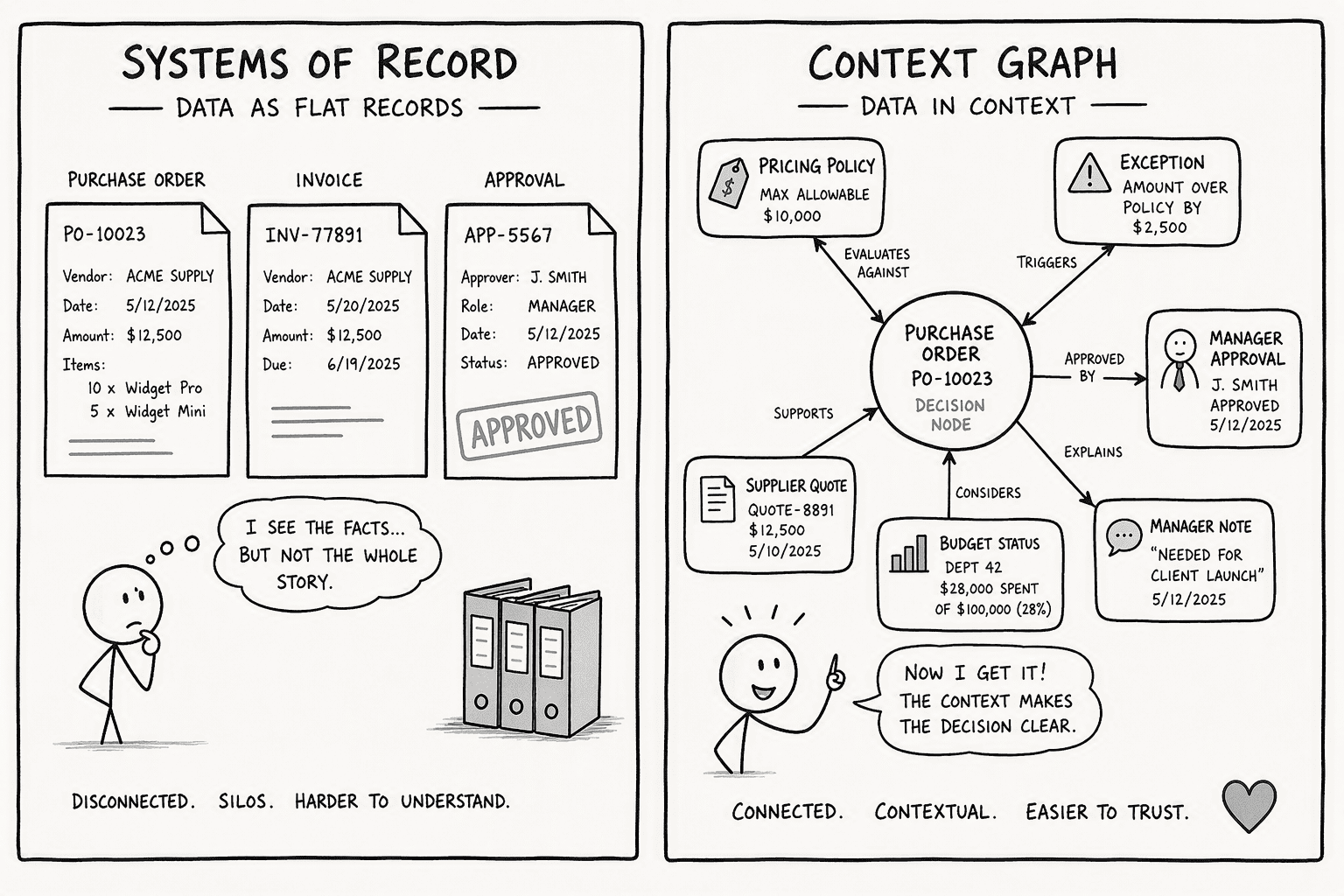
A context graph is a structured representation that extends a knowledge graph with the information plain entity-relationship triples leave out, temporal validity, provenance, and source.
Academic research on the concept frames it directly: knowledge graphs represent entities and their interrelations through triples, but triple-based knowledge graphs lack the contextual information of relational knowledge, like temporal dynamics and provenance details, that's crucial for comprehensive knowledge representation. A context graph incorporates that missing information directly into the structure.
In practical enterprise terms, systems of record tell you a purchase order was approved. A context graph tells you the pricing policy that justified it, the exception that was invoked, and the manager who signed off. One captures events. The other captures decisions.
| Feature | Systems of Record | Context Graph |
|---|
| Core question | What transaction occurred? | Why was that decision made? |
| Data modeled | Invoices, orders, inventory counts | Policies, approval chains, exceptions, evidence |
| Temporal handling | Overwrites; only the current state is visible | Temporal validity on every edge; superseded facts are invalidated, not destroyed |
| Auditability | Log-level; you can see *that* someone acted | Provenance-level; you can see the reasoning path and policy grounding |
A context graph is a persistent memory system for AI agents. It connects long-term enterprise knowledge, short-term conversation history, and reasoning memory so an agent can traverse from a question to the actual decision chain behind it. At runtime, the agent grounds its action in that chain rather than in a statistically likely sentence.
How a Context Graph Differs from a Knowledge Graph or Semantic Layer
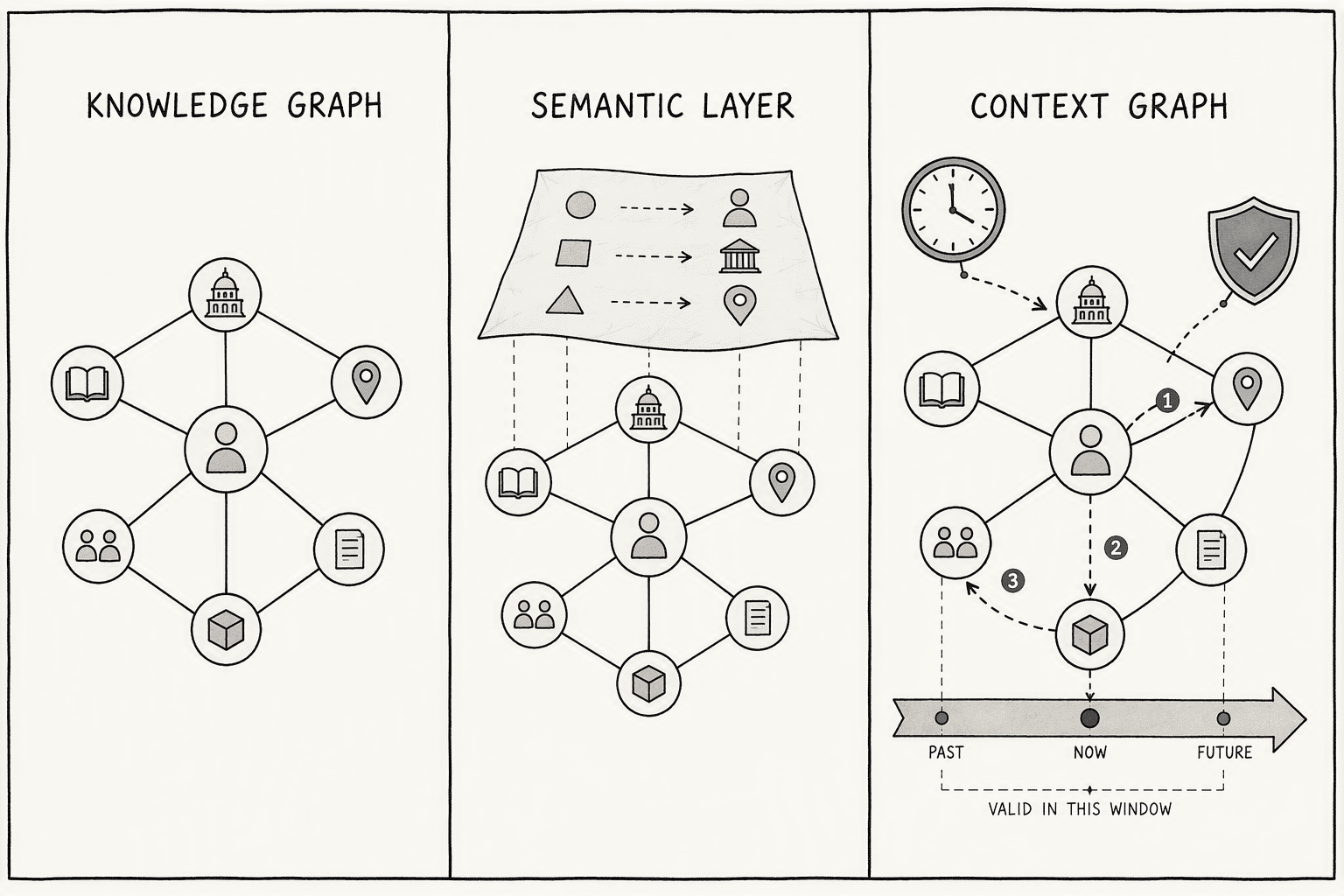
A knowledge graph maps entities and their relationships at design time. A context graph extends that structure at runtime with decision traces, temporal validity, and policy. That difference is everything.
GraphRAG builds a knowledge representation from static document corpora: it indexes what your documents say, then has the model reason over retrieved chunks. A context graph does not stop at indexing facts. It maintains temporal validity on every edge, so superseded facts are invalidated rather than overwritten. When an agent asks whether a client's discount exception is still in force, the graph can answer from the policy edge's valid-from and valid-to metadata, not from an ambiguous passage in a six-month-old contract PDF.
A semantic layer defines business definitions for analytics: what counts as revenue, which customers are active, how margin is calculated. It does not encode decisions. A context graph captures the procedural logic those definitions support: that a discount above 17% requires VP approval, that a specific override was granted for Q4, and that the same override expires on December 31.
Temporal validity makes the context graph a living institutional memory rather than a frozen snapshot.
The Core Components That Make Up a Context Graph
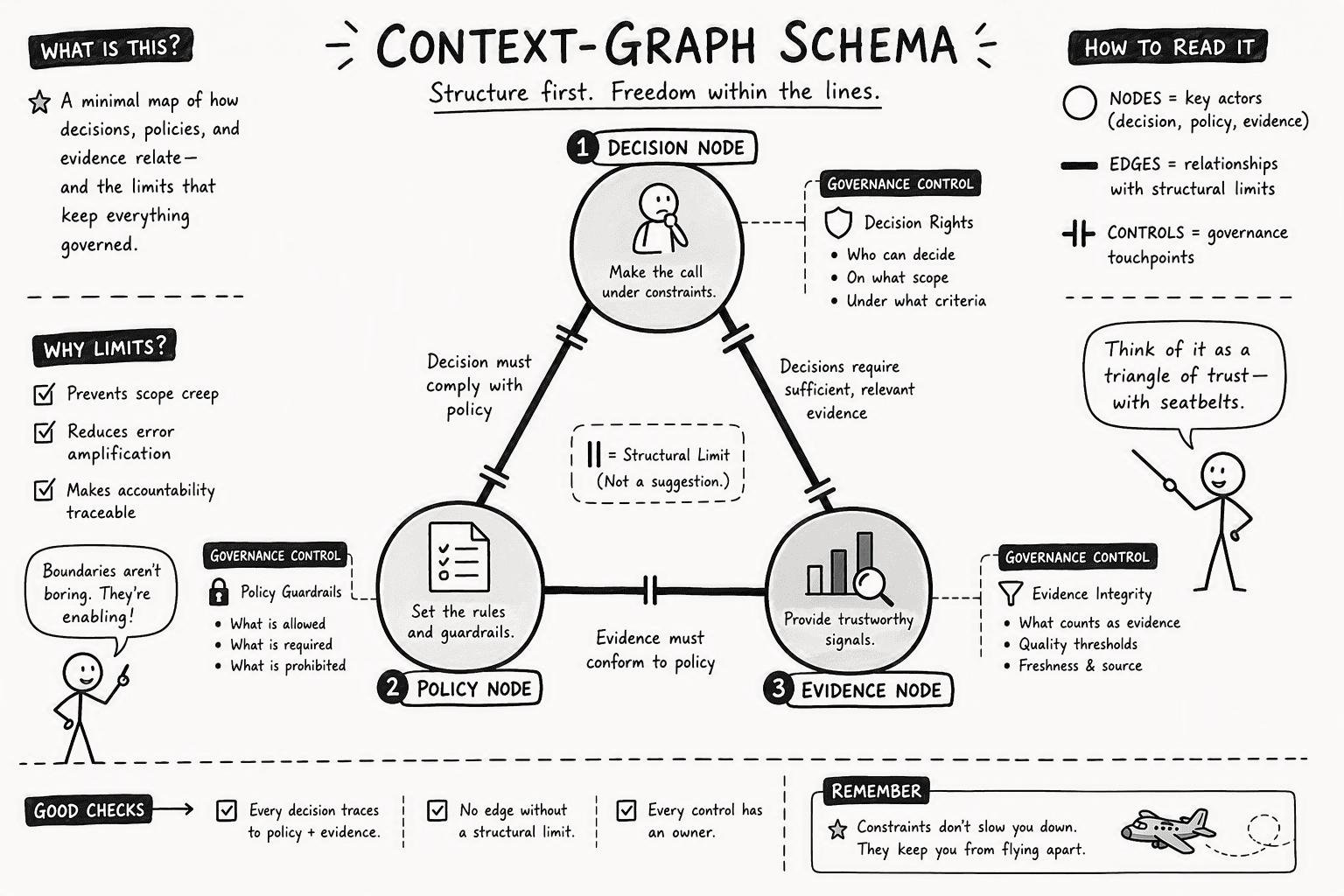
Your context graph isn't one giant, undifferentiated web. It's built from a handful of specific node types and edge types, each mapped to an actual governance control the agent has to obey. You don't need to memorize every possible variant. Three node types do the heavy lifting for most teams, coupled with a few structural edges that enforce real limits.
- Decision nodes record what was decided, who decided it, and the authority they held. This isn't a log entry, it's an anchored object an agent can traverse when it needs to know why a past choice was made.
- Policy nodes hold the standing rules that apply to a class of situations, including version history. When a policy changes, the agent sees the lineage and can enforce the version that was active on the transaction date, not the current revision.
- Exception nodes capture one-time overrides granted for a specific time window. Each links to the policy it suspends, so the system knows the override expired on Tuesday and shouldn't apply on Wednesday.
- Evidence nodes attach the documents, messages, and data rows that backed a decision. An agent reads them as machine-readable grounds, not as a footnote.
- Approval hierarchy edges encode who must sign off and in what order. An agent cannot bypass that sequence.
- Control threshold edges set numerical bounds, discount caps, exposure limits, and trigger escalation when those bounds are breached. These aren't reminders, they're constraints wired into the graph itself.
What makes a context graph useful in practice
Let's take a quick example. Ask an agent to apply a discount. In a plain retrieval setup, it pulls several policy paragraphs, weighs them statistically, and might land on the wrong number because it read that figure in an exception note meant for a different client.
With a context graph, the same agent works differently:
- It looks up the customer's standing discount policy node.
- It follows a causal edge to check whether an exception node is active.
- The exception carries a valid-to date and an evidence node linking the original approval thread.
- If the exception has expired, the temporal validity on the edge tells the agent so, and it falls back to the standing policy instead.
The agent isn't guessing. It's traversing a structure that encodes institutional reasoning. Grounding agents in governed context lifted AI-generated SQL accuracy by 38% across 174 queries in Atlan's benchmark, and that same report attributes hallucination reductions of 40% or more to embedding governance policies and temporal context directly into the structures a model accesses. The improvement doesn't come from a better prompt, it comes from removing ambiguity before the model ever reads it.
A few properties consistently separate a context graph that's actually useful from one that's just a data-modeling exercise:
- It grows from real work, rather than requiring every policy and exception to be hand-modeled before anyone sees value from it.
- It's collaboratively maintained, not owned and gatekept by a single team.
- Corrections update it directly, rather than requiring a separate re-indexing or documentation step days later.
- It stays open and inspectable, so a person can see the actual reasoning path, not just trust a black-box embedding space.
That structure also pays off on auditability and security specifically:
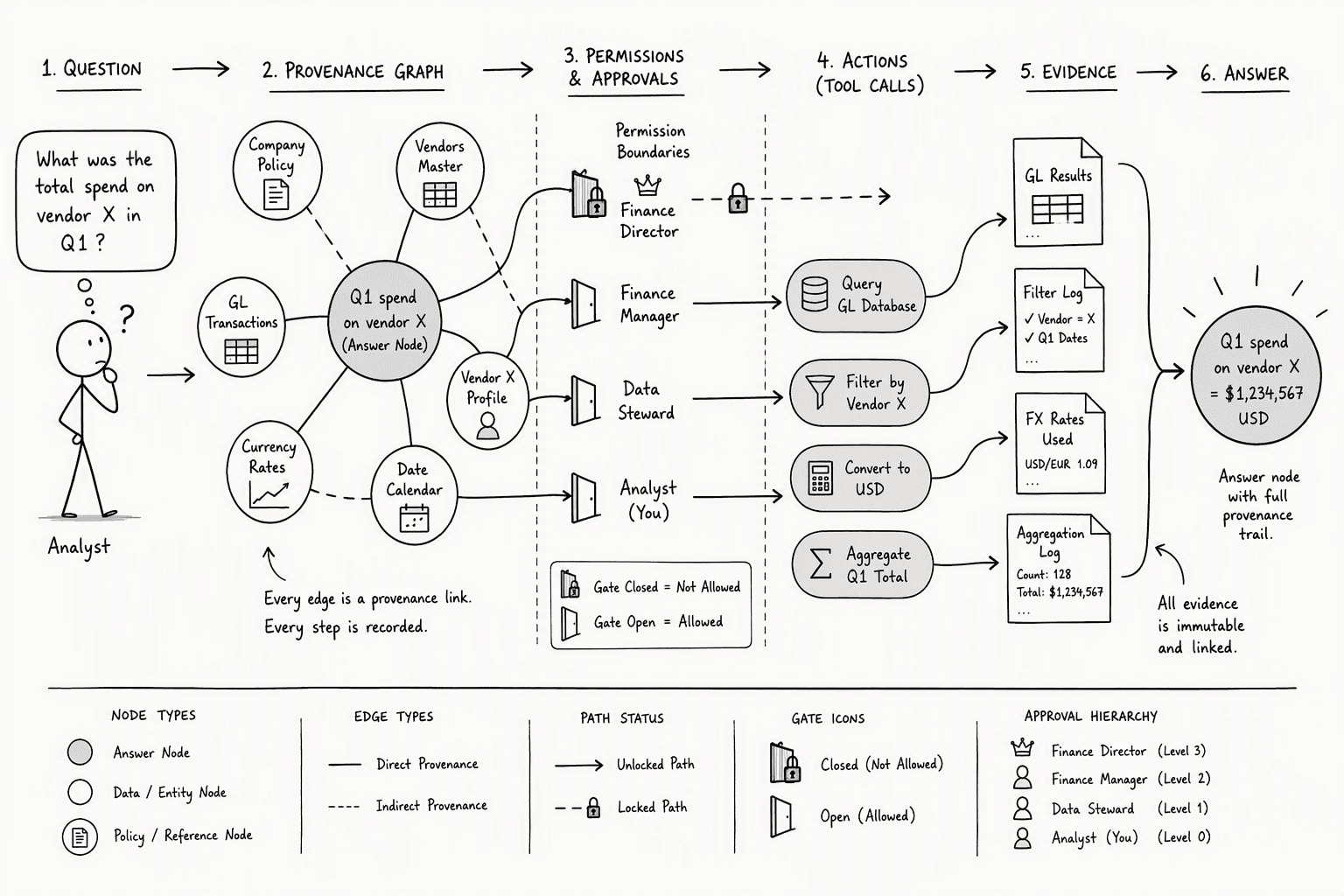
- Every answer carries a full provenance trail. A context graph records the decision, the reasoning path, the tool calls, the evidence returned, and the outcome, so a compliance officer can inspect it and every query leaves footprints that can be retraced.
- Security becomes structural, not bolted on. Approval hierarchies and permission boundaries live in the graph edges themselves, and an agent inherits the rights of the human who triggered it, with those limits enforced deterministically at the data layer rather than filtered after the fact.
Auditability becomes automatic. The context graph records the decision, the reasoning path, the tool calls, the evidence returned, and the outcome. That means:
- Every answer carries a full provenance trail a compliance officer can inspect.
- Every query leaves footprints you can retrace.
- Security is structural: approval hierarchies and permission boundaries live in the graph edges themselves.
- An agent inherits the rights of the human who triggered it, and the graph enforces those limits deterministically at the data layer. It is not a filter applied after the fact.
How PromptQL operationalizes context graphs
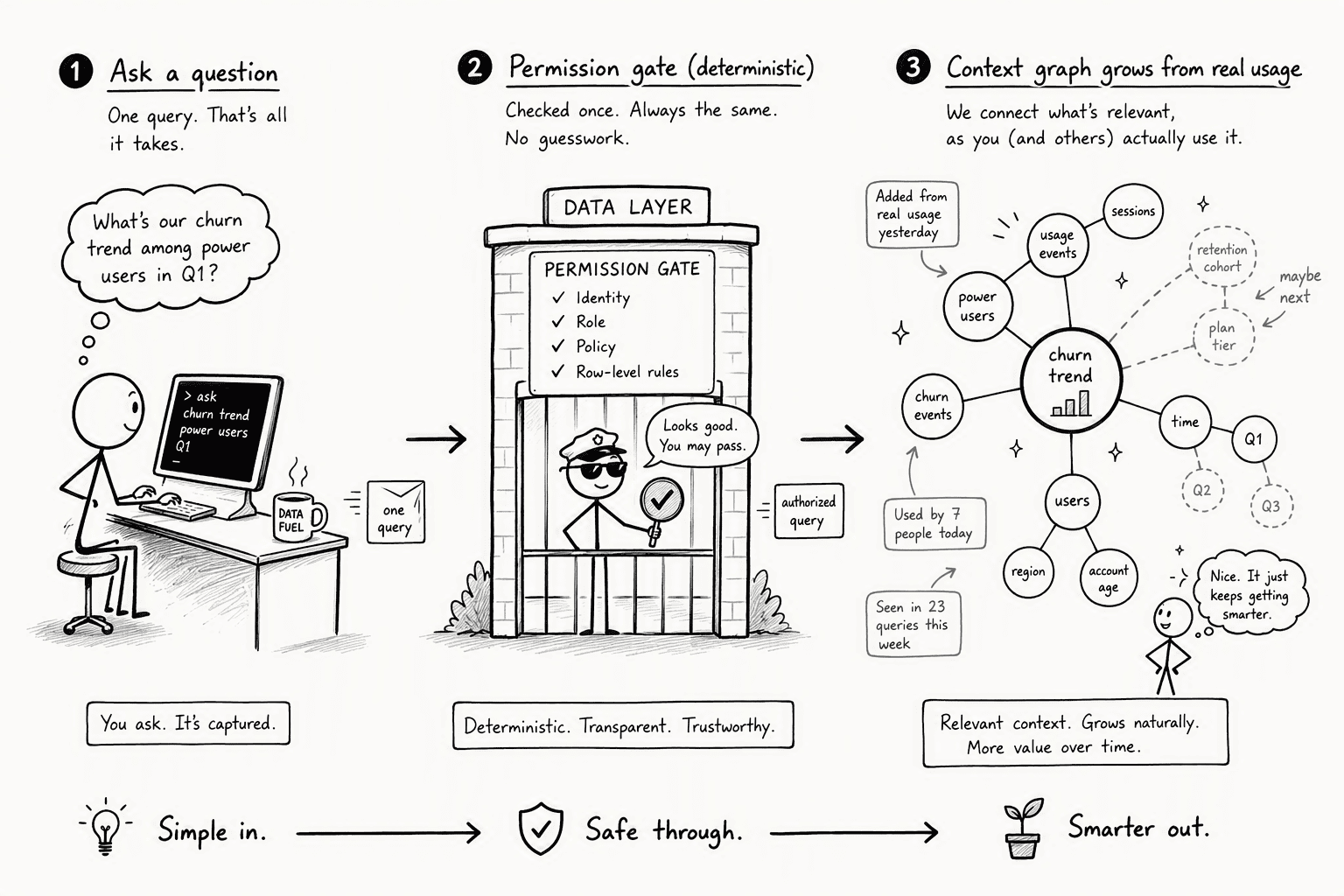
A context graph is only as useful as the tooling that keeps it current. Hand-modeling every policy node before you see value is the surest way to kill adoption. PromptQL lets the graph grow from actual use.
The platform enforces permissions deterministically at the data layer. It acts with each user's permissions, so the access boundary is not something the model negotiates. It is something the platform refuses to violate.
PromptQL uses plan-based execution. When you ask a question that crosses policy boundaries, the plan surfaces the decisions the agent is about to make. You can challenge a step before it executes.
The reasoning is visible, referenceable across multiple steps, and tied to the graph structure. With any reasoning LLM, the same contextual backbone stays consistent. The memory does not live in the model's weights; it lives in the context graph.
The product runs in your own cloud or on-prem, with BYOC so data stays where it already is. Enterprise includes data-access audit trails and forward-deployed engineering support. For teams shipping agentic applications that need persistent memory across sessions and traceable decision reasoning, tools like PromptQL turn the context graph into something you can try in a playground today.
Conclusion
As agentic AI matures, the organizations that dominate their space will be the ones that capture and curate their institutional reasoning as a context graph. Not as a knowledge base. Not as a vector store. As a temporally valid, permission-aware structure that grounds every agent action in provable policy. The difference between an AI that sounds right and one that is right is a graph.
Frequently Asked Questions
What exactly is a context graph in the context of enterprise data and AI?
A context graph is a knowledge representation technique where decisions, policies, exceptions, precedents, evidence, and outcomes are modeled as first-class connected nodes, structured for AI consumption. It captures institutional reasoning (the 'why') rather than transactional records (the 'what').
How does a context graph differ from a knowledge graph or a semantic layer?
A knowledge graph maps entities and relationships at design time. A context graph extends that at runtime with decision traces, temporal validity, and policy, invaliding superseded facts rather than overwriting them. A semantic layer defines business definitions for analytics; a context graph encodes the decisions and approval logic those definitions support.
How does an AI agent use a context graph to improve accuracy and reduce hallucinations?
The agent traverses the graph to ground actions in approved policies with traceable provenance, not statistical guesswork. By checking causal edges and temporal validity metadata before acting, the agent references governed facts rather than retrieving ambiguous text chunks. This deterministic grounding can reduce hallucinations by over 40%.
What are the core components that make up a context graph?
Core components include decision nodes, policy nodes, exception nodes, and evidence nodes, connected by approval hierarchy edges and control threshold edges. Together they form a machine-readable governance structure that encodes who approved what, under which policy, for how long, and with what evidence.
What are the practical benefits of using a context graph for business intelligence?
Every answer comes with a full audit trail showing the reasoning path, evidence returned, and decision outcome. For business intelligence, this means analytics are grounded in actual decision logic, not just transactional data, enabling trustworthy AI outputs that can be inspected and verified step by step.
How does a context graph enable secure, permission-aware data access for AI?
Permission boundaries are encoded directly in the graph structure through approval hierarchy edges and control thresholds. An AI agent can only act within the rights of the user who triggered it, and the graph enforces those limits deterministically at the data layer, never as a bolt-on filter.
Sources
- Context Graph - arxiv.org (2026)
- What is a context graph? - Neo4j Graph Intelligence Platform - neo4j.com (2026)
- Context Graph vs Knowledge Graph: The Definitive 2026 Guide - atlan.com (2026)
- Gartner on Context Graphs: Trends, Capabilities, Setup in 2026 - atlan.com (2026)
- How Specialized Context Improves AI Reliability - trustgraph.ai (2026)
- Context graph | Technology Radar | Thoughtworks China - www.thoughtworks.com (2026)