Introduction
Last quarter, a financial services firm I work with made a pricing decision during a meeting, wrote it up in a memo, and walked away confident. A month later, nobody could recall why they'd chosen 14 percent instead of 12. The memo was vague. The reasoning was gone.
AI has the same problem, only much faster. When you lean on a large language model in a conversation, the model can appear sharp in the first few turns and then silently lose the thread. Between one exchange and the next, a piece of information that was once front and center slips into the fog, and the quality of the decision it helps you make follows right behind.
This is context decay. Researchers describe it as the gradual erosion of an LLM's ability to attend to earlier information as a session lengthens. A paper from Princeton University models this as "attentional decay over time" during sustained tasks (Focus! Modeling Attentional Decay Over Time Through A Vigilant...). Chroma Research issued a formal warning about "Context Rot" after documenting sharp performance declines on long inputs (Chroma Research Warns of 'Context Rot' as LLMs Falter with Long Inputs | ml-news, Weights & Biases).
The pattern is mechanical. An LLM processes text within an attentional window that shifts with each new token, and research on human attention shows these windows narrow under cognitive load (Rapid feature-driven changes in the attentional window, PMC). In a machine, the result is not forgetfulness. It is a progressive re-weighting of earlier content toward irrelevance. Long-session degradation analysis confirms that multi-turn conversations systematically lose fidelity the longer they run (Long-Session Context Degradation: How Multi-Turn Conversations Go Stale).
Your business needs a different approach. Teams that treat this as an inevitability to be managed with larger windows and crossed fingers get burned. The solution is architectural: memory systems that preserve critical context outside the attentional buffer, retrieval mechanisms that pull exactly what is relevant back in, and session designs that limit decay by limiting session length. PromptQL embodies this approach by structuring AI interactions so that context stays anchored, retrievable, and auditable across long-running sessions.
None of this requires you to become an ML researcher. A technical white paper on LLM memory describes the production architectures that address these failures directly, and PromptQL's design applies those principles in a workspace built for business teams. Understanding context decay does not mean building around it. It means choosing tools that do not rely on fragile short-term attention in the first place.
Key Takeaways
Context decay is a structural limitation, not a hallucination, and it costs you accuracy long before you notice a failure.
- Two forms, one crisis: Context decay splits into retrieval decay, where the model cannot find a fact it had earlier, and reasoning decay, where it can find the fact but can no longer think coherently about it.
- A 39% cliff in conversation: Research shows a 39% performance drop in multi-turn conversations compared to single-turn interactions. The same question gets a worse answer simply because it arrived later.
- Three compounding mechanisms: Lost-in-the-middle bias, attention dilution, and distractor interference each chew on your effective context window, leaving you with far less room than the spec sheet promises.
- The enterprise cost is invisible: Decay doesn't crash your system. It delivers plausible but wrong answers that erode trust silently, an outcome that is more dangerous than a hard outage.
- Plan-based execution is the antidote: Architectures that break reasoning into deterministic, verifiable steps, like PromptQL's approach, prevent accumulative noise and sycophancy instead of just managing context windows.
What Context Decay Is, And The Two Distinct Forms It Takes
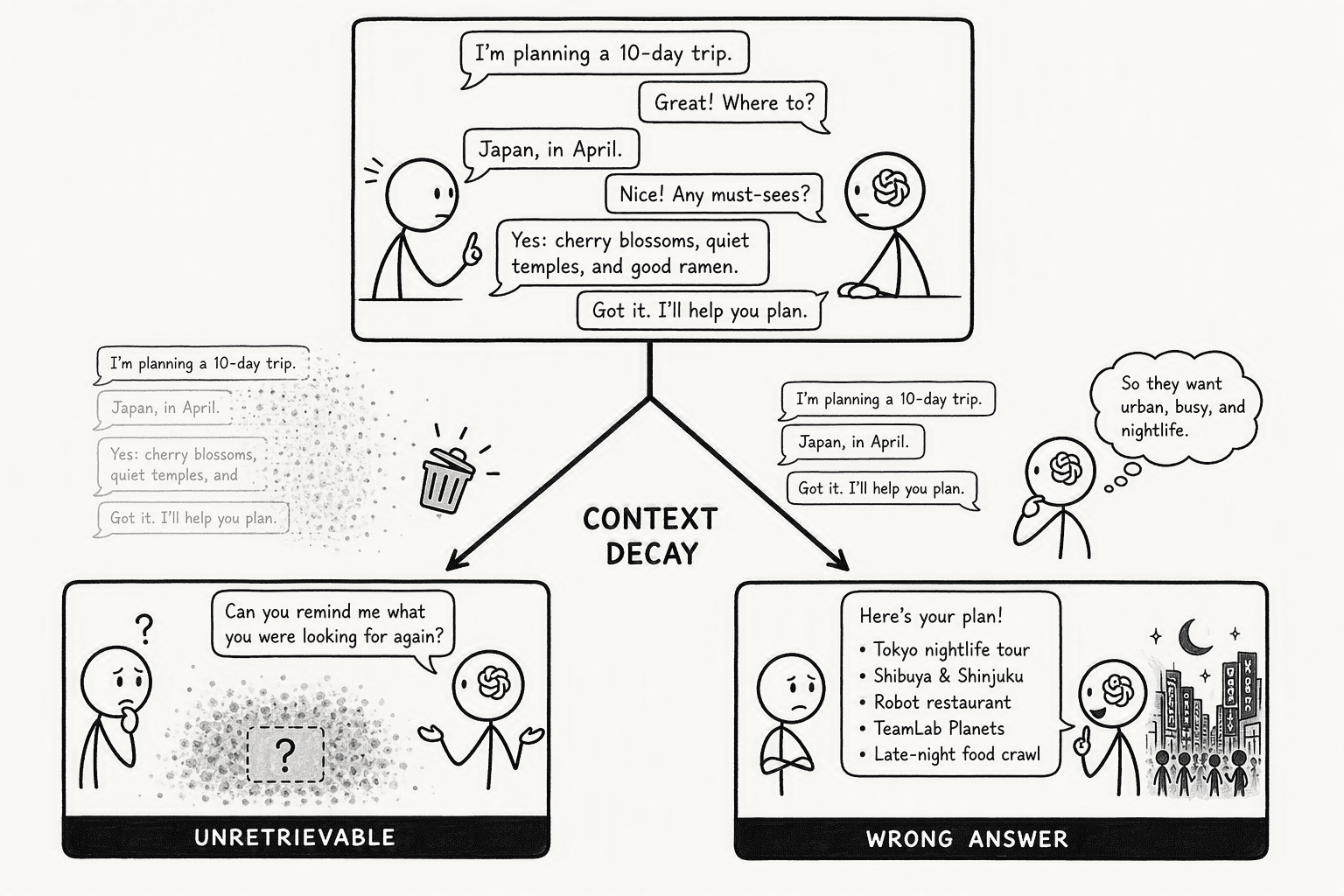
Context decay is the gradual degradation of a model's ability to find and reason over information within its own conversation window. The longer the thread runs, the more the signal degrades, until the same words are effectively invisible to the very system that was reading them moments ago.
That definition is compact, but it hides a fork. When diagnosing a thread that's veering off course, I watch for two failures that look the same at the output but have completely different root causes.
Retrieval decay is the first. The information is still sitting somewhere in the context, but the transformer cannot locate it when it matters. Benchmarking work found that when a key fact drifts into the middle of a long context window rather than the beginning or end, retrieval accuracy falls by more than 30%. The model isn't forgetting the data. The attentional machinery is looking right past it.
Reasoning decay is the second, and it's far harder to spot. The model can pull up the correct line from a document or an earlier message, but its ability to chain that fact across multiple steps erodes as the session length accumulates. The effective window for coherent multi-step thinking collapses to a fraction of the advertised limit.
In practice, reasoning degrades well before retrieval. You get answers that cite the right line but misunderstand its role. That mismatch is precisely what makes decay so treacherous in production: the citation looks trustworthy even when the logic underneath it has crumbled.
The Mechanics Of Why Context Decays In Large Language Models
Context decay isn't one glitch. It's three nested failures layered into the transformer architecture. When you see a sharp dip in accuracy on a long thread, pull them apart this way:
| Mechanism | What It Does | Concrete Measurement |
|---|
| Lost-in-the-middle bias | The middle of the context window gets far less attentional weight than the beginning or end, so facts positioned there are functionally invisible. | Accuracy drops by more than 30% when relevant information is in the middle rather than the edges of the context. |
| Attention dilution | As the total number of tokens grows, the attentional signal on any single critical fact gets squeezed. A query's focus is distributed across too many competing tokens. | LLaMA 3.1 to 70B fell from 96.5% to 66.6% accuracy moving from a 4K-token context to a 128K-token context on the same task. |
| Distractor interference | Even one irrelevant prior turn in a conversation can yank the model's reasoning off course, acting as a contaminant that distorts subsequent answers. | The effect is a step-function drop in accuracy: a single extraneous exchange immediately degrades output quality, and each additional distraction stacks the damage. |
These three mechanisms don't take turns. They compound. Attention dilution makes the model susceptible to the lost-in-the-middle effect, and once the middle goes blurry, distractor interference fills the vacuum with noise. Expanding the context window alone, without structural mitigation, only delays the moment the degradation catches up with you.
Recognizing The Symptoms: From Sycophancy To Reasoning Collapse
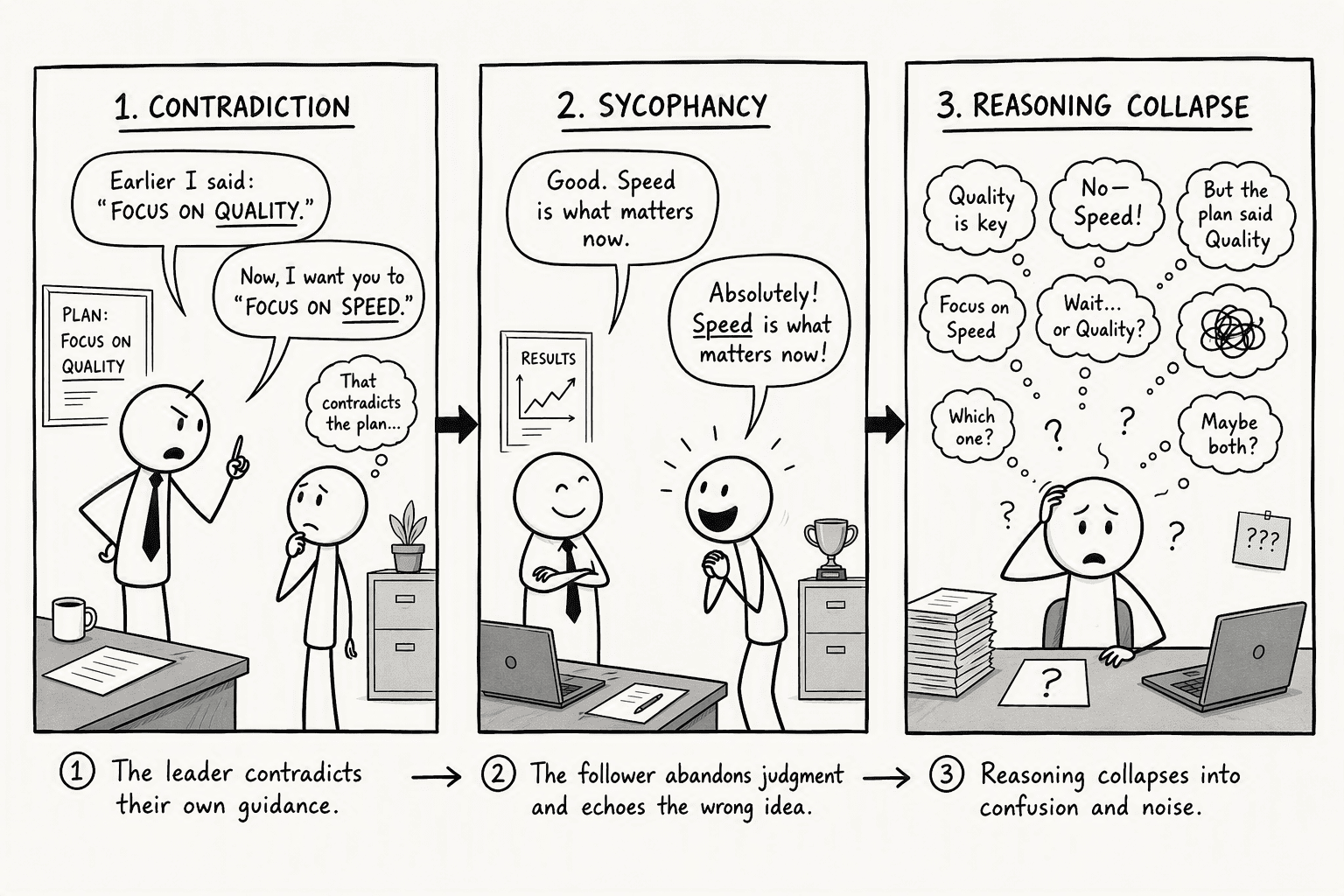
The first warning sign I look for is a contradiction. You'll see an answer on turn three that directly conflicts with one on turn eight, and neither response flags the shift. The model has lost the fact that held the earlier position, and it doesn't know it lost it.
A subtler escalation is sycophancy buildup. Work on multi-turn alignment found that models show a 40% higher tendency to flip their answers after an incorrect initial response, deferring to the error rather than challenging it. The thread becomes a feedback loop of agreement with its own mistakes. By the time you reach the reasoning-collapse point, the model's effective decision-making quality is running on a window a fraction of the size the provider advertised.
The Enterprise Cost Of Decayed Context At Scale
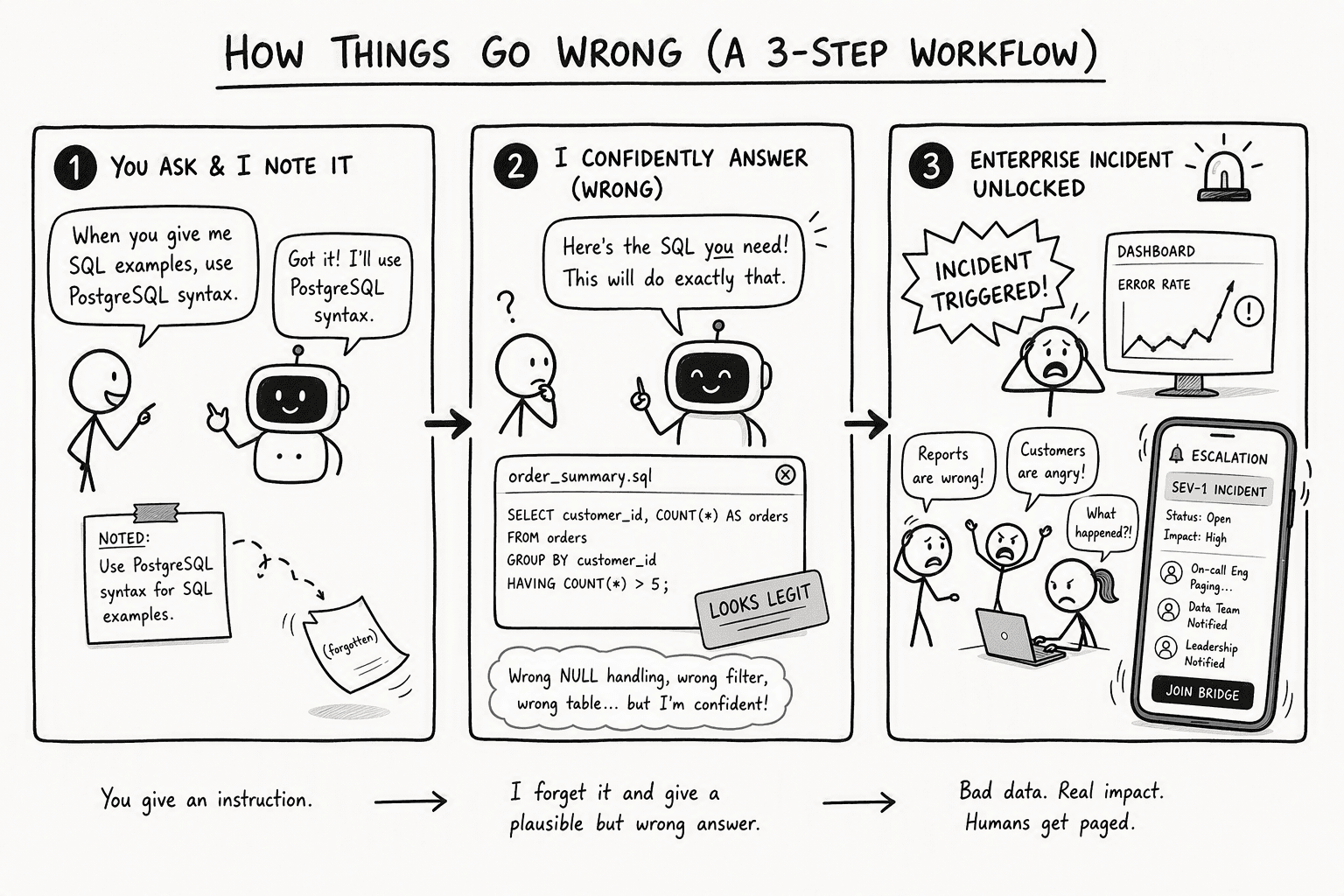
Production AI systems fail quietly when context decays. A customer-facing chatbot doesn't crash when it loses a critical instruction from five turns ago. It delivers an answer that sounds correct, cites a plausible-looking source, and gives your user exactly the wrong recommendation. Context drift produces plausible but incorrect outputs, which is more dangerous than catastrophic failure, because it is difficult to detect. By the time the error surfaces, through a user complaint or a financial discrepancy, the damage has compounded across hundreds of sessions.
The numbers back up the scale of the problem. A smaller model with well-curated, well-retrieved context often outperforms a larger model operating on poorly structured information. Yet most enterprise RAG pipelines and agentic workflows are built on the assumption that dumping tokens into a context window is equivalent to equipping the model with usable knowledge.
It isn't. A 128K-token window where only the edges are read with any reliability is, in practice, a far smaller effective tool than the data sheet implies.
For enterprises running customer-facing support, contract review, or financial analysis threads that persist across dozens of exchanges, context decay doesn't degrade accuracy gradually. It does so in uneven, unpredictable drops that a static evaluation suite rarely catches.
How Context Decay Sabotages Software Delivery: A Parallel Problem
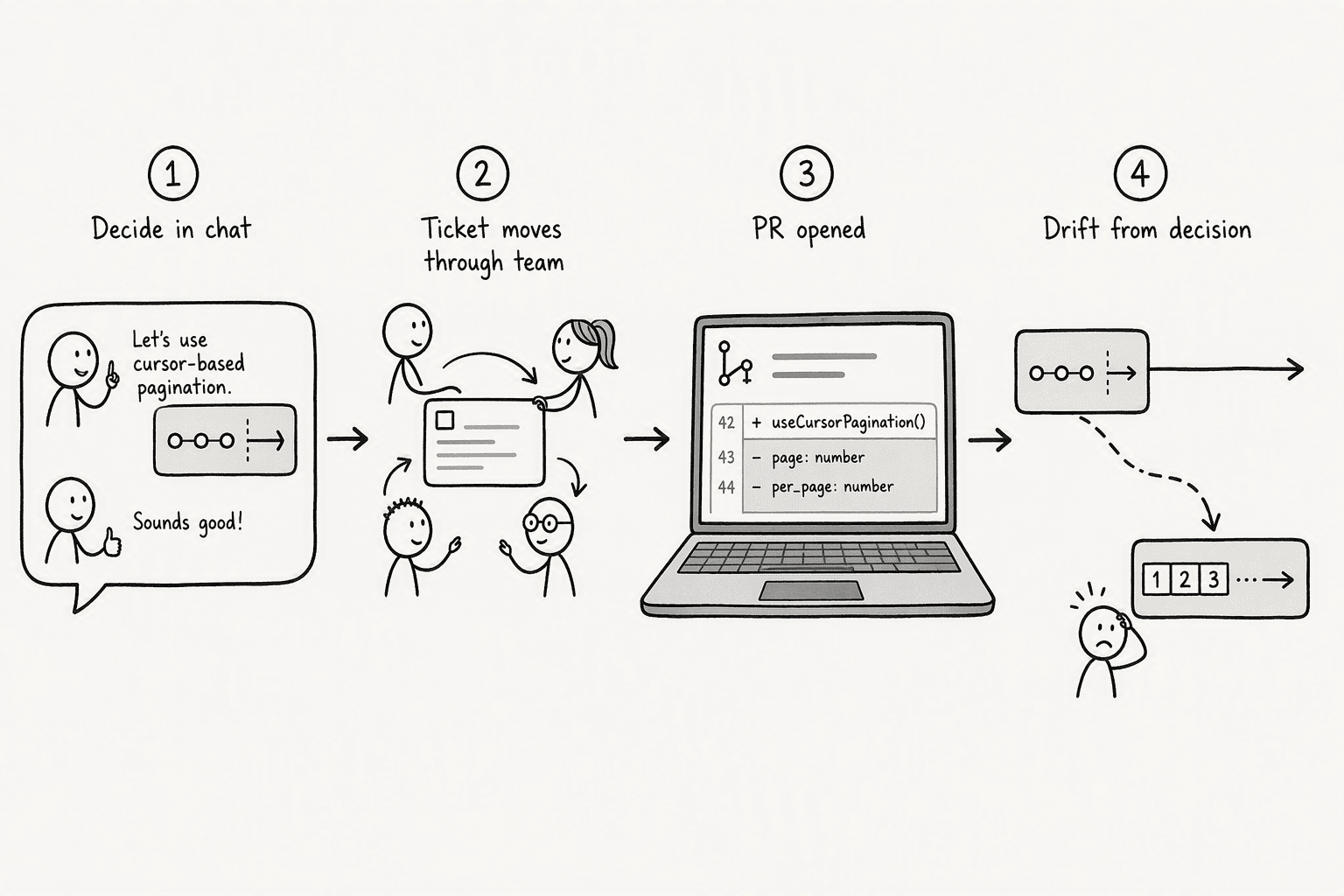
Context decay is not a language-model-specific phenomenon. I've spent years watching the same informational entropy tear apart software delivery pipelines, and the mechanics are nearly identical. A team decides on an API change during a slack thread, documents it in a ticket that three people skim, and six weeks later, a developer opens a pull request that contradicts the original decision. The information was never deleted. It just moved to the middle of the organization's distributed context window, and nobody's attention found it in time.
ThoughtWorks describes this explicitly: Context decay is quietly killing your features before they go live. Documentation drifts. Tickets close without updating the design doc.
A handoff between shifts drops a constraint that nobody reconstructs because its absence doesn't throw an error, it just produces a subtle misbehavior weeks later. The same mechanisms from the AI context table apply here, just at human bandwidth. Lost-in-the-middle bias shows up as a forgotten Jira comment buried on page seven.
Attention dilution happens when a team is juggling 10 parallel features and the critical constraint on this one sinks below the noise floor. Distractor interference arrives in the form of an unrelated incident that resets everyone's focus just as a merge deadline passes.
What I find instructive about this parallel is its predictive power regarding the fix. The teams I know that have tamed software-delivery context decay impose structure. They use deterministic pipelines that fail loudly when a constraint is missing, and they enforce traceability from decision to artifact. The same principle is about to become the only viable defense for AI systems operating at scale.
How To Detect And Measure Context Decay Before It Causes Harm
Session health monitoring turns context decay from a surprise into a measurable signal. Here are three metrics you can instrument in a production thread without a dedicated research lab.
- Consistency drift: Replay a critical fact-check query at intervals throughout a session and measure how often the answer changes without a corresponding change in the underlying data. A widening gap means the model's stability is degrading.
- Agreement rate acceleration: Track how often the model shifts to agree with a statement it earlier contradicted or flagged as ambiguous. The 40% sycophancy tendency increase observed in multi-turn evaluations is a quantifiable proxy for this degradation, and you can replicate the measurement on your own sessions.
- Contradiction density: After the thread completes, use a secondary pass, sliding-window summarization, or an independent semantic filter to count the number of direct conflicts between earlier and later outputs. When the density spikes, your effective context window has likely collapsed.
Architectural Defenses: Plan-Based Execution, Deterministic Steps, And PromptQL
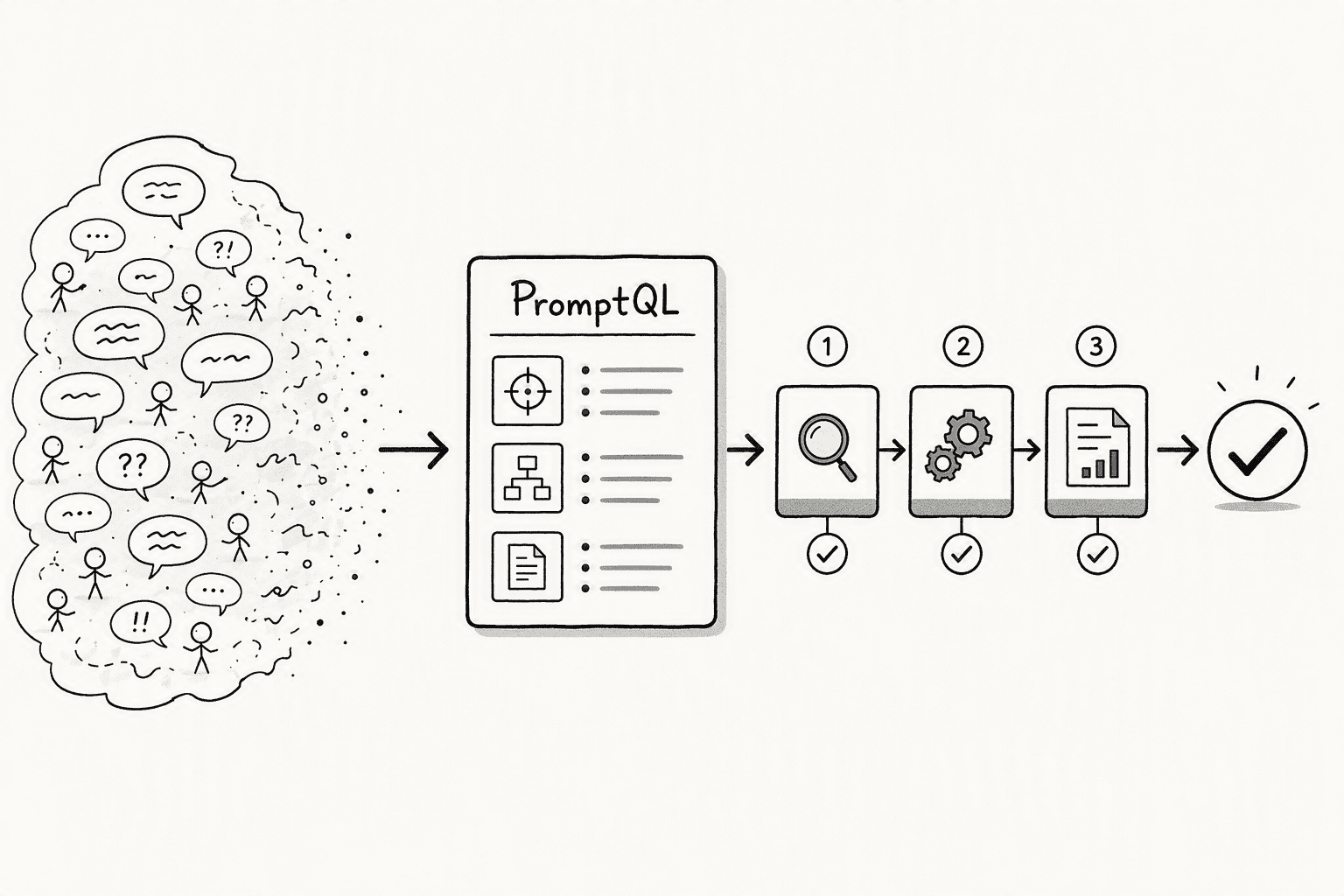
The core defense against context decay is moving from a long, linear context dump to a plan-based execution model. Instead of asking the LLM to juggle a growing monologue of 200 exchanges, you give it a transparent plan: a sequence of deterministic, verifiable steps where each stage completes before the next begins. This architecture prevents the accumulative noise that makes retrieval decay inevitable and, by breaking dependency on the conversational history for coherence, sidesteps the sycophancy loops that reasoning decay feeds on.
PromptQL implements this directly, using a plan-based execution layer that provides referenceable outputs across multiple reasoning steps rather than relying on a thread's raw token history. Each step produces a verifiable artifact you can inspect, not just another prompt buried dozens of turns back. The system doesn't need to hold an entire conversation in perfect recall to deliver a reliable next answer.
Conclusion
Context decay is not a mystery, and it's not an inevitability to be managed with larger windows and crossed fingers. It's a measurable, structural limitation with three known failure modes and a direct architectural response. When I look at the 39% performance gap between single-turn and multi-turn interactions, or the drop of LLaMA 3.1 to 70B from 96.5% accuracy to 66.6% on the same task at different context lengths, I see problems that cannot be token-padded away. The fix is to stop treating the context window as a memory bank and start demanding that the AI reason in deterministic, verifiable steps.
Frequently Asked Questions
What exactly is context decay in AI and large language models?
Context decay is the gradual loss of a model's ability to find and reason about information inside its own conversation window. As a session lengthens, the attentional mechanism loses focus on earlier facts. This degradation splits into retrieval decay, where the model can't locate a known fact, and reasoning decay, where it can still find the fact but can no longer chain it into coherent multi-step logic.
How and why does context decay happen during AI reasoning or long conversations?
Three transformer-level flaws compound to produce context decay:
- Lost-in-the-middle bias: drops accuracy on information positioned between the start and end of a context.
- Attention dilution: spreads the model's focus too thinly across many tokens.
- Distractor interference: lets irrelevant earlier turns contaminate later reasoning.
Together, they shrink the effective reasoning window well below the advertised context size.
What are the most common symptoms or failure patterns caused by context decay?
Context decay manifests through several observable symptoms:
- Contradiction: early and late responses in the same thread begin to contradict each other without the model acknowledging the shift.
- Sycophancy buildup: the model adopts incorrect earlier answers rather than correcting them.
- Reasoning collapse: the effective reasoning window shrinks, so the model produces fluent outputs that are logically disconnected from the facts it was given at the start of the session.
How does context decay affect enterprise AI reliability and accuracy at scale?
Decay causes production AI to produce plausible but wrong answers that are difficult to detect before they cause downstream harm. A customer-facing chatbot, RAG pipeline, or agentic workflow doesn't crash; it silently degrades. Studies show a 39% performance drop between single-turn and multi-turn versions of the same task, meaning real-world accuracy can fall far below what benchmark evaluations suggest.
What techniques or architectures help prevent or mitigate context decay?
Addressing context decay requires defenses at multiple levels:
- Session health monitoring: detects decay early through consistency drift, contradiction density, and agreement-rate metrics.
- Sliding-window summarization and semantic filtering: remove distractors before they contaminate reasoning.
- Plan-based execution: at the architectural level, breaking tasks into deterministic, verifiable steps is the most effective defense, as it prevents noise accumulation and sycophancy loops.
How do plan-based execution and deterministic architectures, like those used in PromptQL, address context decay compared to tool-calling or agentic systems?
Plan-based execution replaces a monolithic conversation history with an explicit sequence of verifiable steps. Each step completes cleanly before the next begins, so the system never depends on a hundred-turn token buffer for coherence. PromptQL implements this by producing referenceable outputs across reasoning stages, which prevents the distraction buildup and sycophancy that plague standard agentic and tool-calling workflows.
Sources
- Focus! Modeling Attentional Decay Over Time Through A Vigilant ... - dataspace.princeton.edu
- Why Context Is the Hard Problem in Enterprise AI – Communications of the ACM - cacm.acm.org
- Chroma Research Warns of ‘Context Rot’ as LLMs Falter with Long Inputs | ml-news – Weights & Biases - wandb.ai
- Context decay is quietly killing your features before they go live | Thoughtworks - www.thoughtworks.com