You've felt it. You tell Claude your product roadmap, then jump into ChatGPT to draft a launch email and realize it has no idea what you're talking about. The knowledge you painstakingly built in one tool is completely absent in another. This isn't a minor inconvenience, it's memory fragmentation, and as more teams rely on three or more AI assistants at once, it's a problem that compounds every time you switch tabs.
Anthropic and OpenAI both shipped big retention features in 2026. Claude's Chat Memory became automatic on March 2, and ChatGPT's Dreaming background synthesis arrived on June 4. These are sealed, platform-specific silos designed to keep you loyal, not interoperable.
In this guide, we'll discuss why native memory doesn't solve this on its own, and how to move past waiting for individual AI platforms to interoperate by choice. That means centralizing where context actually lives, connecting it to every model your team uses through the right standards, and treating a correction as something that updates everyone, not just the one conversation where it happened.
Key Takeaways
Here's the architecture of a shared context layer that works across every major LLM you use:
- Native memory is a retention silo: ChatGPT's memory and Claude's Chat Memory lock context inside their own platforms. They were never built to share.
- Manual copy-paste doesn't scale: Pasting Markdown snippets keeps things consistent for a few minutes, then decays. An automated vault is the only path that holds up for teams.
- A single-tenant Knowledge Vault is the source of truth: An encrypted store every agent reads from and writes to stops the drift where each AI quietly builds its own version of reality.
- MCP is the universal connector: The Model Context Protocol lets ChatGPT and Claude access the same external vault, the way USB-C standardized a fragmented hardware mess.
- PromptQL turns static retrieval into a self-improving layer: It prunes stale facts and promotes what your team actually uses, which cuts iteration cycles without anyone manually curating.
Why context gets siloed across different LLMs
Native memory has genuinely improved on both sides, but it was never built to travel between tools. A few reasons that gap exists in the first place:
- Teaching one assistant something doesn't teach the others, so each one only ever sees its own slice of the picture
- Over time, tools drift into slightly different versions of the same fact, each one accurate to what it's seen, just not to each other
- Keeping context inside one platform is part of what keeps someone using it, so this isn't something either company is likely to fix on its own
How to share context across ChatGPT, Claude, and other LLMs
Step 1: Choose your shared context architecture, manual or automated
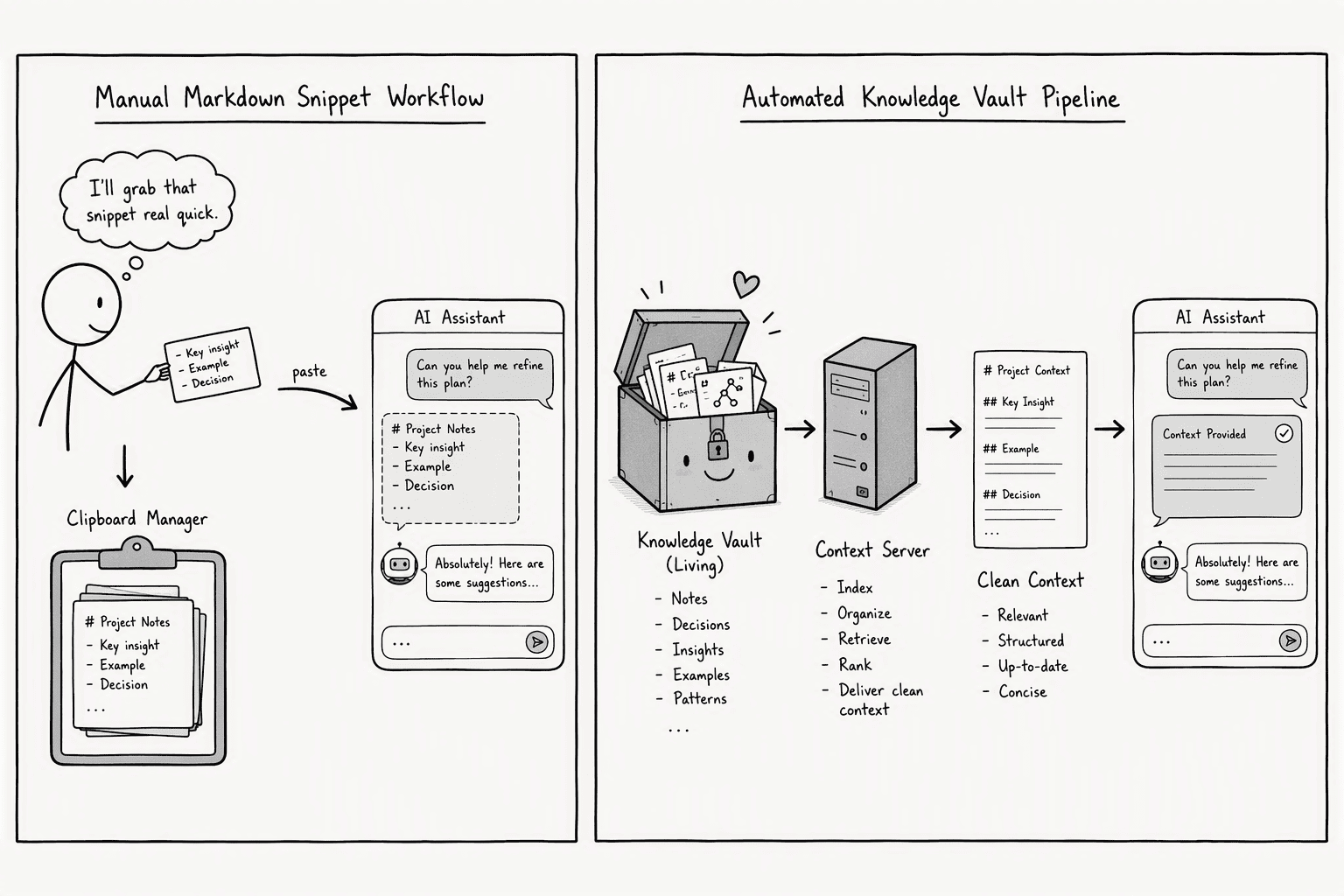
You have two fundamental paths. The first is manual: you maintain a personal library of Markdown snippets that paste your core identity, project goals, and constraints into the start of every new chat. Tools like clipboard managers or snippet expanders make this faster, but you are the clock generator. You're responsible for freshness.
An automated architecture flips this entirely. Instead of injecting a static document, you connect your tools to a living Knowledge Vault. A context server exposes resources and tools via the Model Context Protocol, and every compliant AI client reads from and writes to that same central source.
The effort shifts from 'remembering to paste' to 'trusting the retrieval,' and the accuracy jump is profound because you've eliminated the human as the single point of failure in context delivery.
Automated wins on consistency and freshness. Manual copy-paste decays the moment you hit enter.
Step 2: Deploy a single, centralized context store as the source of truth
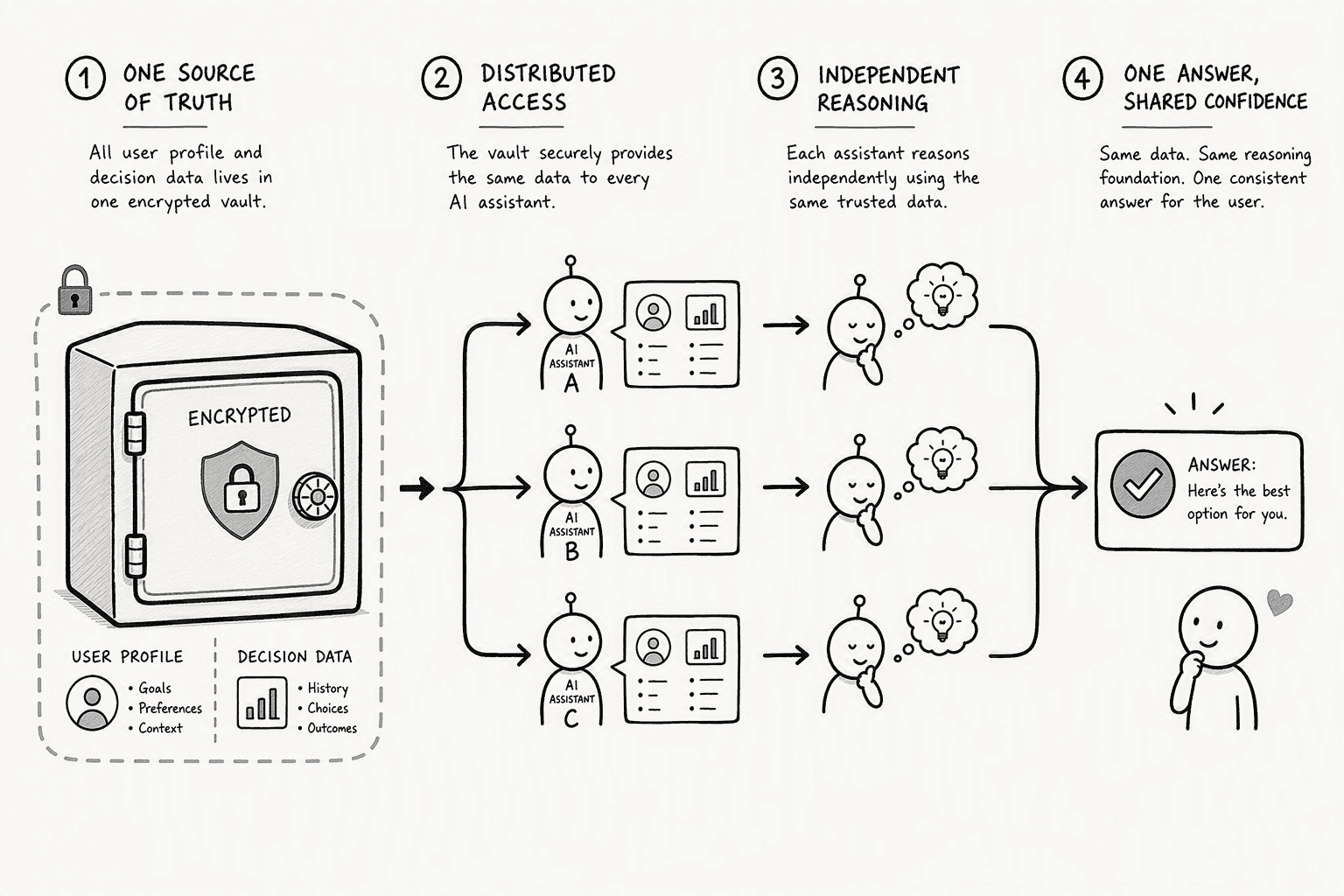
This store is the canonical container for everything your AIs need to know about you, your team, your decisions, and your preferences. It holds user profiles, project constraints, key entities, and the reasoning behind past decisions. Instead of ChatGPT recalling your revenue target as one figure while Claude recalls something slightly different, both query the same encrypted record and return a single, consistent answer.
Single-tenancy is the security boundary that makes this safe. Your data lives in a logical container that is uniquely yours, encrypted, and never commingled with another organization's context, the architectural prerequisite for the kind of secure, compliant context sharing that a real security review will actually ask about.
Step 3: Connect your context store to any LLM via an open protocol
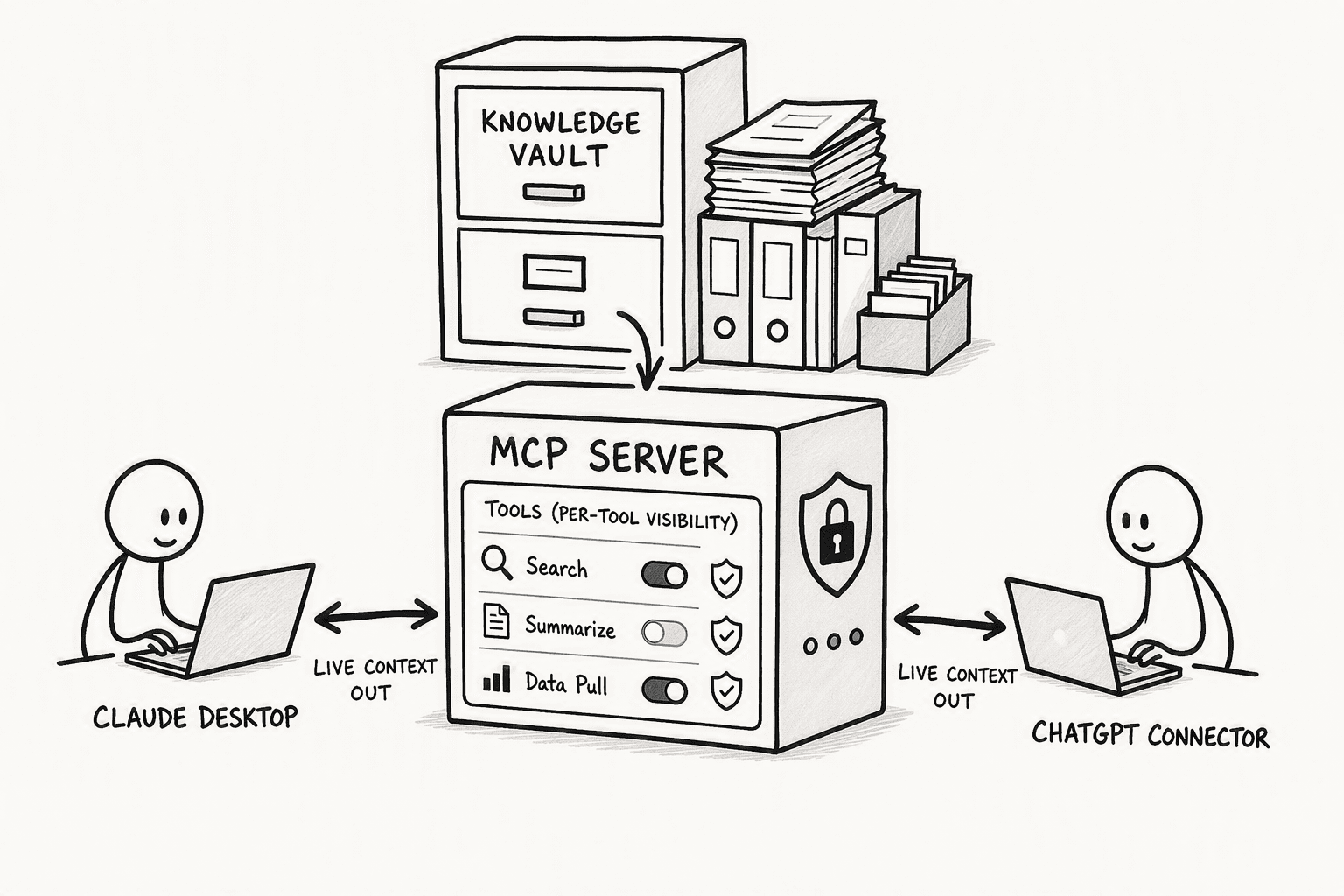
An open protocol like the Model Context Protocol (MCP) gives large language models a direct, structured way to pull context from your tools and data. A server sits in front of your context store and exposes live resources, documents, a decision log, a user profile. Any compatible client, whether that's a native integration or a connector, can discover and consume those resources in real time. You set per-tool visibility controls so you decide exactly what each AI can see.
Some paths already exist natively too, Claude's own Memory Import feature can pull memories directly from ChatGPT, Gemini, and Grok into Claude, a useful one-time starting point even before a shared store is fully in place.
Step 4: Make it a self-improving, multi-agent knowledge layer, not static retrieval
Traditional retrieval pulls static document chunks, a snapshot of the past that goes stale the moment something changes. A better architecture treats context as something multiple people and agents query and update at the same time. When someone corrects a fact, every future session gets the fix, rather than each tool holding onto its own outdated version.
This is what separates a context layer that actually compounds in value from one that just accumulates outdated documents: Here's how the two approaches compare:
With PromptQL, correcting a metric in Slack through the @-tagged agent writes directly to the knowledge graph. The next teammate who queries the assistant pulls the corrected number. Context sharpens with use instead of decaying.
| Traditional retrieval | A self-improving context layer |
|---|
| Data structure | Static document chunks; retrieves semantic matches | Living record; agents update entities and relationships in real time |
| Freshness mechanism | Relies on a re-indexing schedule; stale by default | Automatic pruning of unused entries, promotion of high-value facts |
| Multi-agent capability | Isolated retrieval per query; no write-back | Shared context; a correction in one thread enriches context for every session |
| Collaboration model | Single-player query against a document store | Multiplayer, with shared threads across tools and people |
With an architecture like this, correcting a metric through one connected assistant writes directly back to the shared record. The next person who queries a different assistant pulls the corrected number. Context sharpens with use instead of decaying.
Step 5: Secure the system with least-privilege access and encryption
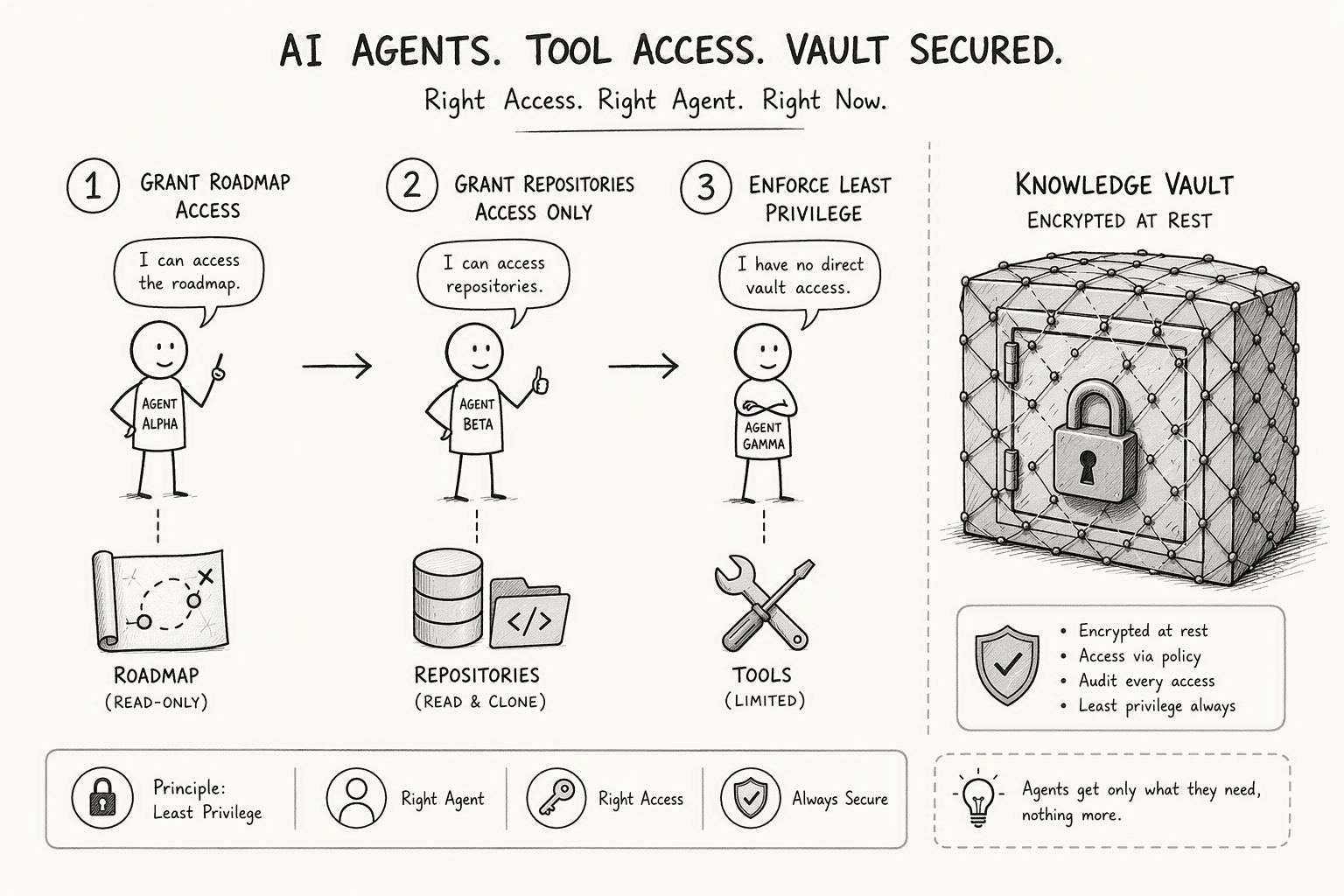
The non-negotiable security rule: every AI agent receives only the permissions it needs for its specific function, and nothing more. Within your chosen protocol, per-tool visibility controls enforce this directly, you might grant a product-strategy assistant access to your roadmap but restrict a code-review assistant to repositories only.
Encryption ensures that stored profiles, decisions, and preferences are protected at rest. Treat context connectivity as a governed data layer from day one, not a blind pipe you lock down after the fact, since that's the posture a real SOC 2 Type II review will actually expect.
Step 6: Measure ROI through context freshness and reduced iteration cycles
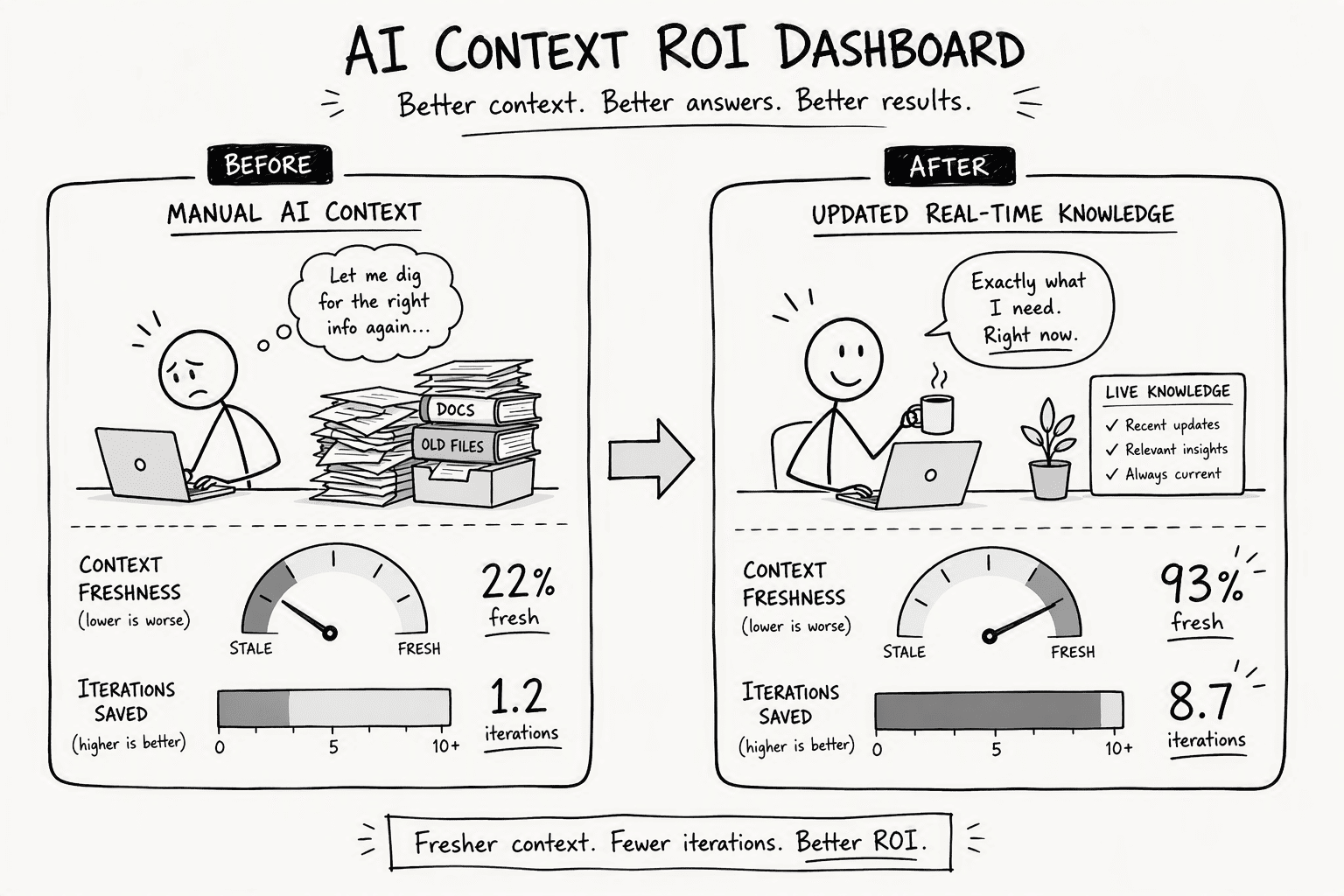
Forget vague productivity gains. Most enterprise AI pilots stall because the impact feels soft; nobody can point to a dollar saved. You fix that by tracking two things no one else measures: how current the AI's knowledge actually is, and how many prompt revisions you skip.
- Context Freshness: Measure how current the knowledge your AI accesses is. A manual copy-paste decays instantly. A self-improving knowledge graph updates in real time as your team works, automatically pruning stale entries.
- Reduced Iteration Cycles: Count how many times you revise a prompt because the AI lacked critical information. When context is pre-loaded, fresh, and accurate, your team gets the right answer on the first or second turn instead of the fifth, slashing the cost of 'helping' the AI.
- Enterprise AI Pilot Survival Rate: Many enterprise pilots fail because impact isn't measurable and tied to dollars. By correlating reduced iteration cycles directly with engineer or analyst hours reclaimed, you translate accuracy gains into hard operational savings that keep a pilot funded.
The easier way to do it
Building this is a real infrastructure project, not something to bolt together over a weekend.
PromptQL is built around exactly this problem. It runs on any underlying model, and that's a real, configurable capability, not just marketing, you can assign OpenAI, Anthropic, or other providers to specific tasks, using one model for summarization and a different one for structured reasoning, all drawing from the same shared context underneath. Corrections made in one thread don't stay in that thread: they become reusable skills, facts, and semantic-layer improvements, shared team-wide with citations, revision history, and notifications, so the next person, using whichever model they prefer, starts from the fix instead of re-explaining it.
PromptQL Tag makes the contrast concrete against a single-vendor alternative like Claude Tag. Claude Tag brings Claude into Slack, but memory stays scoped to each Slack channel separately, and it only runs Anthropic's own models. PromptQL Tag builds one shared, org-wide brain that compounds across both Slack and Microsoft Teams, runs on any model, and acts with the permissions of the real person who tagged it rather than a single shared bot identity. That's the actual difference between a smarter single-vendor assistant and a genuine shared context layer.
See how PromptQL works across models, or compare PromptQL Tag to Claude Tag directly.
Conclusion
ChatGPT Dreaming and Claude's Chat Memory are designed to remember you inside their own world. But in 2026, you don't live in one AI's world, you orchestrate several. The fix is a single-tenant Knowledge Vault, connected via MCP, and powered by a self-improving layer like PromptQL that gets smarter with every interaction. Don't wait for the platforms to interoperate; they won't. Start by choosing the automated architecture in Step 2, deploy an external MCP context server this week, and finally give every AI you use the same, correct memory.
Frequently Asked Questions
What are the main ways to share context across large language models like ChatGPT and Claude?
You share context by creating an external memory layer, not by relying on native features. Connect a single-tenant Knowledge Vault to each LLM via the Model Context Protocol (MCP), so every assistant reads from and writes to the same canonical source of truth.
How does PromptQL enable shared context and multiplayer AI collaboration across different LLMs?
PromptQL maintains a self-improving knowledge graph that multiple AI agents and users query and update in real time. When you correct a fact in one tool, it writes back to the graph, instantly enriching context for every other assistant and team member.
What are the security and privacy considerations when granting AI agents access to connected data sources?
Enforce least-privilege access: each agent gets only the permissions it needs. Use per-tool visibility controls in MCP to restrict which data each AI can see. Encrypt the vault at rest and pursue a security certification path like SOC 2 Type II for assurance.
What are the key differences between PromptQL and traditional RAG (Retrieval-Augmented Generation) for enterprise AI?
Traditional RAG retrieves static document chunks that decay. PromptQL uses a live knowledge graph that agents update collaboratively. It prunes stale entries, promotes high-value facts, and eliminates extraction errors by grounding reasoning in structured context, not chunked text.
How can teams measure ROI and prevent failure in enterprise AI pilots?
Measure two KPIs: context freshness (how current the accessed knowledge is) and reduced iteration cycles (fewer prompt revisions needed). Tie these to reclaimed hours and operational savings to prove the layer's dollar impact and keep the pilot from being cut.
What specific capabilities does PromptQL offer for building a shared, self-improving knowledge layer?
PromptQL connects to your existing data sources, reads from Slack and Google Docs, and builds a shared wiki. It provides multiplayer threads, automatic pruning of stale facts, promotion of verified knowledge, and detailed usage analytics without manual curation.
Sources
- PromptQL | About us - promptql.io
- PromptQL | Multiplayer AI with shared context. - promptql.io