That knot you feel every Monday isn't really about the volume of work waiting for you. It's that you can't reliably find what your own company already knows. A pricing call from Thursday is buried in a Slack thread somewhere. A churn signal is tucked inside a support ticket, with the context that explains it locked away in a doc nobody remembers creating. Decisions get made on a hunch, cross-referenced against a rulebook that's months out of date. You're not just forgetting things. You're losing strategic position, one buried thread at a time.
This guide walks through what a company brain actually is and the steps you can follow to build one.
Key Takeaways
A Company Brain runs on a tight integration equation and a layered structure that converts memory into action. Here is what the blueprint demands:
- The integration equation is indivisible: Factual memory + human communication + context graph and reasoning + governed action must connect as a single system; missing one component leaves you with a searchable archive, not a brain.
- A three-layer model governs all cognition: Raw data enters a factual memory layer, a context graph weaves relationships between artifacts for reasoning, and an action layer proposes plans with human approval.
- Memory is not retrieval alone: The system actively reasons over a permissioned web of artifacts, connecting projects, people, and decisions, before surfacing answers personalized to your role.
- Governed action is a guardrail, not a barrier: Planning-only architectures propose drafts and flag commitments without executing autonomously, which keeps the business safe while multiplying decision speed.
- ROI shifts from logins to decision velocity: Success is measured by how much faster and better the organization decides, displacing vanity adoption metrics as the primary KPI for knowledge systems.
What is a company brain?
A company brain is a living, permissioned model of how an organization remembers, reasons, and acts.
It's the fix for the kind of scattered, buried knowledge described above, and Y Combinator's Summer 2026 RFS uses this same framing.
It isn't a search bar, and it isn't a chatbot that echoes back whatever files it happened to index. It's closer to an executable memory layer that AI can actually use, one that understands not just a fact, but the decision behind it, who was involved, and which project it ties back to.
A widely referenced architecture from ashwingop breaks this down into three connected components, memory, reasoning, and action:
- Factual memory: every stored fact carries provenance, who said it, when, and where it came from, so the system can tell a board-approved decision apart from a stray Slack comment
- A reasoning layer: a network of relationships connecting people, projects, and decisions, so the system can infer relevance instead of just matching keywords
- Governed action: the ability to propose plans, drafts, or next steps, with a human approving before anything actually executes
Step-by-step: how to build a company brain
Step 1: Connect your data sources and ingest with provenance and access scope together
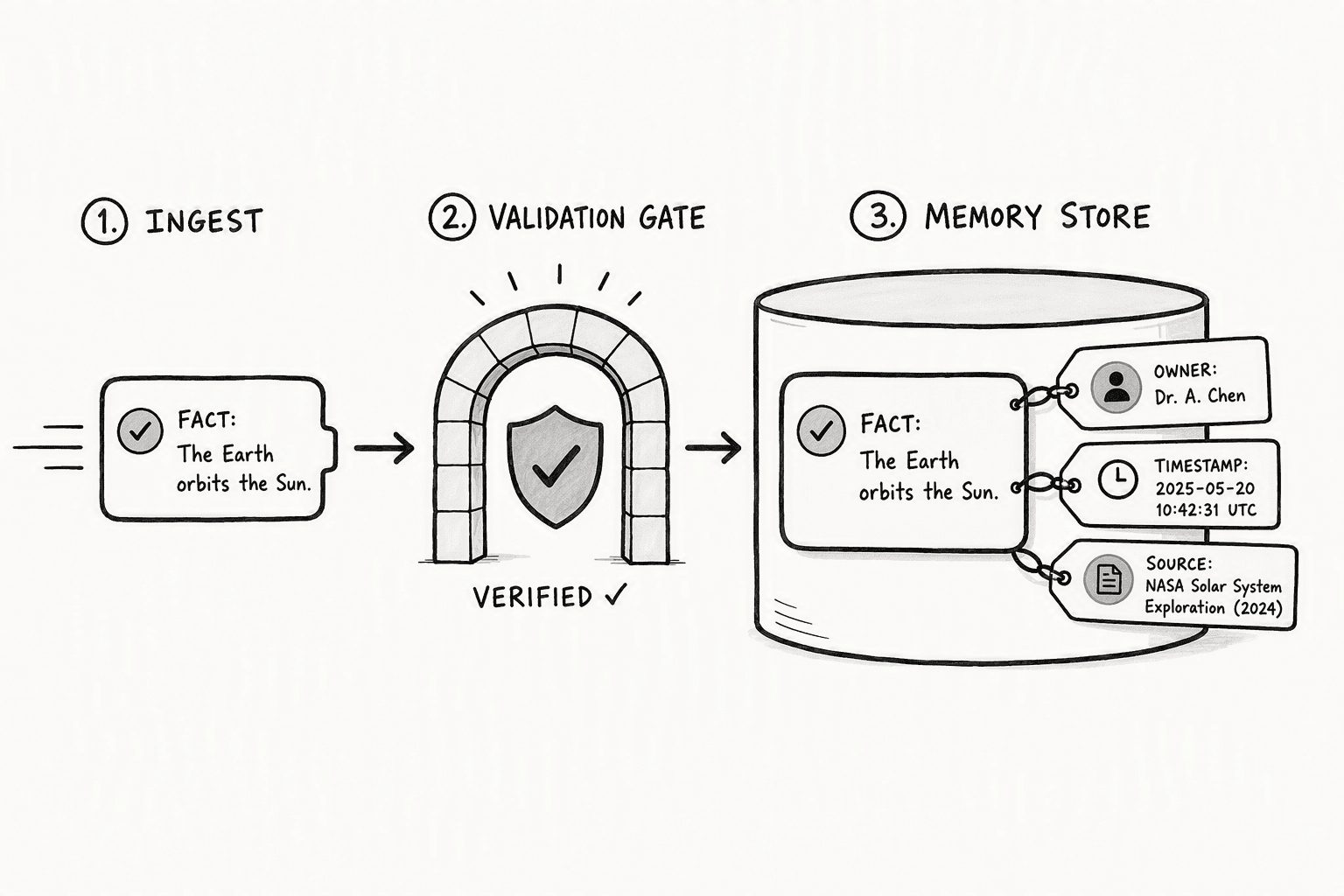
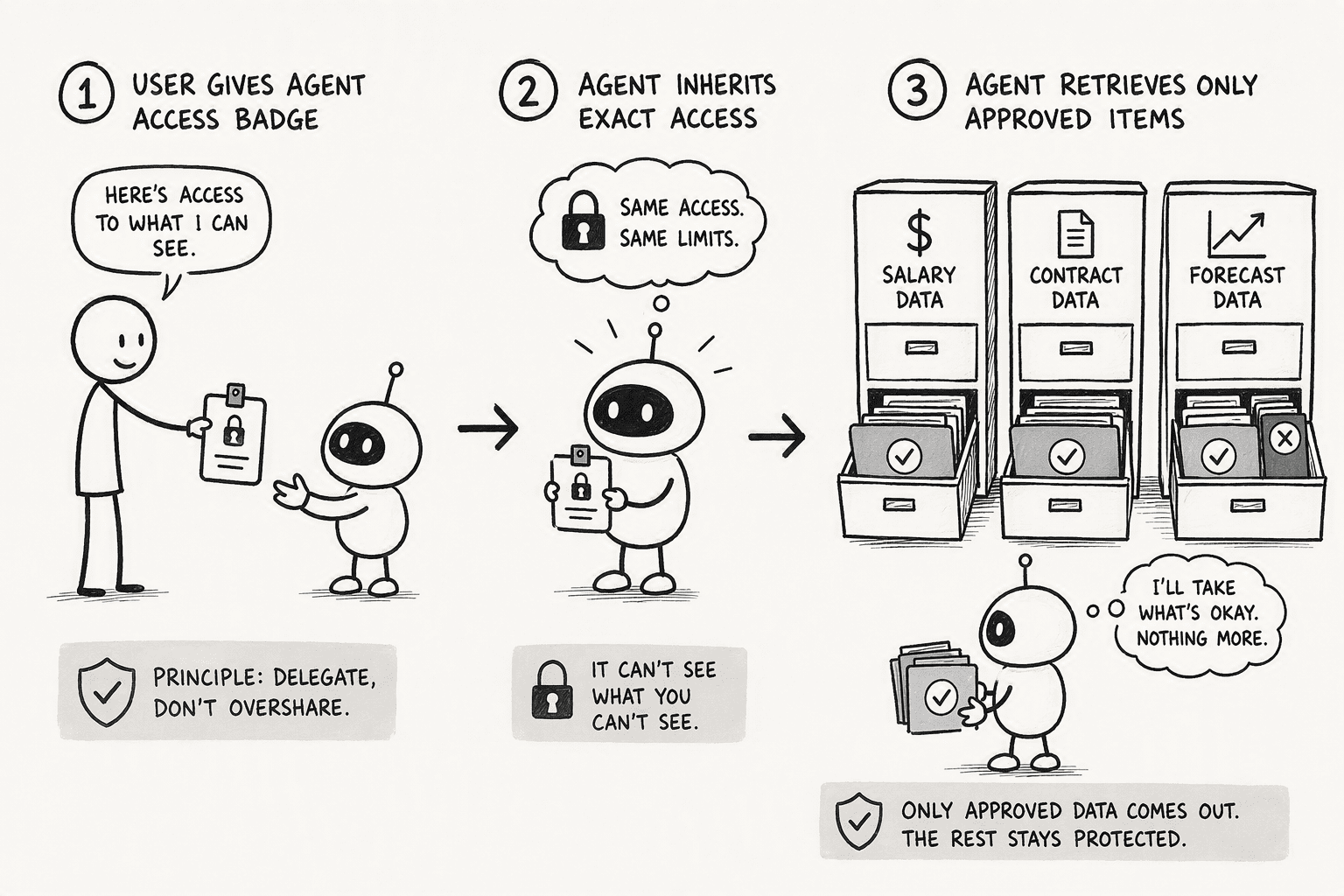
Start by connecting both structured sources (your data warehouse, Snowflake, Stripe) and unstructured ones (Slack, Salesforce, Google Docs) treating both as equally important. As each fact comes in, tag it with its origin, its owner, a timestamp, and who's allowed to see it, all in the same pass. Capturing access scope later, as a separate step, leaves a window where data has been ingested but nothing yet governs who can see it.
This is also where curation matters more than volume. In a study using NVIDIA's NeMo Curator, Coxwave cut a dataset of 2.4 million conversation samples down to roughly 605,000 high-quality ones, about 76 percent smaller, and got a more accurate model out of the smaller, cleaner set. A company brain's factual memory layer benefits from that same discipline: keep the signal, cut the noise, rather than ingesting everything indiscriminately.
Step 2: Build the context graph
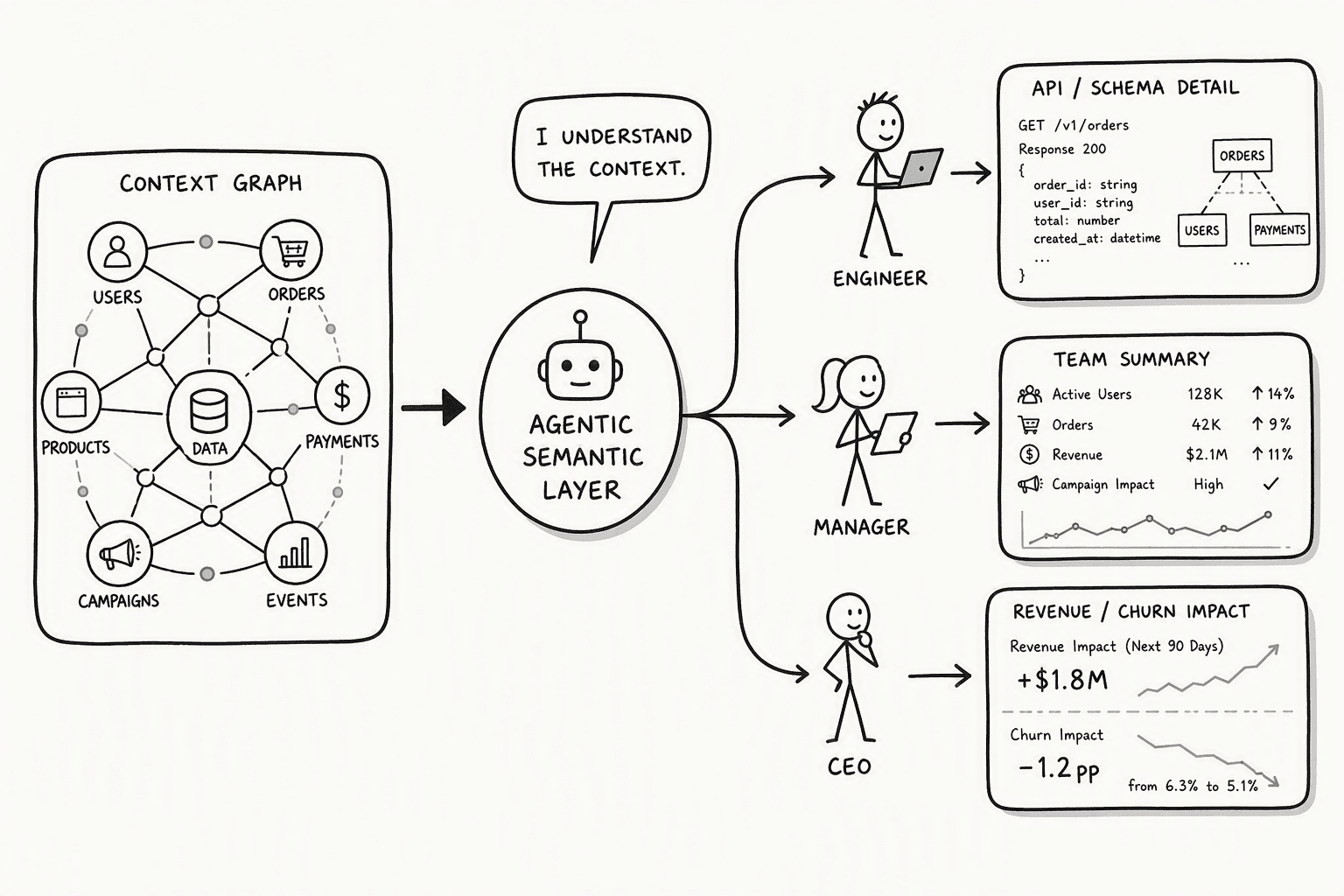
Facts on their own don't tell you much. A support ticket marked "urgent" means little until it's connected to the engineers who discussed the fix, the channel where the incident was declared, and the spec that changed the day before. Building a context graph means preserving those relationships, treating each artifact as a node and each connection between them as an edge, so the system can reason across a network instead of matching isolated keywords.
Because this graph is built on top of the access-scoped data from step 1, it inherits those same permission boundaries automatically. A relationship the system surfaces should never expose something the person asking wasn't already allowed to see.
Step 3: Layer in semantic, role-based retrieval
Different roles need different views of the same underlying graph. An engineer asking about a database issue should see schema-level detail. An executive asking about churn should see a summary tied to business impact, not a raw table. Define these role-based views deliberately, and let the system interpret intent by reading where an artifact sits inside the relationship network you built in step 2, rather than by keyword matching alone.
Step 4: Decide your execution architecture
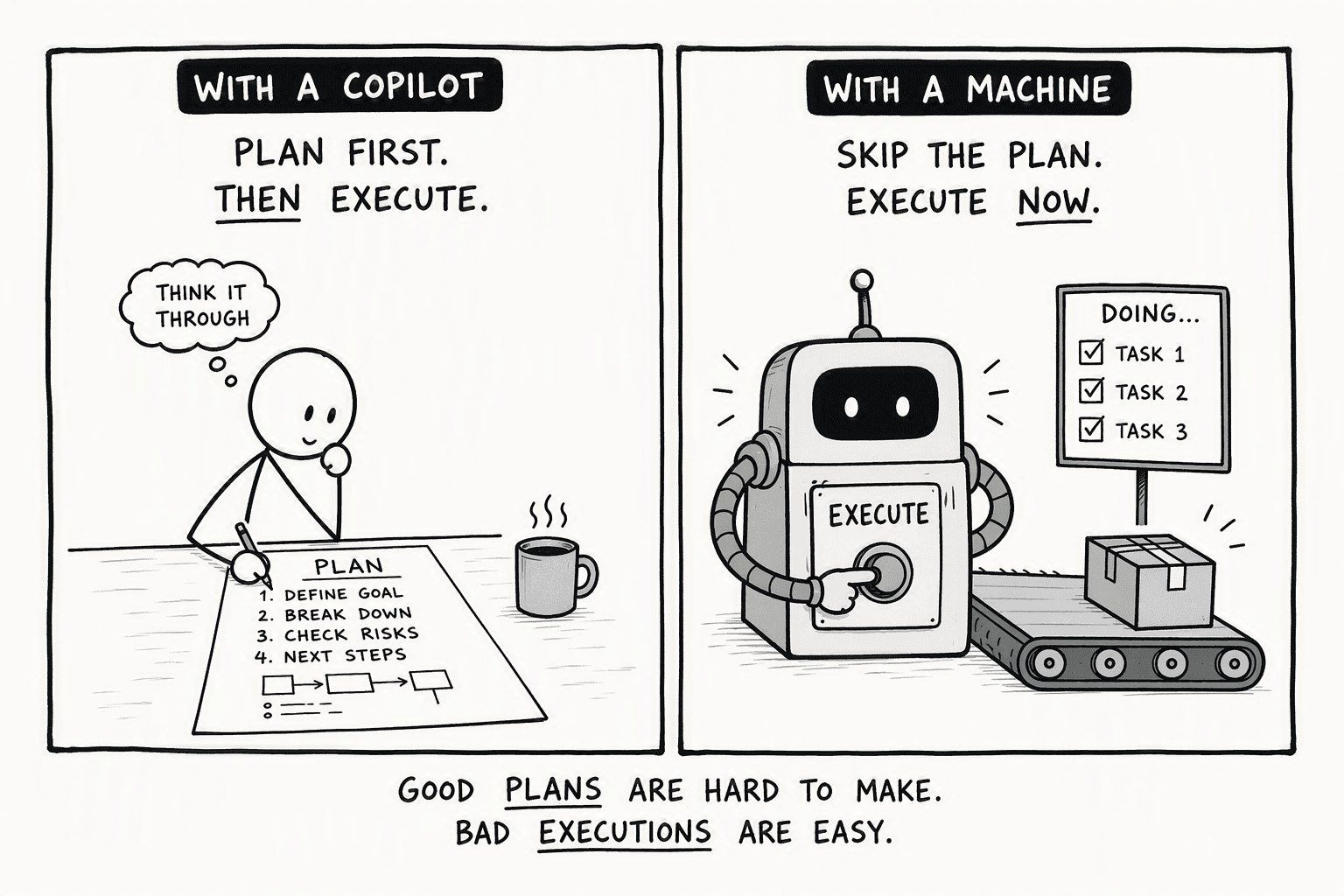
This is the step most teams skip, and it's the one with the most risk attached. A planning-only architecture drafts messages, proposes plans, and flags open commitments, then waits for a human to approve before anything actually sends or updates a record. A fully autonomous system skips that check and acts on its own.
The safer default for anything touching real records is planning-only. A system that drafts a follow-up but can't update a CRM record until someone clicks confirm multiplies your judgment. A system that can auto-resolve a customer ticket without review can just as easily get it wrong silently, and you won't find out until it's already a problem.
Step 5: Measure it by decision velocity, not adoption
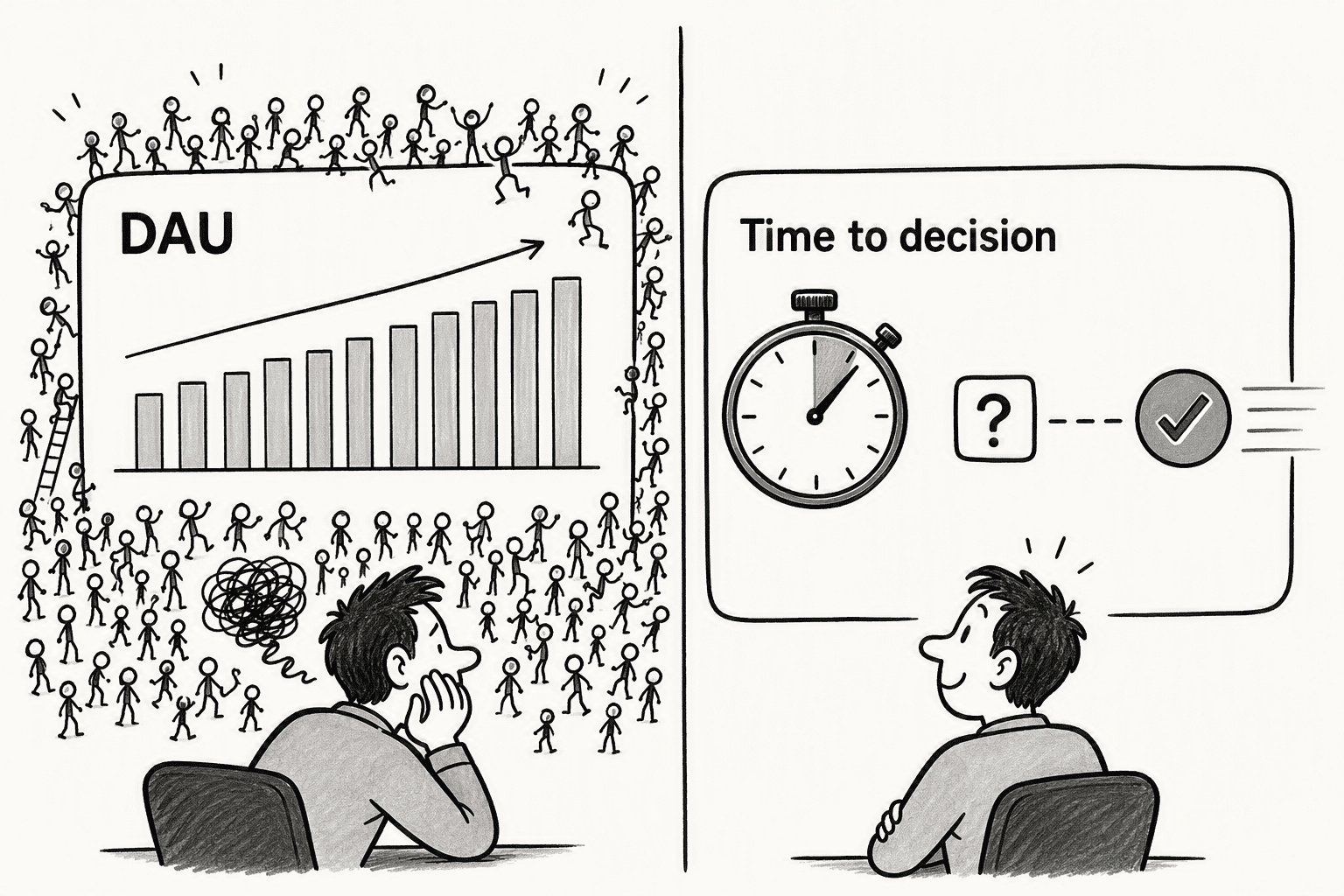
Most teams judge a knowledge system by how often people log in. That's a vanity metric. It tells you nothing about whether the business is actually deciding better or faster. Nearly half of CIOs report that their AI initiatives haven't met ROI expectations, and a mismatched success metric is a common reason why.
Track decision velocity instead: the time between a question emerging in the business and an informed action being taken, measured against a baseline from before the system existed. Pair that with a quality check, since faster decisions only count if they hold up under scrutiny, not just faster guesses at scale.
What working looks like
A company brain that's actually functioning shows a few consistent signs. The same question gets the same answer no matter who on the team asks it. Decisions stop requiring people to re-litigate context that already exists somewhere in the system. And the gap between a question surfacing and someone acting on it keeps shrinking, measurably, over time.
The easier way to do it
Building all five of these layers in-house, provenance-tagged ingestion, a context graph, role-based retrieval, a governed execution model, and a decision-velocity measurement system, is a real, multi-part engineering commitment. It's not something a team builds in a sprint, and it's not something that stays finished once built, since business logic and org structure keep changing underneath it.
PromptQL is built around this exact architecture rather than requiring a team to assemble it themselves. It acts with the permissions of the actual person using it, rather than a shared bot identity, which is the same access-scoping principle covered in step 1. Its semantic layer adapts as business definitions change instead of requiring a manual rebuild every time something shifts, and it uses the underlying model for planning rather than letting it execute directly against raw data, matching the planning-only architecture described in step 4. More detail on how that permission model is designed is covered in Designing an Auth model for Multiplayer AI.
For a first-person account of what it looks like once a team makes this switch, Killing Slack was the only way to make AI accurate covers PromptQL's own team moving off Slack as their system of record.
Conclusion
Memory, structure, and governed action aren't three separate problems to solve in sequence. They're one system. Split them into disconnected tools, a wiki here, a dashboard there, and you're left with a quiet assumption that somebody, somewhere, still remembers why the team made a call last year. That assumption gets expensive fast. Start with provenance and permissions together, and build outward from there.
Frequently Asked Questions
What is a company brain and why do modern enterprises need one?
A Company Brain is a living, permissioned model of how an organization remembers, reasons, and acts, as defined by Y Combinator’s Summer 2026 RFS. Modern enterprises need it to unify scattered domain knowledge across Slack, emails, and databases into a single actionable AI, turning fragmented data into an auditable, proactive strategic asset.
How do you build a company brain using graph-based architectures and agentic semantic layers?
You build it by ingesting data with mandatory provenance for a factual memory layer, constructing a context graph that maps relationships between artifacts, and integrating an agentic semantic layer that interprets intent and proactively surfaces role-based insights and open commitments.
What are the key components required to make a company brain accurate, secure, and scalable?
Accuracy requires provenance-first data curation that filters out noise. Security demands identity-aware permissions where the AI inherits user-level access scopes. Scalability relies on governance fabrics with full data lineage, dedicated VPC or bring-your-own-cloud deployment, and semantic deduplication.
How does PromptQL's approach to building a company brain compare to other knowledge management or RAG systems?
PromptQL uses an agentic semantic layer rather than acting as a passive retriever, with three key differentiators:
- Multi-source ingestion: Reads from multiple enterprise sources like Slack, Snowflake, and Salesforce using shared threads with a full audit trail.
- Proactive commitment surfacing: Unlike basic RAG systems, it surfaces commitments proactively without requiring a direct query.
- Identity-scoped output: Scopes output to the user’s identity without exposing raw database credentials.
What real-world data integrations and deployment models are available for an enterprise company brain?
Enterprise brains can connect structured databases like Snowflake with unstructured feeds like Slack, Google Docs, and Salesforce. Deployment models include dedicated VPC or a bring-your-own-cloud setup, allowing the system to run in a customer’s own infrastructure and to deploy in hours, not weeks.
How can organizations measure the ROI and success of a company brain initiative?
Replace vanity adoption metrics with decision velocity, the time from question to informed action. Pair speed with quality by using an AI assessment playbook that benchmarks compliance, security, and customer satisfaction improvements, proving the brain directly multiplies business outcomes rather than just search capacity.
Sources
- Bridging Knowledge, Data, and AI: Harnessing the Semantic Layer Framework to Drive Intelligence | Springer Nature Link - link.springer.com
- [2406.02594] Graph Neural Networks for Brain Graph Learning: A Survey - arxiv.org
- Measuring AI becomes key pursuit as enterprises seek ROI | TechTarget - www.techtarget.com
- Boost Embedding Model Accuracy for Custom Information Retrieval | NVIDIA Technical Blog - developer.nvidia.com