Introduction
When Google retired its internal wiki, around 90% of its documents had no views or updates in the previous few months. If a company with Google's engineering culture ended up there, your company wiki will not stay fresh on motivation alone.
The rot sets in for two structural reasons.
First, knowledge is separated from work. A wiki page is a copy of a process that changes somewhere else, so updating it demands a second, separate edit nobody prioritizes.
Second, ownership is absent. Nobody's name is on the page. Google's own engineering book puts it plainly: "Because there were no true owners for documents, many became obsolete." Page after page drifted into irrelevance while everyone assumed someone else would fix it.
The fix is four structural rules: one named owner per page whose own work changes what the page describes, a visible review-by date in every header, updates made in the same change as the work itself, and fast-changing knowledge kept out of the wiki.
The eight steps below put those rules into practice and add the roles and routines that keep them running.
Key Takeaways
A company wiki stays alive through structure, not willpower. Here is the framework boiled down to its bones:
- Single owner: Every page gets one named person whose own work changes what the page describes, never a team, never a department.
- Visible freshness: A "Last reviewed by [Name] on [Date]" line in every page header builds reader trust and creates gentle accountability.
- Update with the work: A page changes in the same commit, pull request, or configuration change that alters the process it describes, with no separate calendar task.
- Exclude the ephemeral: Project status, weekly decisions, and meeting notes belong in linked live documents, not the wiki. The wiki holds durable reference knowledge only.
- One accountable steward: A Wiki Gardener owns the structure itself, the monthly review cadence, the page ownership registry, and the handover when someone leaves.
- Departure is transfer: Every offboarding checklist includes a named line that reassigns wiki pages. A page without an owner gets archived.
- Automate the audit: A bot can scan for stale pages, broken links, and ownership gaps, so the monthly review starts from a list instead of a hunt.
Step 1: Assign a Named Owner to Every Page
A team cannot own a page. A team spreads responsibility until nobody feels it. A page needs one person whose own work changes what the page describes. When that person changes the payroll provider, the stub that says "we use Gusto" becomes wrong, and they feel it because their name is on it.
GitLab's handbook follows the same logic. Its repository keeps a CODEOWNERS file that lists the maintainers for its pages, and its maintenance process includes removing people from that file when they leave the company. One human, one page, one line in a file that the system reads.
Start small. List your ten most-used pages and put one name on each.
Step 2: Put a Review-By Date in Every Page Header
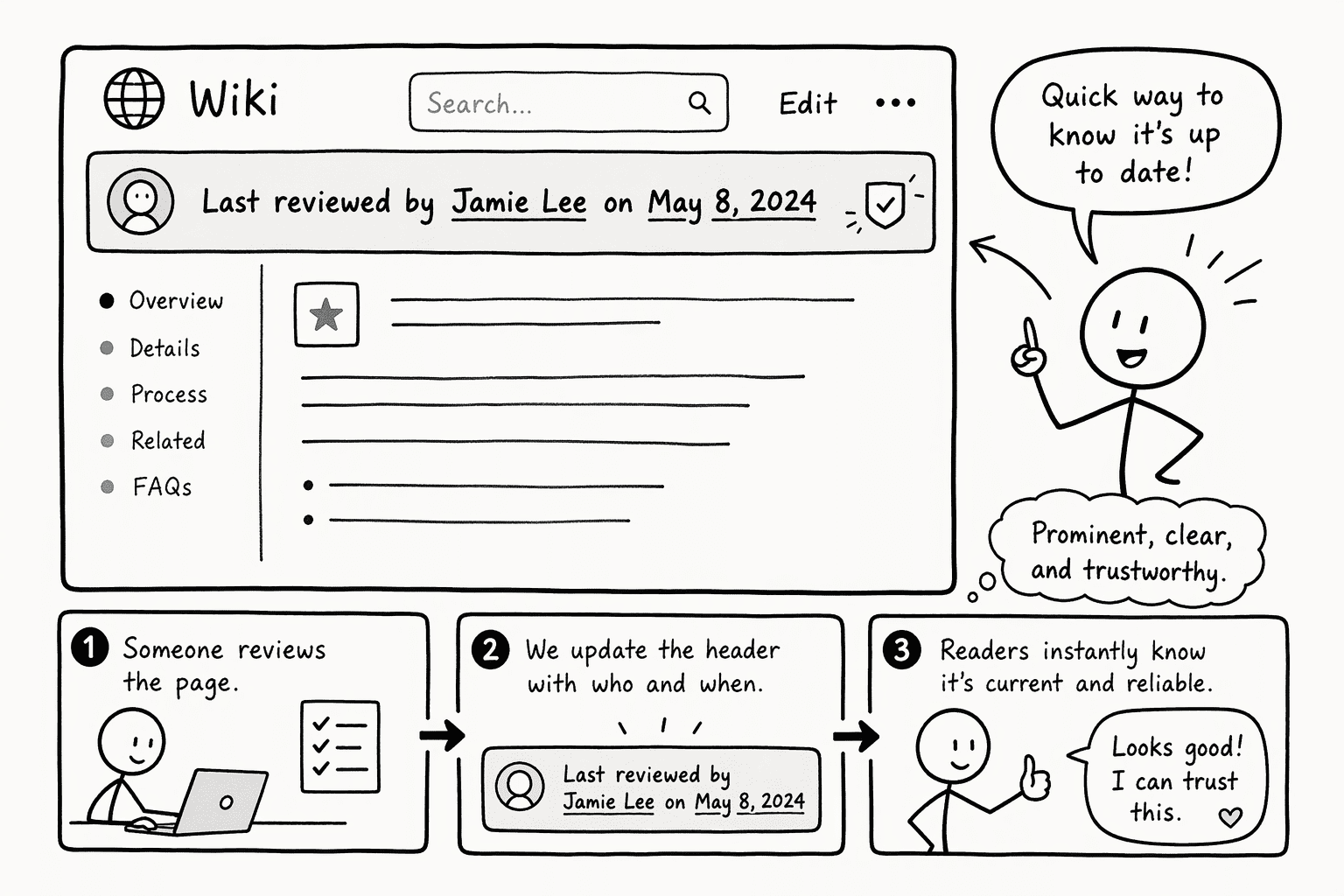
A page without a date is presumed stale. The reader's internal monologue is brutal and consistent: "This looks old. I'll ask in Slack." A line at the top that reads "Last reviewed by [Name] on [Date]" reverses that calculation. It tells the reader who stands behind the page and when it was last checked.
Google's engineers saw the same effect. Their book reports that adding a "Last reviewed by..." byline with the owner's name to a document's freshness date led to increased adoption.
An owner's name turns a floating document into someone's responsibility, and a recent date tells the reader the content still holds.
You do not need to track dates by hand. Notion, Slab, and Guru all let you set how long a page stays verified, and they notify the verifier or owner when that period runs out. Notion's page verification also emails the owner when verification lapses. The date creates accountability quietly. It sits there, visible, until the owner updates it.
Step 3: Update the Page in the Same Change as the Work
The fatal flaw that kills most wikis is the second edit. Work changes in one place. The wiki sits in another. Updating it demands a separate trip to a separate tool, on a separate mental thread, usually days or weeks later. That trip never happens.
The fix is event-triggered: when the thing the page describes changes, the page changes along with it.
A concrete example: when your team switches payroll providers, the "How do we run payroll?" page changes in the same working session. When the API endpoint for the billing system moves, the wiki page that documents it gets the new endpoint in the same pull request.
This collapses two tasks into one. The documentation becomes a byproduct of the actual work.
Step 4: Keep Fast-Changing Knowledge Out and Structure by Question
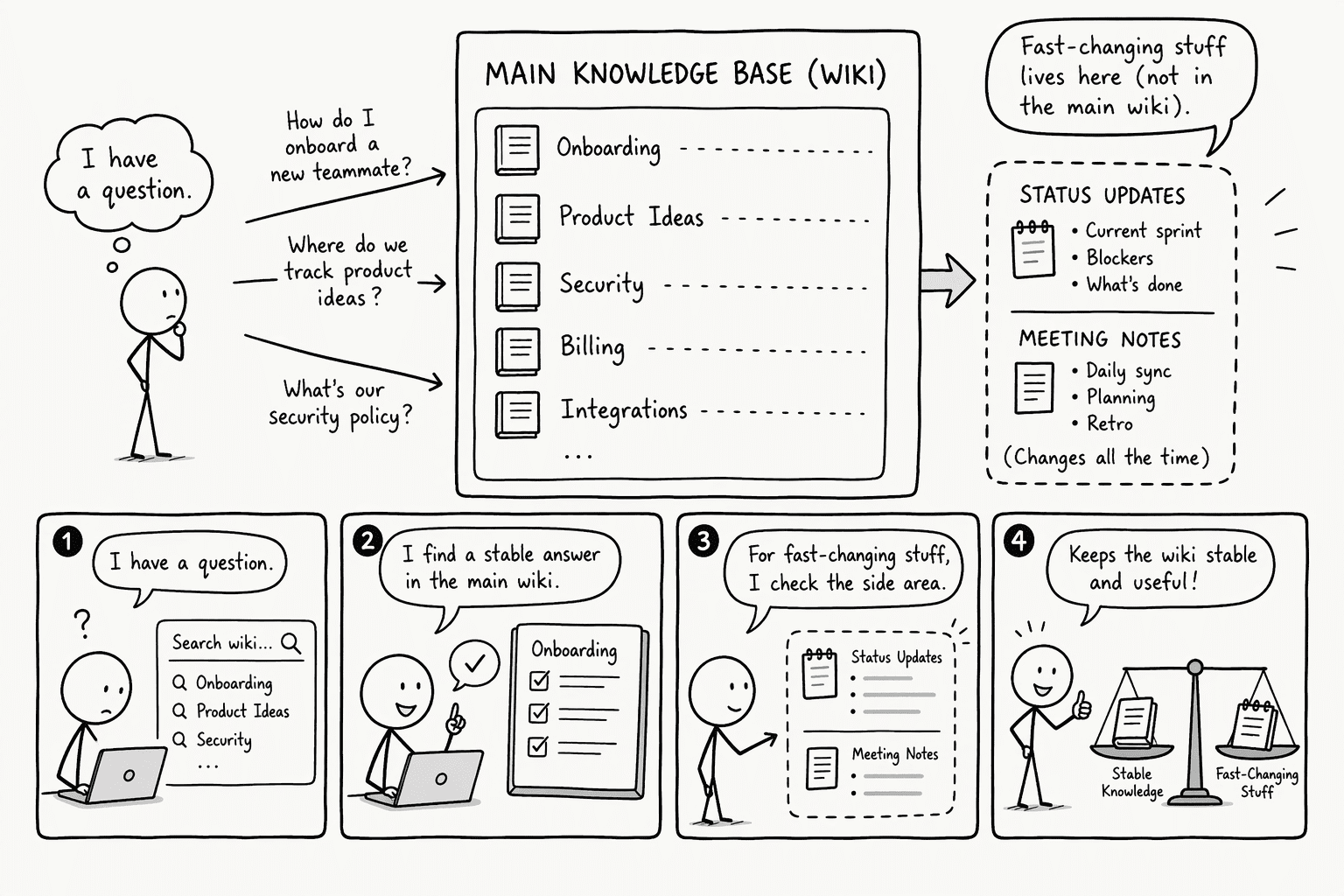
The organizational chart is not an information architecture. People search by question: "How do I request PTO?" not "HR Department > Policies > Time Off." Structure the wiki around those questions.
As a rule of thumb, keep the top level to seven sections or fewer. Beyond seven, the structure itself needs a search.
Equally important is what you leave out. Fast-changing knowledge like project status updates, weekly meeting notes, and decisions still in flight goes stale as soon as you publish it. Pull it out entirely and link to live documents for the volatile material. The wiki holds durable reference knowledge: the process, the why, and the policy that outlasts a single sprint.
| Dimension | Wiki (durable reference) | Live documents (volatile knowledge) |
|---|
| What lives there | How we do things, where things are, what we decided | Project status, weekly decisions, meeting notes |
| Update trigger | When the process or system changes | As work progresses, often daily |
| Owner | Named page owner | Whoever runs the project or meeting |
| Staleness risk | Low if owner and date are enforced | High by design, since it is meant to age out |
| Search intent | "How do I...?" and "What is our policy on...?" | "What's the current state of...?" |
Step 5: Appoint a Wiki Gardener to Own the System
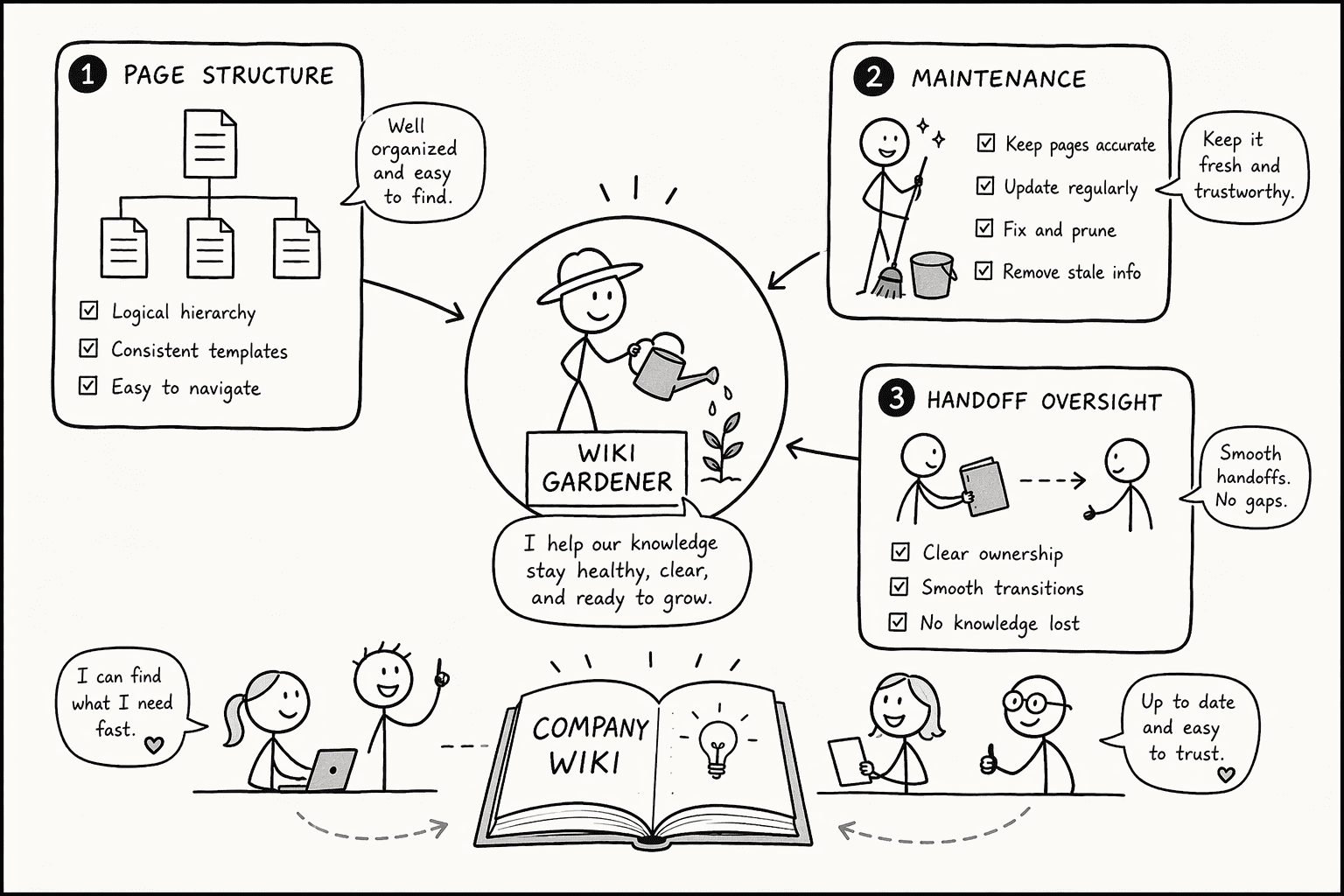
Structure does not enforce itself. Someone has to hold the line.
That someone is the Wiki Gardener. In a company of 20 to 200 people, it fits naturally with an operations lead or chief of staff, someone who already thinks in systems and handoffs.
- Pick the right person: Choose someone who already owns operational processes and cares whether documents are current.
- Define the charter explicitly: The Gardener does not write every page. They own structural integrity, run the monthly review cycle, and reassign pages when someone leaves.
- Give it real authority: The Gardener can archive an ownerless page on sight. No committee vote, no Slack poll.
- Lock in the cadence once: A monthly review is the repeating drumbeat. Everything else in this framework hangs on that rhythm.
A wiki without a named steward drifts into neglect. Once the owner and date rules exist, the Gardener is the person who keeps them enforced.
Step 6: Run a Monthly Review: Confirm, Fix, Archive, Delete
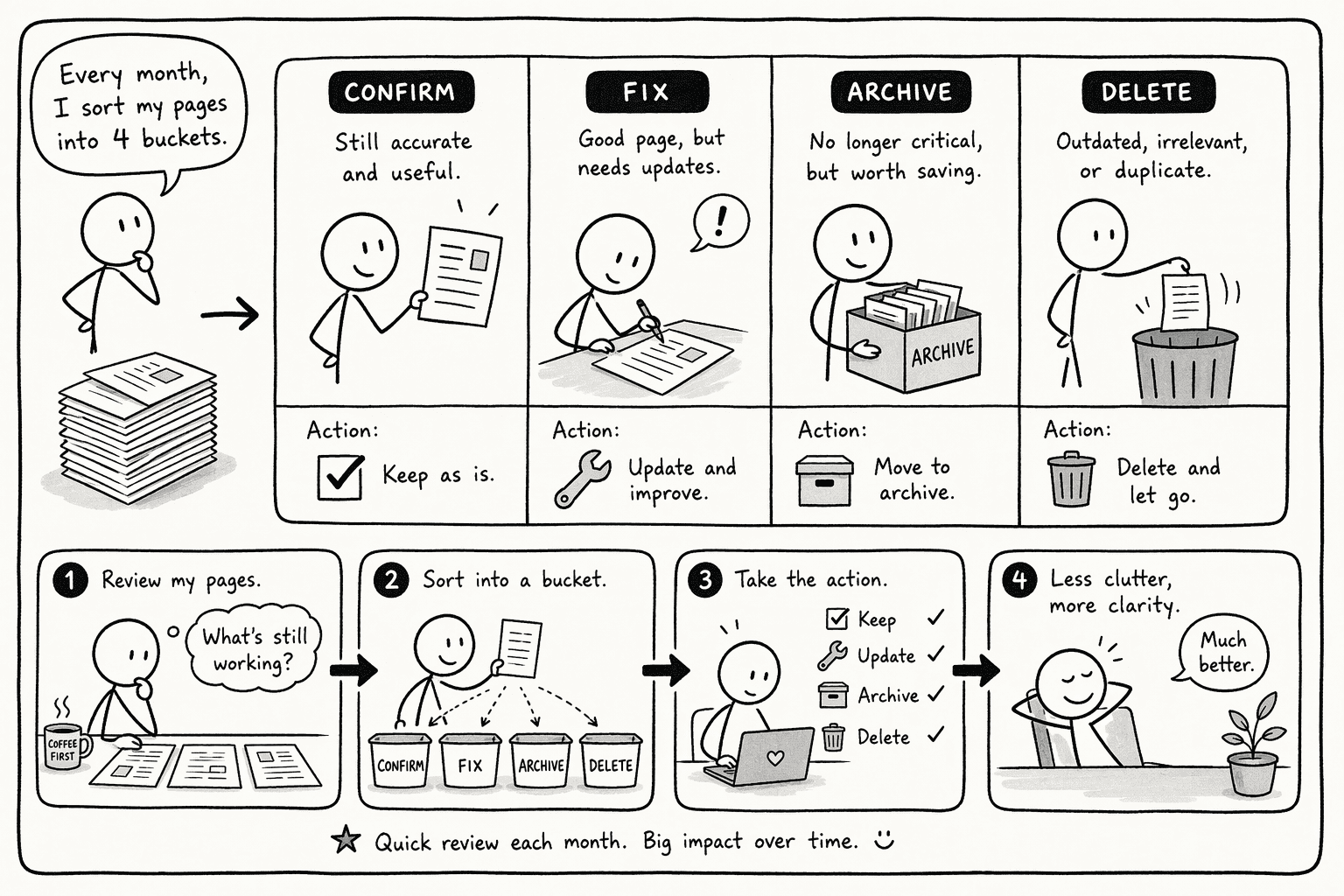
The Gardener runs one bounded, predictable ritual every month. Each page lands in exactly one bucket.
- Confirm: The page holds up. The owner stamps a new review-by date and moves on.
- Fix: Small breaks, like a phone number change or a dead link, get corrected in minutes.
- Archive: The page describes something no longer relevant but worth keeping for history. It leaves the active index.
- Delete: The page is obsolete and has no archival value. It disappears.
Paired with the event-triggered updates from Step 3, this monthly pass becomes a safety net rather than a heroic effort. Keep it short.
Step 7: Transfer Page Ownership When Someone Leaves
Someone leaves, and their pages turn into ghosts. The author name stays, the dates freeze, and within a month nobody trusts the content enough to rely on it.
The fix is a single line in every offboarding checklist that moves ownership before the person walks out the door.
- List every owned page: The departing team member audits their pages. The Gardener keeps a registry that makes this a quick lookup.
- Name the successor explicitly: Ownership transfers to a specific person. That person's name appears on the page before departure.
- Let the Gardener handle the unclaimed: Pages without a named successor get archived on the spot.
- Date the transfer: The review-by date resets to the handover date. The new owner owns the freshness clock from that moment.
Step 8: Automate the Audit With PromptQL Wiki Ops
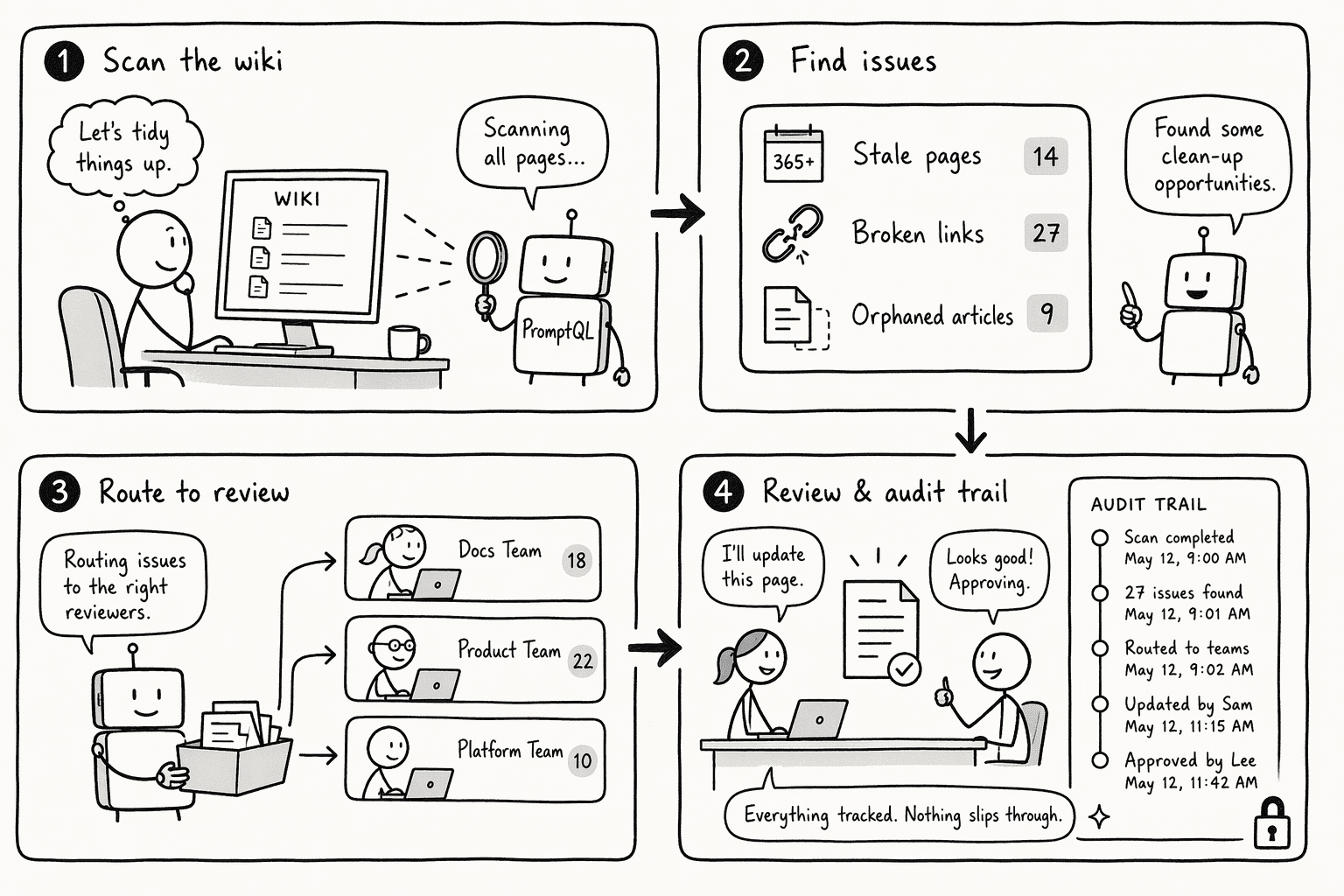
Human ownership is the foundation, but automation catches what people miss.
In PromptQL, you can spin up a bot to measure your wiki's health and propose repairs: stale pages, broken links, duplicate definitions, unresolved conflicts, and gaps in ownership.
That is the Gardener's monthly checklist, prepared before the review starts, so the Gardener spends the time deciding instead of searching.
The wiki also keeps its own paper trail. PromptQL captures corrections as human-reviewed, cited wiki entries, and it gives you revision history and a full audit trail, so you can see what changed and why. It syncs its user directory and privileges from your identity provider over SCIM.
When you deactivate someone there, their access is revoked everywhere, which supports the handover rule in Step 7.
Conclusion
A wiki that nobody updates has two root causes: knowledge separated from work, and absent ownership. A kickoff meeting or a team-wide enthusiasm campaign solves neither. Structure does.
To get started, name an owner for your ten most-used pages and add a "Last reviewed by" line to each. Then appoint a Wiki Gardener to run the monthly review. What you call the role does not matter. What matters is that one person who understands the wiki checks the dates on a fixed cadence and either updates a page or retires it.
That is what separates a wiki that serves the team from one everyone learns to ignore.
Frequently Asked Questions
What are the biggest challenges that cause company wikis to become outdated?
Two structural problems cause the decay:
What strategies or workflows help teams maintain an up-to-date wiki without constant manual effort?
Three core practices keep a wiki fresh:
How can AI tools automate wiki updates and knowledge capture?
AI tools can take over the audit work:
How do you measure whether a company wiki is effectively maintained?
Track the percentage of pages with a review-by date in the last 90 days, the number of ownerless pages, and reader trust signals, like whether people still ask in Slack for information that exists on a wiki page. A healthy wiki has fewer repeat questions, not more proudly listed page counts.
What role does version history and an audit trail play in keeping a wiki trustworthy?
Version history lets readers see not just what the current rule says but why it changed and what it replaced. Readers trust a page that shows its provenance. Without it, they assume the information is unverified and likely stale.
Sources
- How to keep a company wiki updated: owners, dates and links - knowledgework.ai
- Internal wiki: tools, structure, and the wiki that grows out of the channel history (2026) — Blog | InterMIND - intermind.com