A team runs an AI agent on what looks like a clean dataset and asks a simple question: what's the projected Q4 revenue for the East Coast division? The agent returns a number, confident and completely wrong. The real culprit usually isn't the model. It's a total divorce between the AI's reasoning and the gritty, governed reality of the actual data systems underneath it, data connectors, a vector database, and a slick chat interface, with no component telling the AI who can see what, which data is real, and how to navigate the messy logic of the business.
The missing piece is a context layer. It's the infrastructure that turns brittle, hallucination-prone AI experiments into reliable enterprise tools. Without it, an AI agent is just guessing faster. With it, an agent starts acting like the most well-informed, security-cleared colleague on the team.
This guide covers what a context layer actually is, how it differs from adjacent concepts, and why it's the one architectural tier that separates AI pilots that impress from AI systems that earn trust.
Key Takeaways
- A context layer sits between your data estate and your AI agents, translating raw metadata into governed business meaning while enforcing permissions in real time. It plans every query before a tool runs it.
- It replaces naive vector retrieval with dynamic query planning that understands structured entities and unstructured documents together. An LLM alone cannot do that, it has no way to know which sales figures are current orders and which are training artifacts from 2019 without a plan-first approach.
- The context layer enforces role-based access control, column-level security, and data residency policies at the moment a query executes. Permissions live inside the layer, so no agent ever sees data it should not touch.
- Instead of a black-box agent guessing token by token, a context layer compiles a query into an auditable, step-by-step context graph. You can inspect the plan before tools run, then trace every result back to its origin.
- Trust becomes measurable when you evaluate a system against a golden Q&A dataset, scoring plan accuracy and grounding recall with frameworks like LLM-as-a-judge. You stop relying on vibes and start tracking numbers.
- An enterprise rollout is a multi-quarter program that layers in federated domain ownership, compliance overlays, and compounding reuse. Verified context accumulates across teams, so every subsequent query gets cheaper and more accurate than the last.
What is a context layer?
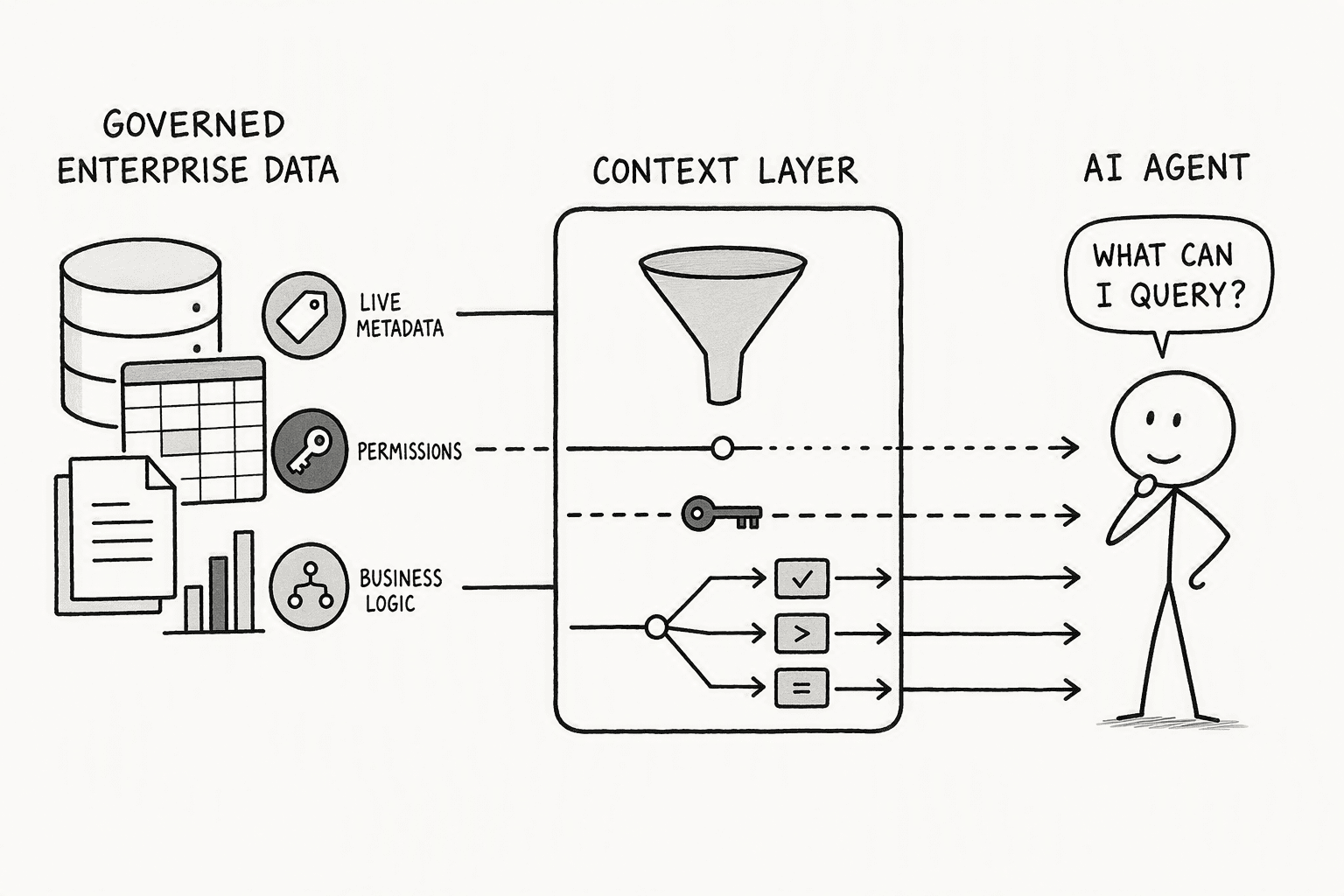
A context layer is infrastructure that makes all governed enterprise data usable by AI agents by retrieving, structuring, and enforcing live metadata, permissions, and business logic at query time. It restores the meaning that traditional data pipelines strip away.
It dynamically assembles a queryable view of the business that includes data connectors, a knowledge graph of entity relationships, and a policy engine that respects row-level security. A context layer is a persistent, queryable system that captures the state, constraints, evidence, and rationale around AI-driven decisions.
It doesn't replace a data warehouse or vector database, it orchestrates the flow of logic, meaning, and rationale between data sources and AI consumers. High intelligence with low context is the most dangerous combination, because the agent ends up confidently wrong.
How a Context Layer Differs from Semantic Layers and RAG Pipelines
The easiest way to get lost in enterprise AI architecture is to confuse a semantic layer, a RAG pipeline, and a context layer. Think of them as three distinct eras of data access.
The semantic layer was born in 1991, when Business Objects patented a metadata layer that let business users query relational databases directly. It translates raw database schemas into business-friendly metrics, mapping cryptic column names like "custxctnamnt" to "Transaction Amount." Its job is to give every dashboard and report a shared definition of "revenue" or "active customer." The modern resurgence hit in 2021 when dbt Labs' co-founder opened a public issue titled "dbt should know about metrics," and by 2023, dbt had acquired Transform and its MetricFlow engine to build it out properly. A semantic layer defines static metrics, it has no reasoning engine for unstructured text.
A RAG pipeline solves a different, narrower problem. It chunks up documents, embeds them into vectors, and retrieves semantically similar passages to stuff into a prompt.
Industry estimates consistently put unstructured data at 80 to 90% of all enterprise information, including legal contracts, engineering specs, and customer correspondence, a substantial gulf in scope across all three:
| Semantic layer | RAG pipeline | Context layer |
|---|
| Built for | Static BI dashboards and reports | Naive document search | Governed, real-time AI reasoning |
| Handles structured data | Yes, its core purpose | Poorly | Yes |
| Handles unstructured data | No | Yes, but ungoverned | Yes, governed |
| Freshness | Defined once, updated on a schedule | Depends on re-indexing | Live, at query time |
| Permissions | Not its concern | Not its concern | Enforced at query time |
| Serves | BI tools | Prompts | AI agents |
A context layer is also worth distinguishing from a context graph specifically. A context graph is a structural implementation, decisions, policies, and exceptions modeled as connected nodes with temporal validity, that a context layer can use as one of its components. The layer is the broader system; the graph is one way to structure part of what lives inside it.
The Core Architecture Tiers of an Effective AI Context Layer
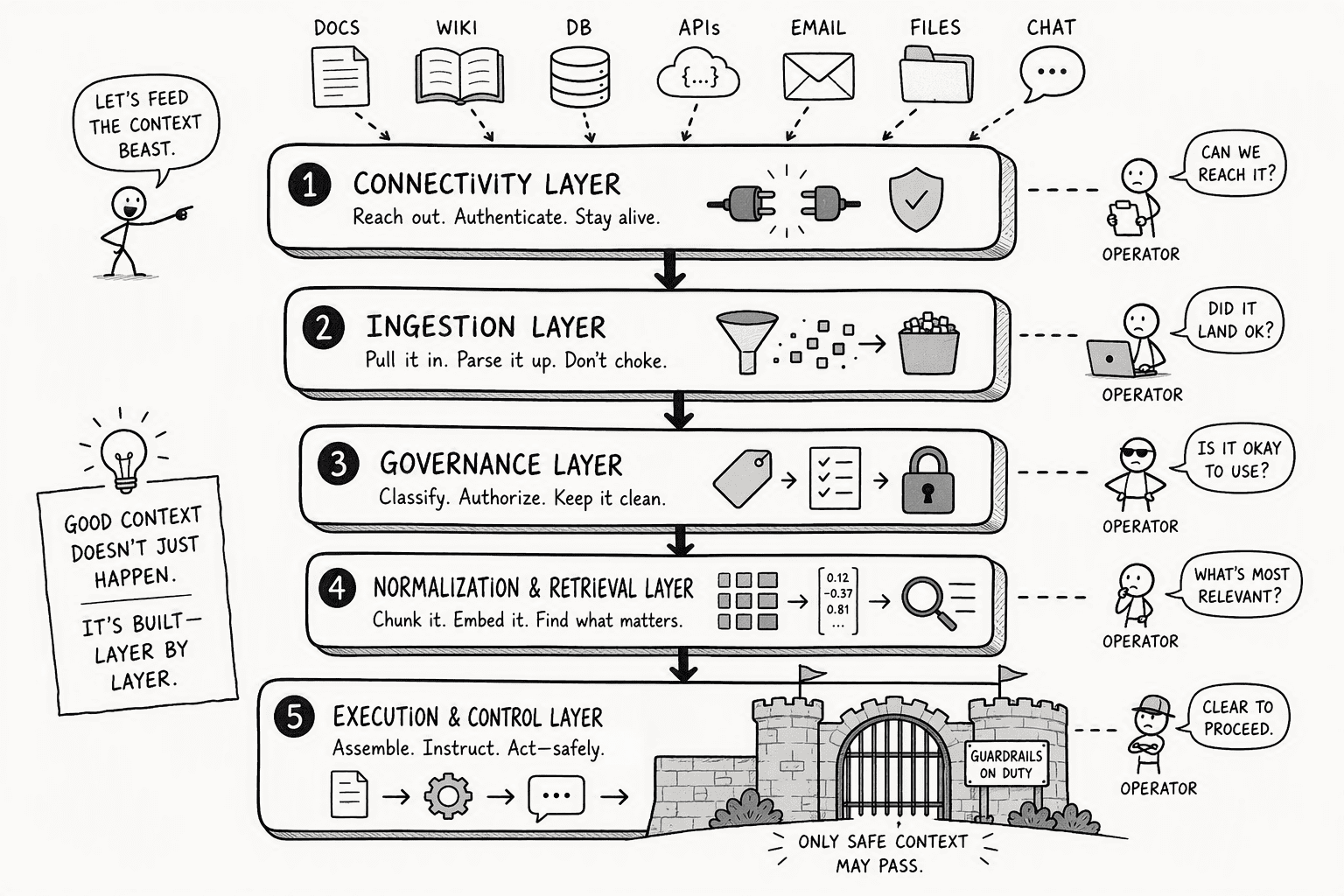
Most reference architectures I see for "AI data platforms" stop at "add a vector database to your lakehouse." That recipe creates a data swamp your agents will drown in. An effective context layer has five distinct tiers. If one is missing, the system breaks at scale.
| Tier | Function | What It Prevents |
|---|
| Connectivity & Ingestion | Continuous, real-time integration with structured databases, SaaS tools, and unstructured stores via change data capture and API gateways. | Stale training snapshots and outdated answers. |
| Dynamic Knowledge Assembly & Indexing | Constructing a queryable knowledge graph that links structured entities (customers, orders) to unstructured rationale (contracts, emails). | Entity blindness where the AI can't connect a credit score to a specific borrower's jurisdiction. |
| Policy & Permission Enforcement | Enforcing identity-aware, role-based access controls that mirror source system permissions (RBAC, column-level security) at query time. | Data spillage where an intern's agent sees HR data it has no business accessing. |
| Plan-Based Query Orchestration | Decomposing a natural language question into an explicit, auditable execution plan before retrieving any data. | Probabilistic hallucinations and black-box token guessing. |
| Explainability & Audit Logging | Capturing the full reasoning trace, data sources, and transformation steps used to answer a question. | Regulatory audit failures where you can't prove "who knew what when." |
Plan-Based, Auditable Execution vs. Black-Box Agent Guessing
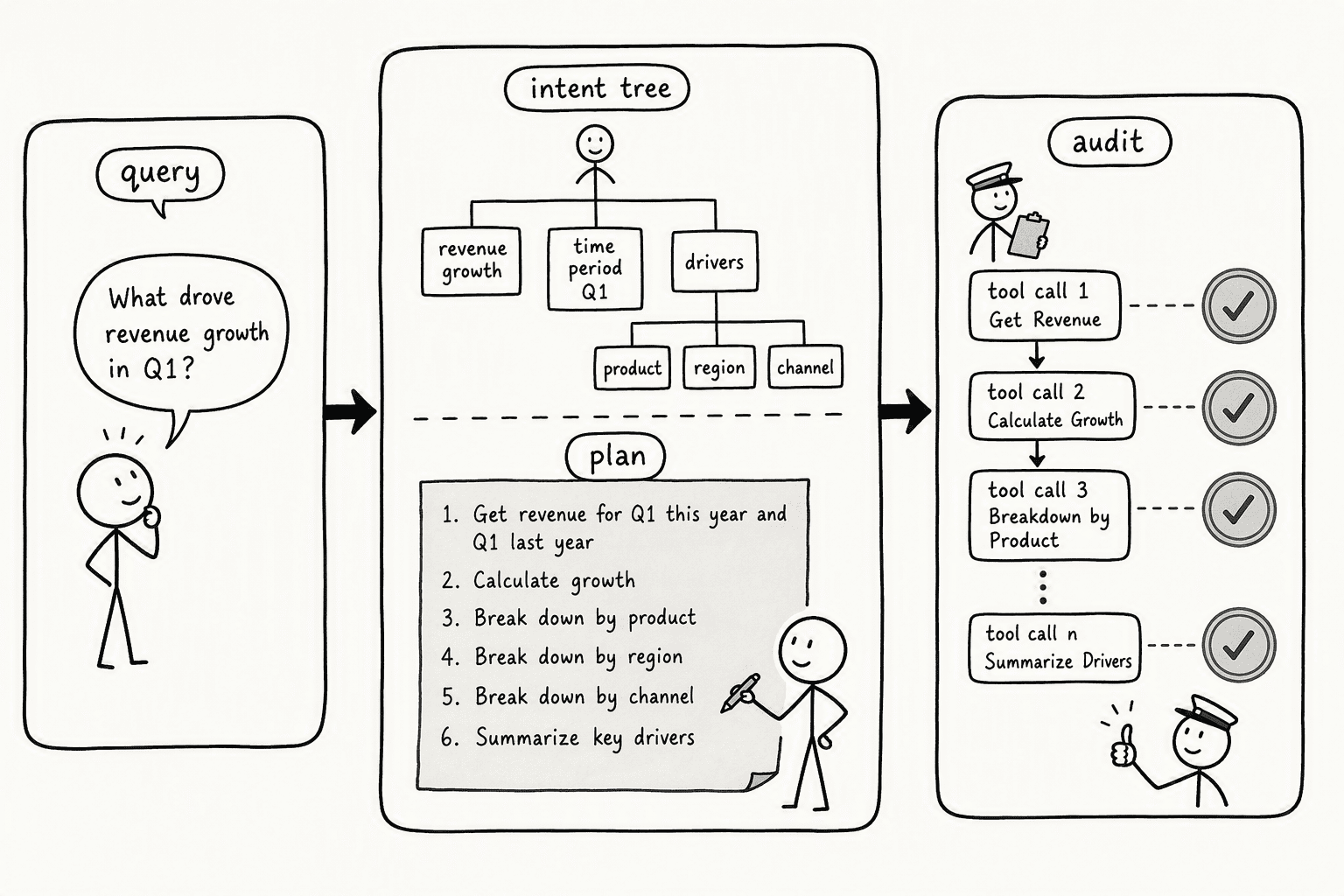
A ReAct agent that loops autonomously, interleaving a hallucinated thought with a destructive API call, will destroy executive trust in an AI initiative faster than any budget overrun. A context layer enforces a different execution model entirely, one that generates a plan before it generates an answer:
- Parse the natural language question into an intent tree. The system identifies the entities, metrics, and filters embedded in the user's question without yet touching any data.
- Decompose into an explicit context graph. The planner builds a step-by-step execution sequence: which databases to hit, which permissions to check, which business logic rules to apply. This graph is auditable before anything runs.
- Execute tools in a governed sandbox, never as a raw LLM. Code runs in a secure cloud environment governed by deterministic data-layer permissions. No dynamic package installs compromise the runtime.
- Assemble and cite every output. The final answer stitches together results from multiple sources, providing referenceable, citation-backed artifacts rather than a single paragraph of probabilistic text. A context layer is a persistent, queryable system that captures the state constraints, evidence and rationale around AI-driven decisions.
Enterprise Governance, Security, and Deployment Models
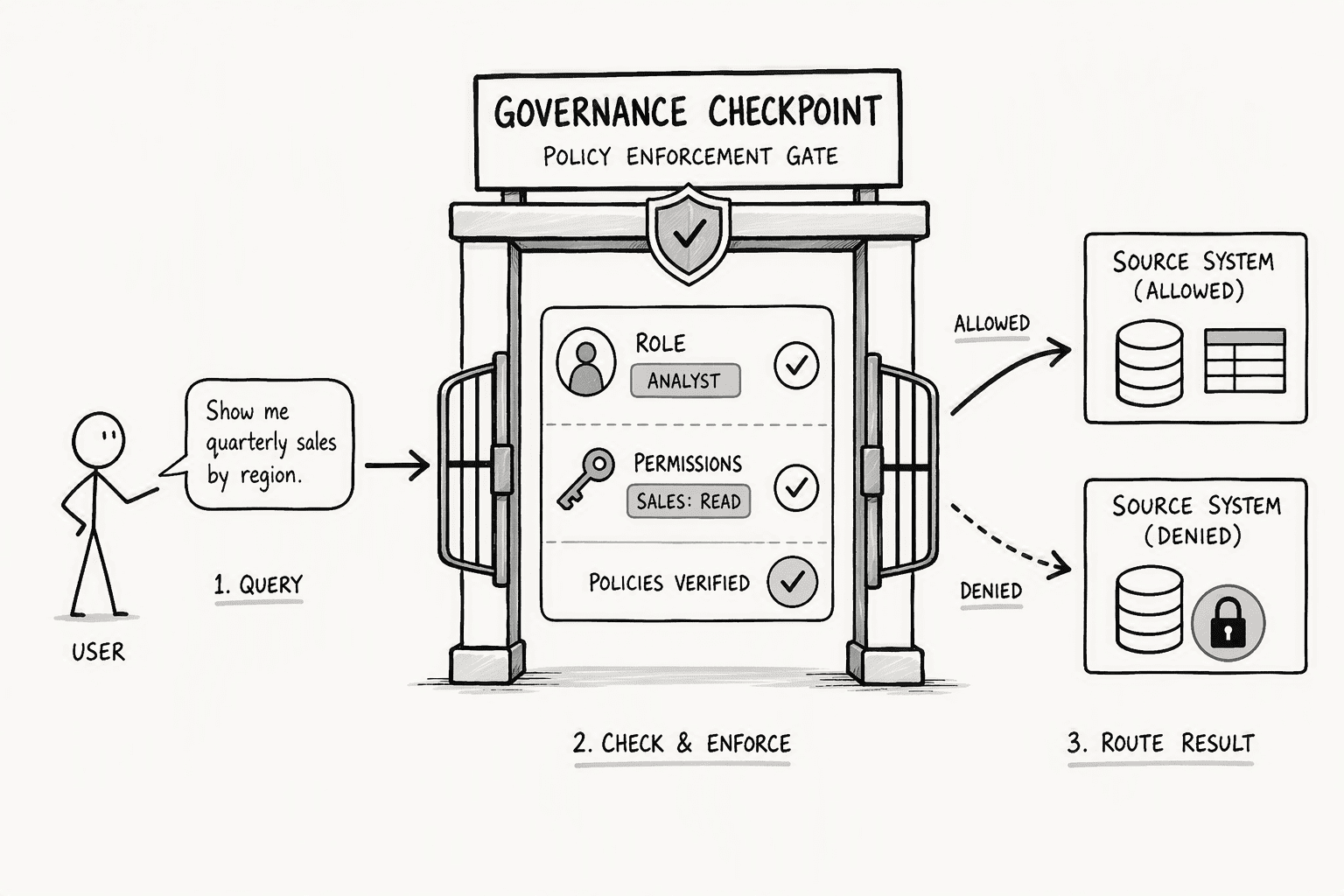
Governance in a context layer is the first gate every query walks through. It acts as a real-time enforcement point for identity-aware access, mapping the end user's role to the fine-grained permissions already living in the source databases. For financial services, a feature store might return a credit score, but the context layer provides the regulatory context that defines how a specific borrower can use that score in a given jurisdiction. This deterministic enforcement, acting with each user's permissions, is the only way to prevent a super-user AI agent from becoming a one-stop exfiltration engine.
The deployment model has to be airtight. Any architecture that funnels raw enterprise data into a shared, third-party SaaS ingestion pipeline is a non-starter for regulated environments. An enterprise context layer demands a self-hosted, private cloud-native service, often deployed inside a single-tenant VPC or a BYOC setup. This keeps customer-managed keys controlling encryption at rest and data inside the governed perimeter, a hard requirement for SOC 2 and HIPAA frameworks.
Data provenance splits along a clear line. The context layer has to distinguish a live customer order from a training artifact, applying access controls by evaluating metadata lineage, creation timestamps, and source-system tags. Without that capability, a financial analyst querying historical transactions could pull stale test records alongside real PII, breaking both audit readiness and customer trust.
Evaluating Context Layer Accuracy and Reliability in Practice
You can’t manage what you can’t measure, and you absolutely can’t trust an AI whose accuracy you only assess through “vibe checks.” Evaluating a context layer requires shifting from subjective trust to empirical measurement. We do this by creating a golden dataset of domain-specific questions and answers, paired with the exact source records that should surface. The evaluation framework runs an LLM-as-a-judge pattern using structured rubrics adapted from open-source frameworks like DeepEval and RAGAS. You measure:
- Plan accuracy: Did the system generate the correct execution plan?
- Grounding precision: Did the retrieved context match the golden source?
- Answer faithfulness: Did the final output contradict the retrieved evidence?
Using this harness, we’ve seen that governed context lifted AI SQL accuracy by 38% across 174 queries in targeted team testing. That’s a delta you can present to a risk officer.
How PromptQL Implements Its Agentic Semantic Layer
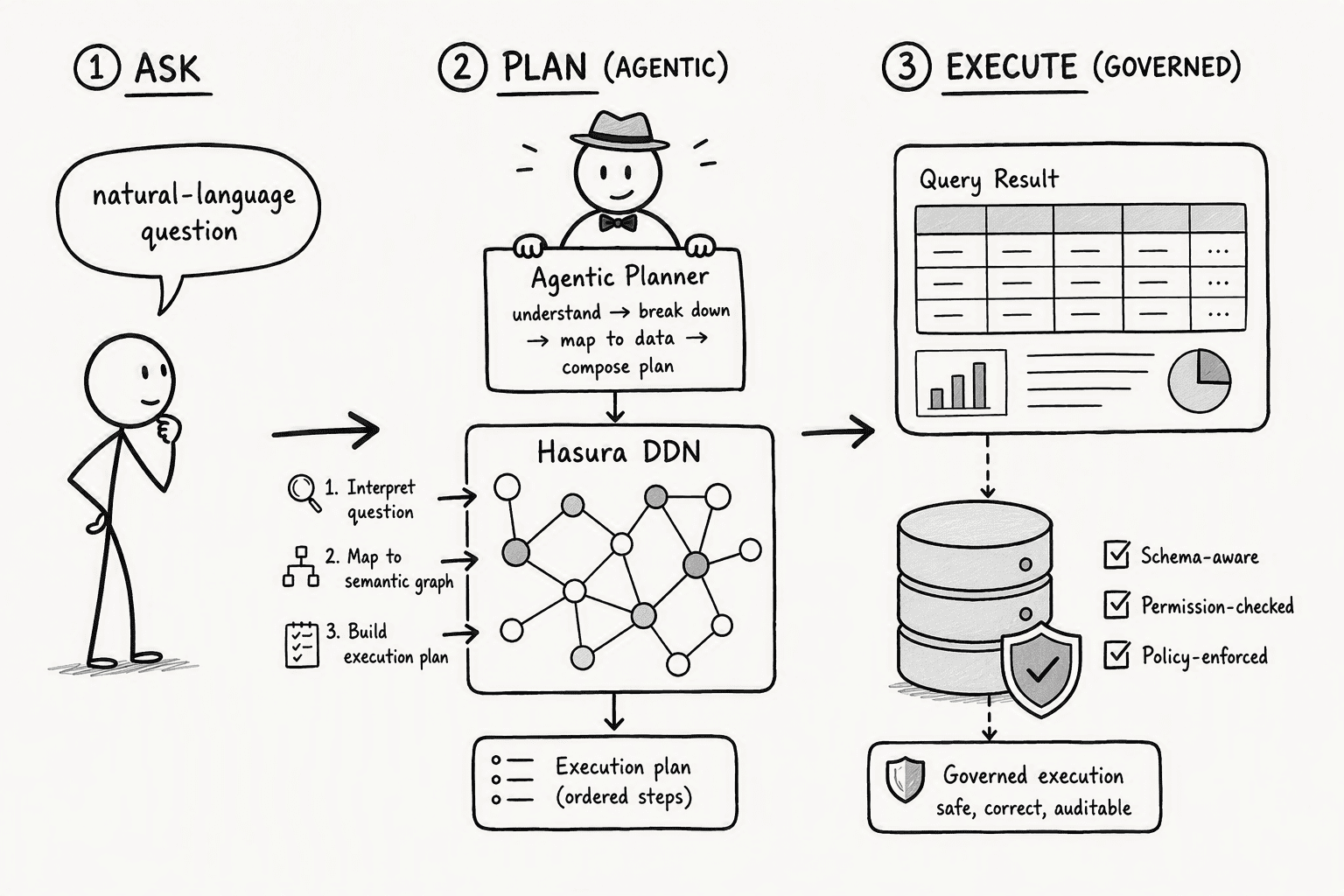
PromptQL was built around the same wall its users run into: perfect data doesn't exist, but deterministic, governed execution can. Its approach, the Agentic Semantic Layer, is a concrete implementation of a context layer where a plan-based AI query planner orchestrates data federation through Hasura's Data Delivery Network as the semantic graph backbone.
How it works:
- A user asks a plain-English question.
- Instead of blindly issuing SQL, the planner compiles the query into an auditable plan that maps business concepts to source-system metadata.
- Row-level security is enforced, provisioned off the user's role.
- Code executes in a secure cloud sandbox, with no raw database credentials ever exposed to the LLM.
- The output becomes a thread of referenceable artifacts across multiple reasoning steps, and the system flags ambiguity explicitly, asking for clarification before guessing.
Governance and deployment:
- PromptQL's control plane respects existing governance, acting with each user's permissions, deterministically enforced at the data layer
- It connects to a company's data infrastructure without moving data outside that environment
- Teams can deploy it in their own cloud, run it on dedicated infrastructure, and manage encryption with a customer-controlled key, eliminating months of preparation typically required before AI can deliver value
The Agentic Semantic Layer codifies an organization's internal language by building a governed, self-improving context layer that compounds in accuracy as a team works within it, the same underlying idea covered directly on PromptQL's healthcare solutions page: a living context layer built from every correction, clarification, and conversation.
Conclusion
A context layer replaces brittle prompt engineering with governed, plan-based data access. It tells an AI agent how to find the truth in a company's systems, prove it found the right answer, and respect the boundaries of who gets to see it. Enterprise AI strategy has to mature past the "add a vector database to a chatbot" phase. The next step is a full-stack AI data infrastructure with a permanent, auditable control plane, something to build on, not bolt on.
Frequently Asked Questions
What exactly is a context layer in AI and enterprise data systems?
A context layer is governed middleware that retrieves, structures, and enforces live metadata, permissions, and business logic at query time. It grounds AI agents in factual reality, capturing the “why” behind decisions that raw data pipelines discard.
How does a context layer differ from a traditional semantic layer or RAG pipeline?
A semantic layer defines static BI metrics for dashboards. A RAG pipeline retrieves chunks of unstructured text for prompts. A context layer unifies live structured entities and unstructured rationale while enforcing real-time permissions and providing auditable query plans across both.
What are the core components or tiers of an effective context layer for AI?
Effective tiers include: connectivity for real-time data ingestion, dynamic knowledge graphs for entity assembly, a policy engine for real-time permission enforcement, a plan-based orchestrator for agentic reasoning, and an audit tier for lineage and explainability.
How does PromptQL implement its Agentic Semantic Layer to deliver reliable AI outcomes on enterprise data?
PromptQL uses a plan-based query planner on top of a semantic graph to decompose natural language into explicit, auditable steps. It enforces row-level security deterministically at the data layer and executes code in a sandbox without exposing raw credentials.
What security, governance, and deployment models does a context layer require for enterprise adoption?
It requires deterministic RBAC and column-level security enforcement at query time. For deployment, regulated enterprises typically require a self-hosted, private cloud-native model using BYOC or single-tenant VPCs to ensure data never leaves the governed perimeter.
How is a context layer evaluated for accuracy and reliability in real-world use?
Accuracy is measured using a golden dataset of Q&A paired with source records. Systems evaluate plan accuracy, faith, and grounding precision using an LLM-as-a-judge pattern to verify the retrieved context and final answer match the authoritative source.
Sources
- Context layer | Atlan Documentation - docs.atlan.com
- Semantic Layer vs. Context Layer: Why Enterprise ... - contextual.ai
- Exploring the context layer for AI systems | TechTarget - www.techtarget.com
- Context Layer for AI Agents: Enterprise Guide 2026 | Atlan - atlan.com