A new hire asks how to handle a billing edge-case refund. The answer lives in three different Slack threads, a Google Doc last touched years ago, and one senior engineer's memory. That's technically a shared skills library, just the bad kind, where the only way to find anything is asking around until someone remembers.
That version breaks the moment someone leaves or a thread scrolls out of view. The research points the other way: a study evaluating 500 real-world skills across 19 agent-model configurations found that access to a defined skill significantly changes how a model behaves compared to having no skill at all. The problem was never a lack of good workflows. It's that most of what teams call a "skills library" is a pile of unsearchable documents, not something an agent, or a person, can reliably act on.
Key Takeaways
Every durable skills library shares a few properties that separate it from a document graveyard:
- Atomic skill definition comes first: A skill is not a document. It's a structured artifact with defined inputs, outputs, constraints, and an opinionated workflow. Without that skeleton, you have a wiki, not a library.
- Metadata is the navigation layer: Trigger phrases, domain tags, and required data sources transform a flat list of skills into a navigable graph an agentic semantic layer can query with precision.
- Row-level security is foundational, not add-on: If a skill can't scope data access to the invoking user's context, the library becomes a data breach vector. Slack's multi-tenant PostgreSQL with RLS on workspace_id provides the architectural blueprint.
- Version control keeps production from breaking: Git-like commits, tags, and promotion paths (draft to production) prevent the chaos of concurrent edits with no rollback. PromptQL's skill lifecycle management encodes this as a practical pattern.
- Governance without bureaucracy: A tiered access model of contributors, reviewers, and admins lets open contribution coexist with production reliability. The gate is a lightweight PR, not a committee vote.
What a shared skills library actually is
A shared skills library is a centralized repository of structured, reusable knowledge artifacts, workflows, prompts, task definitions, that standardize how work gets done, especially in AI-driven environments.
Step-by-step: how to create a shared skills library
Step 1: Define the Atomic Unit, What Exactly Is a Skill?
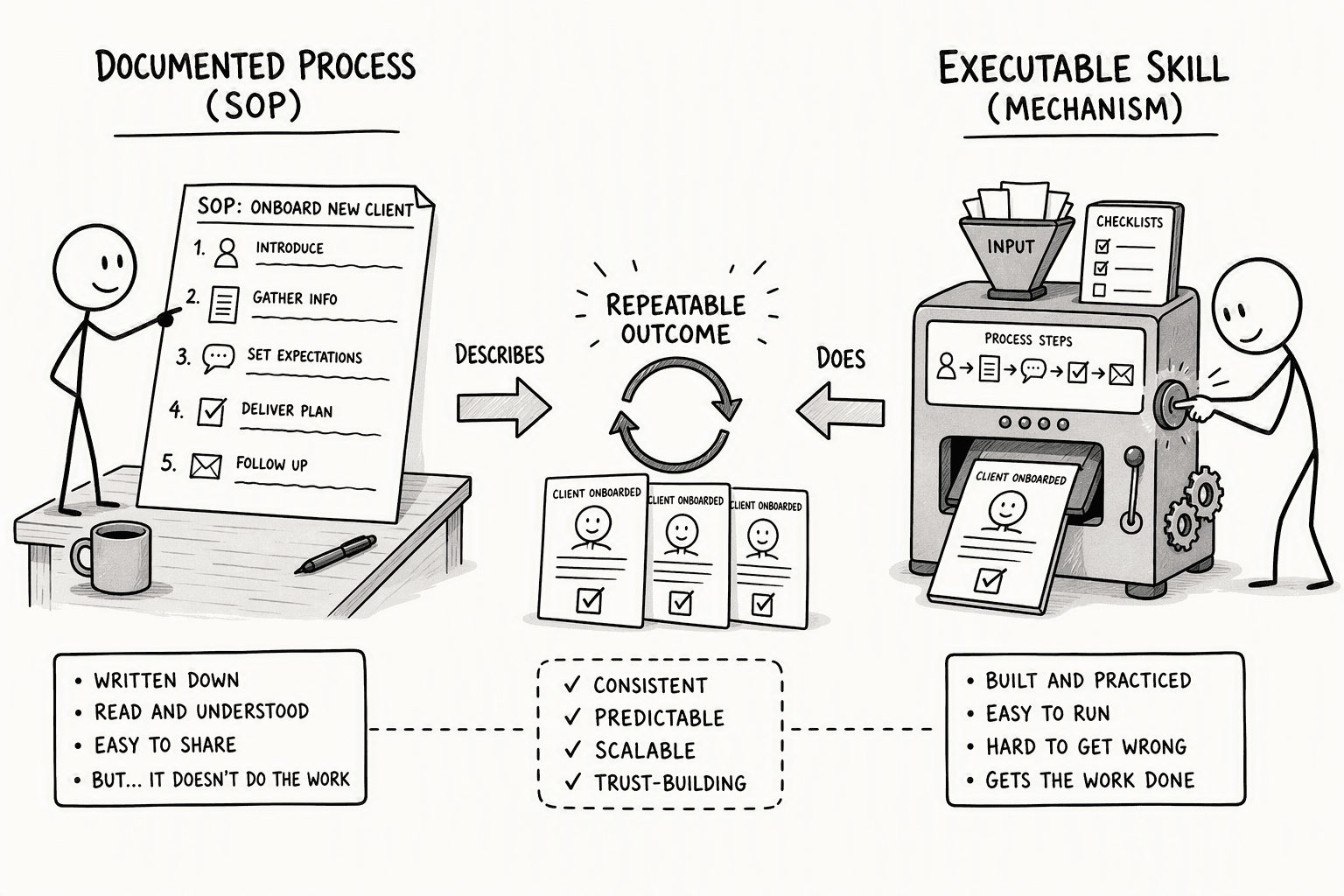
A skill is the smallest self-contained workflow that produces a reliable, repeatable outcome. A document describes something, a skill does something. The distinction matters because in the same 500-skill evaluation, models varied widely in how closely they adhered to the instructions encoded in a skill. If the artifact is ambiguous, the output drifts.
Here’s how the two worlds compare:
| Dimension | A Document (or SOP) | An Executable Skill Artifact |
|---|
| Core identity | Describes a process in prose | Encodes a workflow in a structured format (JSON, YAML) |
| Inputs | Implied by context; reader must infer | Explicitly declared; required fields, schemas |
| Outputs | Human-readable prose, no parseable contract | Defined output shape (e.g., a response action, a data object) |
| Constraints | Ad-hoc cautions buried in paragraphs | Machine-readable guardrails (rate limits, data-scoping rules) |
| Model behavior impact | Passive; the model interprets then improvises | Active; the model follows the opinionated workflow, reducing variance |
A skill artifact needs a few minimum components: declared inputs, an expected output schema, execution constraints, and the workflow itself. PromptQL stores these as structured definitions rather than free-text prompts, so the agent has an actual contract to execute against, not a paragraph to interpret.
Step 2: Choose an Isolation Architecture That Matches Your Security Posture
Isolation architecture needs to be decided before the first skill ever runs against connected data, not after several are already live, since the moment a skill leaks data across tenant boundaries, the whole system becomes a liability.
One well-tested pattern is a single, shared data layer with row-level security enforced by the database itself, keyed to a tenant or workspace identifier. Every query gets transparently filtered to only the rows belonging to the requesting tenant, with no application-layer loophole to work around. Slack's own multi-tenant architecture is one real-world example of this pattern at scale. For larger deployments, sharding the underlying database by that same tenant identifier keeps performance steady as the number of tenants grows.
The alternative is per-tenant sharding at the instance level, where each project or team gets its own isolated database. Which one fits depends on whether the threat model requires hard physical separation or accepts cryptographically enforced logical isolation. The row-level-security-plus-sharding pattern tends to fit most teams best, since it scales without the overhead of managing many small instances.
Step 3: Enforce Row-Level Security on Connected Data Sources, Without Exposing Credentials
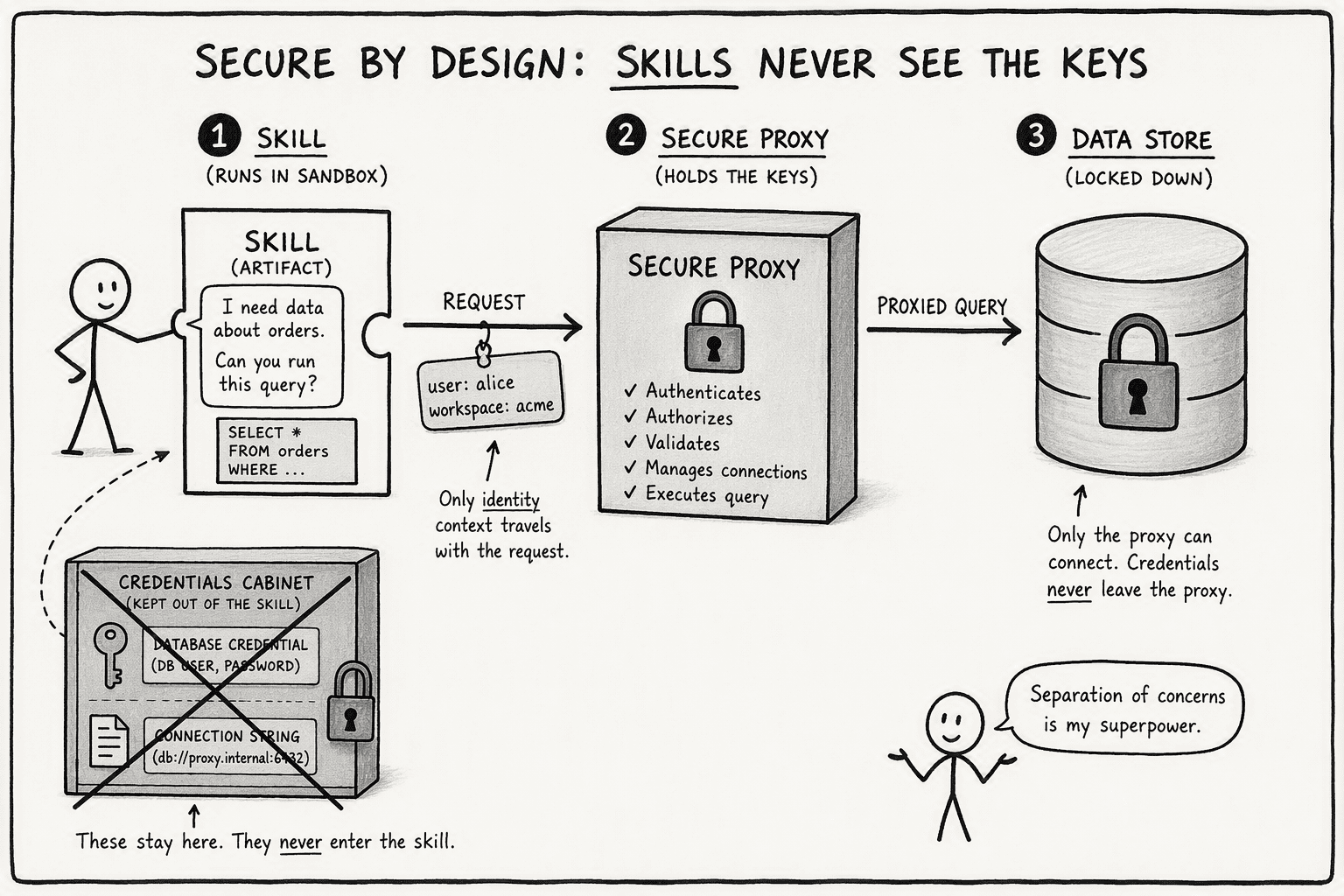
A skill that says 'query the orders table' is a loaded weapon unless every execution scopes to the invoking user. Hard-coding credentials into a skill artifact is the fastest way to turn that weapon on yourself. Here's how to enforce RLS safely:
- Never store raw database credentials in a skill definition: The skill's execution context should carry a workspace or user identifier, not a connection string. The credential lives in a secure proxy layer the skill calls, never inside the artifact.
- Implement RLS policies on every connected database table: Policies apply transparently at the query-plan level, checking the current tenant identifier against every row, with no application code that has to opt in or out.
- Index on the tenant identifier (workspace_id): Without an index, RLS filtering scans entire tables and performance degrades fast.
- Validate that the proxy layer cannot be bypassed: An agentic semantic layer routes skill execution through a proxy that attaches the user's trusted context. If any path lets a skill reach the database directly, the isolation architecture is broken. Test this explicitly by running a skill with a known-scoped user and confirming the result set matches only their authorized rows.
Step 4: Govern Contribution with a Tiered Access and Review Model
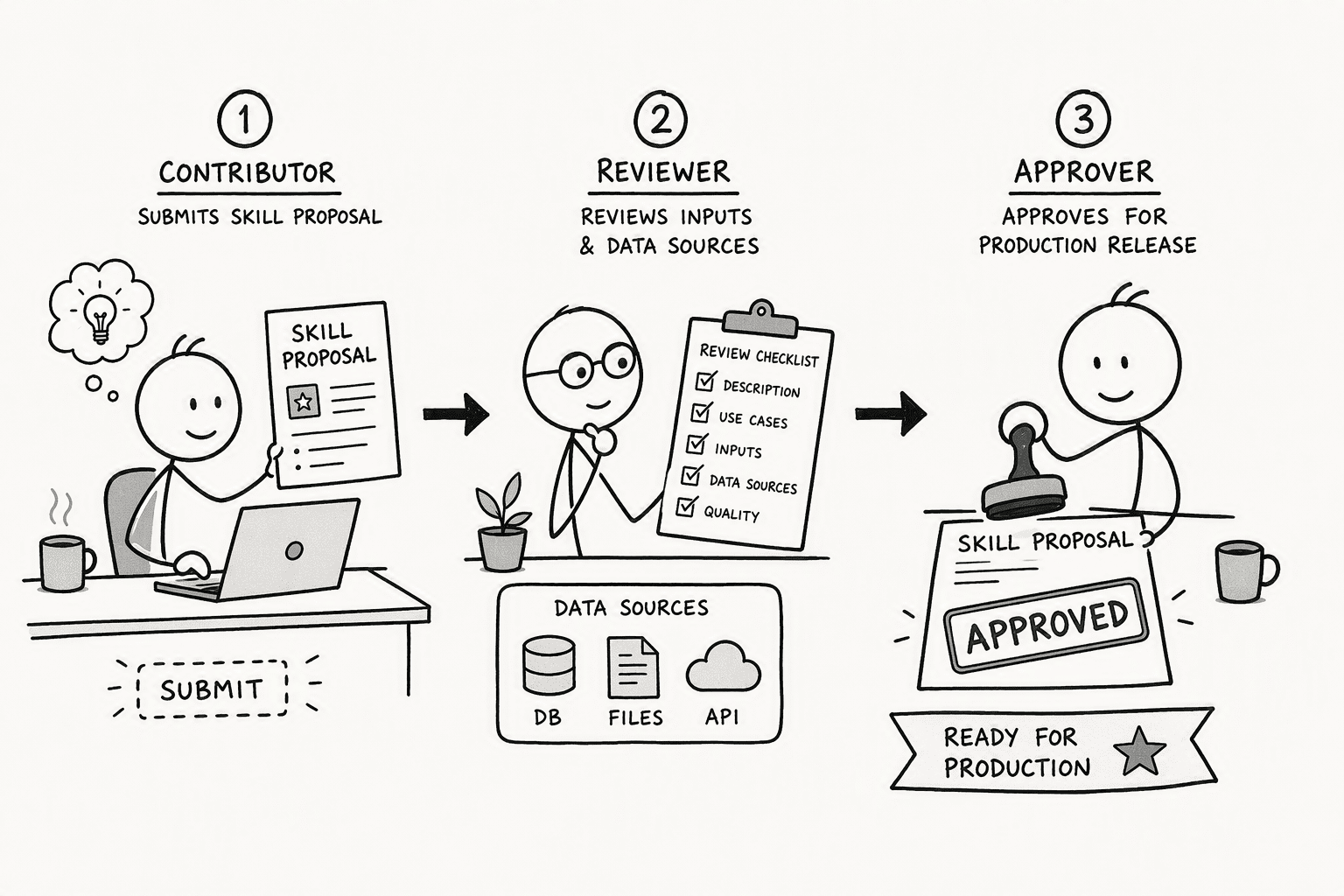
An open-contribution model lets team members propose skills from the front line, which is how a library actually stays current. The question is what happens before one of those proposals reaches production and starts running against real data, and that answer needs to exist before the first skill ships, not retrofitted after several are already live.
A simple three-role model covers this:
- Contributors: write skill definitions and submit them.
- Reviewers (usually domain leads or senior engineers): check the inputs, data sources, and output constraints against the stated intent before merging to production.
- Admins: own the taxonomy schema, role assignments, and the rules that govern promotion between roles.
A skill review is meant to be one short check, not a committee vote. The reviewer verifies the artifact is complete, scoped correctly, and mapped to the right tenant identifier, and that the isolation boundary from Steps 2 and 3 is still intact. That check should take minutes. The pattern borrows from open-source governance: contribution stays low-friction, and the production path is protected by a single checkpoint rather than a long approval chain.
Step 5: Embed Version Control and Lifecycle Management from Day One
A sales operations engineer updates the rebate-calculation skill to reflect a Q3 pricing change. The old version runs in production while the new version sits in draft, and suddenly customer-facing refunds follow the wrong logic. This happens when a skills library treats updates like wiki page edits: instant publish, no rollback.
Version control fixes that. Apply a Git mental model to every skill artifact:
- Each change is a commit, tracked as an atomic unit
- Each stable release gets a tag, marking production-ready versions
- Use an explicit promotion path, draft to review to production, so multiple people can propose changes concurrently without overwriting each other's work
Deprecation is the forgotten half of lifecycle management. Every skill needs a sunset rule: if it goes unused for a defined window (90 days, for example), flag it, and if the flag remains after a second window, archive it with a tombstone record. An archived skill still shows up in the taxonomy as deprecated, so nobody rebuilds it from scratch. Without deprecation, the library rots quietly and regains its old identity as a folder nobody trusts enough to search.
Step 6: Scope Narrowly to Your Most Impactful, Repeatable Task
I've watched teams spend two weeks building a perfect 47-category taxonomy that zero people can navigate. The faster path is to build one skill today that delivers value by tomorrow's standup. Here's the concrete sequence:
- Pick the task that triggers the most repeated questions: Scan the last two weeks of Slack or support tickets. Look for the pattern where someone asks 'how do I X?' and the answer is always the same sequence. That's your candidate.
- Write a planning prompt, not an encyclopedia: Before touching any tool, write 3 to 5 sentences describing (a) the trigger that fires the skill, (b) the exact data sources it needs, and (c) the output the user expects. A tool like PromptQL lets you feed this planning prompt directly to guide the skill definition.
- Build one skill in under an hour and put it in front of a real user: The benchmark is this: one working skill, in one hour, answering one previously painful question. If you exceed that window, you're scoping too broadly.
- Resist adding a second skill until the first logs five successful uses: Data, not ambition, decides when to expand. That discipline stops the library from ballooning into a catalog of hypothetical tasks nobody actually needs.
Step 7: Design a Structured, Metadata-Rich Taxonomy
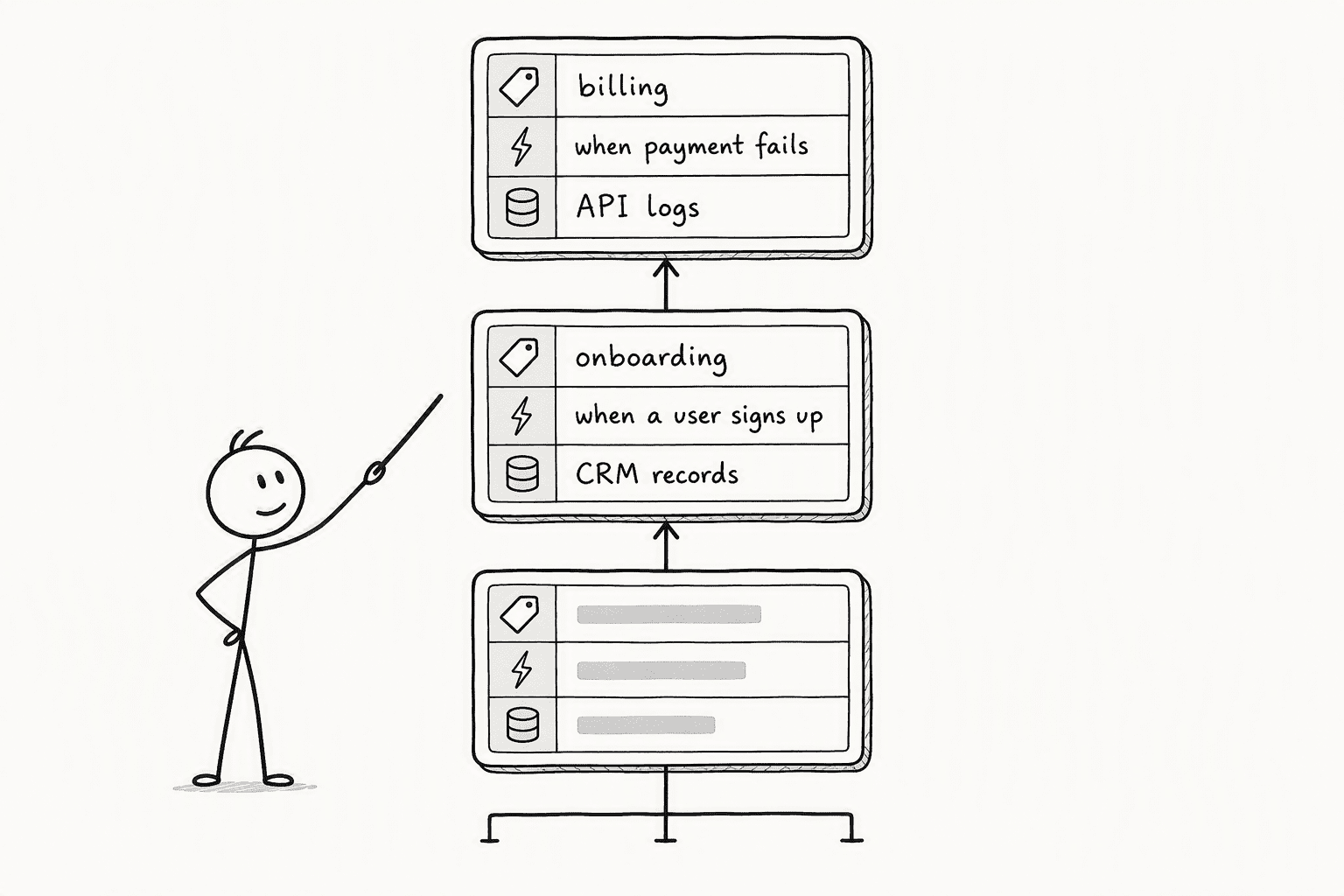
A flat list of skills becomes unusable fast. Without metadata, the only way to find anything is scrolling or guessing at a title someone made up months ago. A structured taxonomy fixes that, letting both people and AI agents locate the right skill for a given question.
A few high-signal fields anchor the metadata schema:
- Domain tags create top-level navigation, categories like billing, onboarding, or compliance
- Trigger phrases act as a semantic index, the exact words a user or agent would actually use
- Required data sources scope the skill's execution boundary, so an agent never fires a query against the wrong database
Wren AI's project-to-channel mapping shows this working in practice, a skill tagged with a channel and a project domain lets the system match a vague question to a precise, scoped skill instead of the nearest-sounding guess. Every skill entry should also carry a version, an owner, and a last-validated date, so the taxonomy tracks what exists, what it touches, and when it was last trusted, not just what it's called. A shared wiki that surfaces this metadata as skills get used, with change notifications and a revision history, keeps it current passively rather than requiring a dedicated curator.
Step 8: Implement an Agentic Semantic Layer for Discovery and Contextual Accuracy
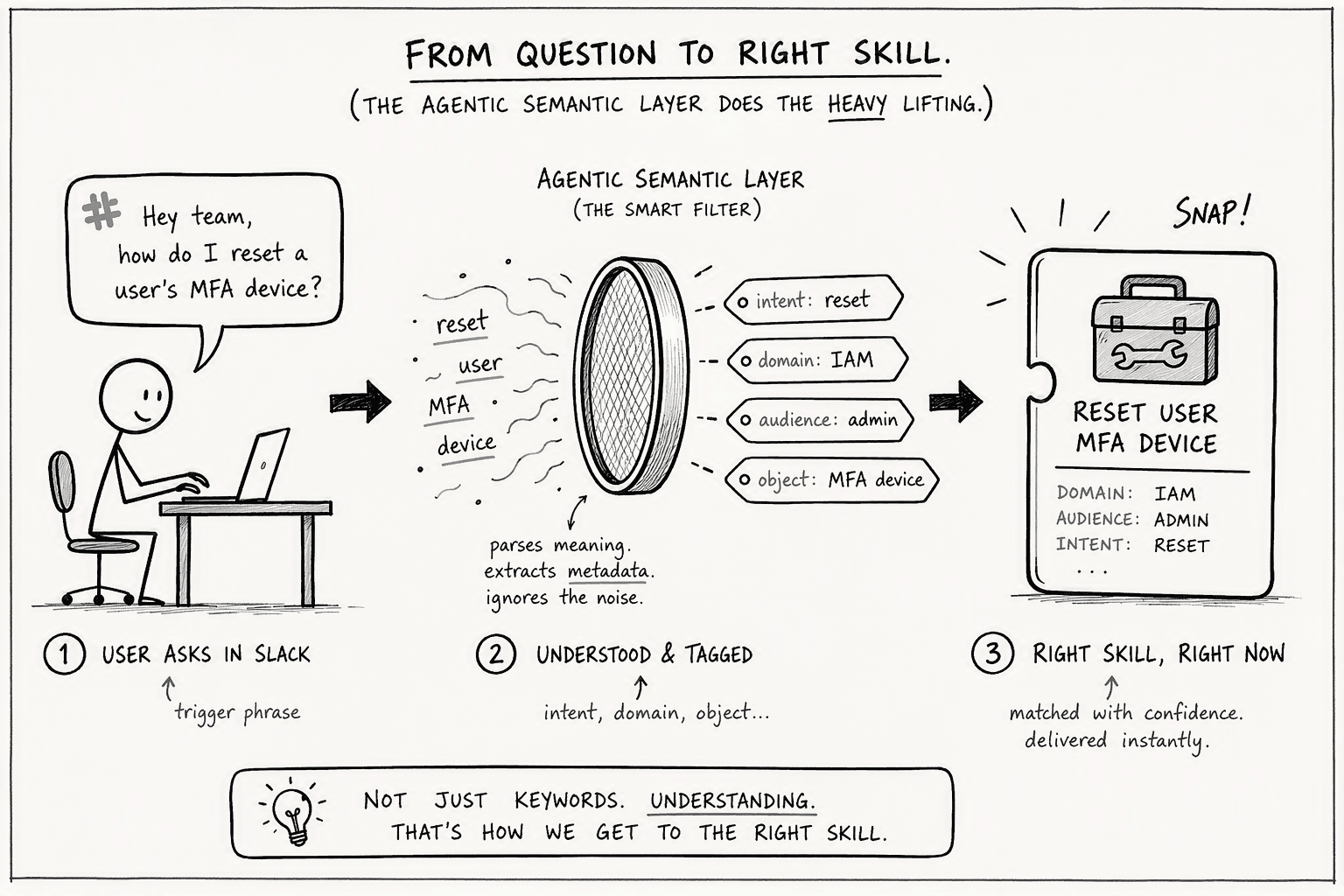
Someone types "how do I process the Q2 rebate adjustment" into a chat tool. That sentence doesn't match any skill title in the library word for word. Without a layer that understands intent, the library is just a list of answers nobody can actually find.
An agentic semantic layer uses the taxonomy metadata, trigger phrases, domain, required data sources, as its matching index. When a question arrives, the system parses intent, narrows to the right domain, and selects the skill whose trigger phrase and input schema align most closely, rather than requiring an exact keyword match. Researchers call this contextual accuracy: matching a real workflow to a query instead of generating a plausible-sounding guess.
The easier way to do it
Building all eight of these pieces, atomic skill definitions, isolation architecture, row-level security, governance, versioning, scoped rollout, taxonomy, and semantic discovery, is a real system to build and maintain, not a one-time setup.
PromptQL is built around this problem directly rather than requiring a team to assemble each layer separately. A reusable skill is one of the actual things a correction becomes automatically as a team works, alongside team knowledge and semantic-model changes, captured into a shared wiki with change notifications, a revision history, and a full audit trail. Instead of a separate library-building project, the skill library grows as a byproduct of the work already happening, with the planning prompt guiding what gets defined and the underlying access model scoping what each skill is allowed to touch.
This is the same underlying approach covered in more depth in how to build a team wiki and how to build a searchable knowledge base, since a skills library, a wiki, and a knowledge base all depend on the same core discipline: structure, ownership, and discoverability built in from the start rather than bolted on after the fact.
Conclusion
A shared skills library is a living system, not a document dump. Atomic skill definitions, isolation architecture, enforced row-level security, tiered governance, version control, and a semantic discovery layer each depend on the one before it. Skip any single piece and the whole thing degrades under real use. The starting point is small: one clearly scoped skill, built in about an hour, answering one real question a team is already asking.
Frequently Asked Questions
What exactly is a shared skills library and why is it important for modern teams?
A shared skills library is a centralized repository of structured, reusable workflow artifacts (prompts, task definitions, execution steps) that standardize how AI agents and humans perform repeatable tasks. It matters because documented prose doesn't constrain model behavior, executable skill artifacts do, and research on 500 skills confirms they significantly change agent outputs compared to a no-skill baseline.
What are the different ways to structure and organize a skills library so it remains useful and up-to-date?
The core structure layers metadata, domain, trigger phrases, required data sources, version, and owner, onto each atomic skill. This creates a navigable graph instead of a flat list. A shared wiki (like what PromptQL Tag builds) coupled with versioned promotion paths and automated deprecation rules keeps the library current without constant manual curation.
How can an AI agent or semantic layer improve the accuracy and adoption of a shared skills library?
An agentic semantic layer matches a user’s vague question to the correct skill using taxonomy metadata and intent parsing, then routes execution to the properly scoped data source. This eliminates the guesswork of keyword search and, as the arXiv evaluation framework shows, boosts contextual accuracy by constraining the model to the skill’s opinionated workflow rather than letting it improvise.
What data sources should a skills library connect to, and how do you ensure data access is both secure and thorough?
Connect to operational databases (PostgreSQL, Snowflake), SaaS tools (Slack, Google Docs, Salesforce CRM), and analytics platforms your workflows already depend on. Secure access by applying Row-Level Security indexed on a tenant identifier at the database layer and routing all skill execution through a proxy that attaches the invoking user’s trusted context, credentials stay out of the skill artifact entirely.
How do you balance open team contribution with production safety in a skills library?
Implement a tiered access model where contributors propose skills via pull requests, reviewers rapidly validate scope, data constraints, and RLS boundaries, and admins govern the schema and promotion rules. The version control system enforces the gate so no skill lands in production unreviewed, but the check stays lightweight, minutes, not days.
Sources
- PromptQL | Multiplayer AI with shared context. - promptql.io
- PromptQL | Multiplayer Claude cowork, on any LLM. - promptql.io
- [2606.17819] A Framework for Evaluating Agentic Skills at Scale - arxiv.org
- Deep Dive: Slack’s Multi-Tenancy Architecture - DEV Community - dev.to
- Slack Integration | Wren AI - docs.getwren.ai