A vector search can return fifteen perfectly matched paragraphs that flatly contradict each other, and a model will still generate a crisp, confident synthesis that's completely wrong. Baseline RAG fails to connect the dots because it treats each chunk as an independent island. GraphRAG is a way around that: instead of dumping a bucket of text snippets into a prompt, it extracts a knowledge graph, clusters it into communities, and pre-computes summaries that capture the macro-themes of a corpus.
Baseline RAG performs poorly when a question requires holistically understanding summarized semantic concepts over large data collections. A vector store can't answer "what themes connect all the incident reports from Q3" with anything coherent, but GraphRAG can, because the community summaries already hold the answer. For the fuller comparison between the two approaches, including when GraphRAG is overkill, see GraphRAG vs standard RAG. This guide focuses specifically on implementation: the actual steps, tools, and libraries involved in building one.
Key Takeaways
Implementing GraphRAG is a data-engineering challenge first and an AI problem second. Here is what I learned running this end-to-end on a corpus of proprietary disclosure documents:
- It is a 7-step offline marathon: Extract, cluster, summarize, and index before you ever run a query. The run can consume a lot of LLM resources, so start small with fast models.
- Hybrid beats pure GraphRAG: Han et al. (2026) found that pure GraphRAG did not consistently beat dense retrieval. A hybrid design fusing community summaries with vector chunks systematically improves relevance and correctness.
- Hierarchical summaries are the secret sauce: The Leiden algorithm splits your graph into nested communities. Pre-computing summaries at multiple scales lets you answer global thematic questions without blowing up your context window.
- Private deployment is non-negotiable: You cannot ship proprietary data to a third-party API for indexing. The whole pipeline must run in your own cloud or on-prem environment.
- Plan your prompts: Moving from raw entity extraction to reliable structured output requires explicit planning steps to eliminate extraction errors.
How to implement GraphRAG
Step 1: Analyze Your Data and Use Case to Justify GraphRAG Over Naive RAG
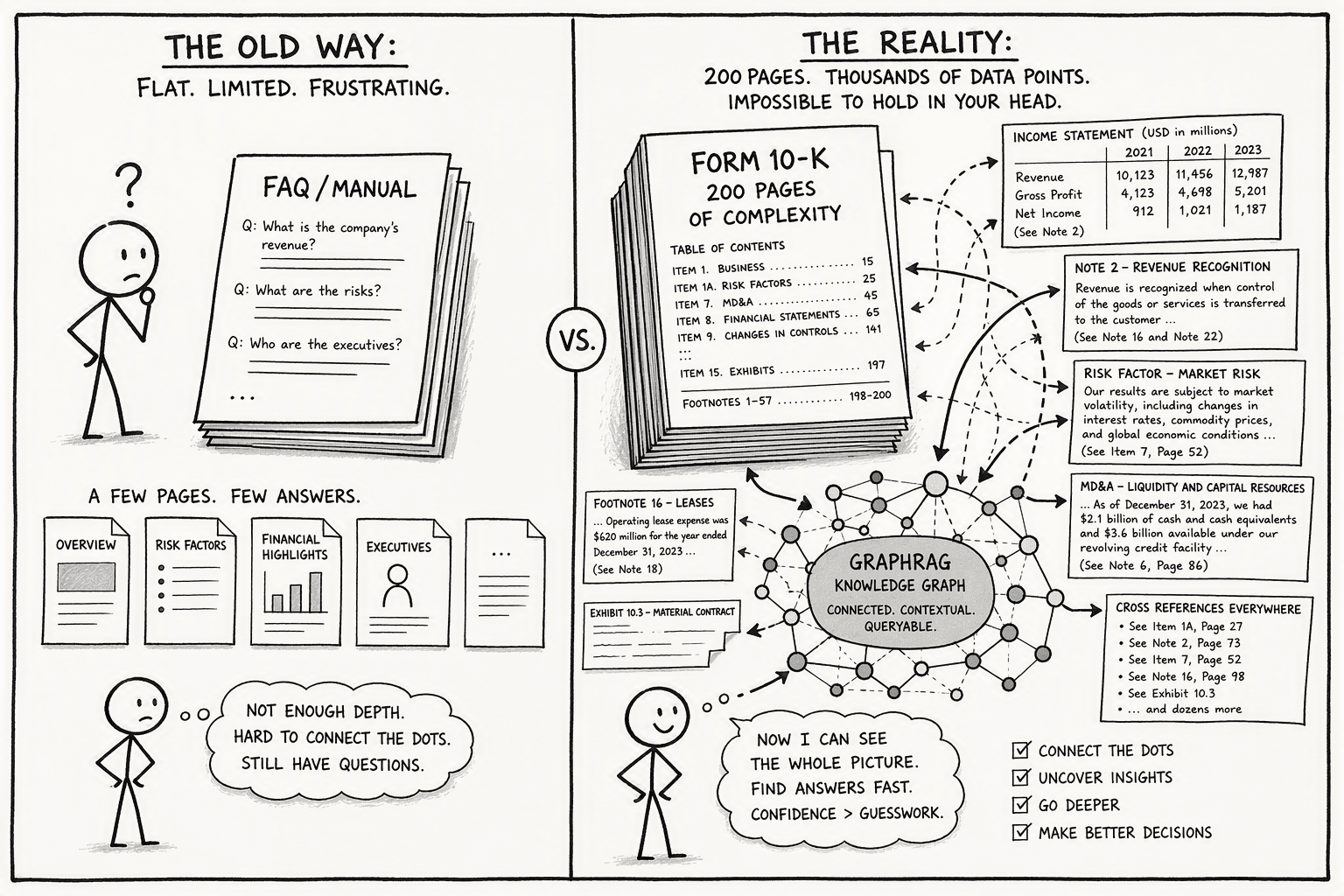
A standard FAQ bot doesn't need a graph, and neither does a simple fact-finding query over a clean manual. A graph earns its cost when the corpus is a dense artifact, not a flat list of pages, standard RAG works fine until it's run on something like a 200-page filing where tables, footnotes, and cross-references carry half the meaning.
Research on long financial documents shows generic RAG fails on a large share of expert-style questions because standard chunking turns tables into word soup. A cell that says "$14.2M" loses its column header, its row label, and the footnote that qualified it, the vector retrieves the number but strips its context. GraphRAG fixes this by recovering the relationships chunking destroys: a figure belongs to a table, a table belongs to a section, a section references a regulation. Those links survive the index.
| Dimension | Naive RAG (Vector Only) | GraphRAG (Hybrid) |
|---|
| Ideal Use Case | Simple factoid lookup; Q&A over flat prose manuals. | Multi-hop reasoning over structured artifacts; cross-document synthesis (e.g., QASPER and ObliQA benchmarks). |
| Document Structure | Works best on unstructured text; fails on tables and forms. | Thrives on structured heterogeneity; maps layout-level relationships and tabular data. |
| Cross-Document Linking | Relies on keyword overlap in isolated chunks; misses shared attributes. | Extracts entities and explicit relationships (e.g., CONTAINS, REFERENCES) to connect disparate sources. |
| Global Thematic Query | Struggles; cannot summarize an entire corpus without loading all relevant chunks. | Answers high-level, thematic questions via pre-computed community summaries. |
| Latency Profile | Low at query time (fast ANN search). | Higher offline indexing cost; lower latency at query time with hybrid KG-RAG vs. full graph traversal. |
Before writing any indexing code, audit the dataset against this: does it actually have the structural density that justifies the cost, or would a simpler vector setup answer the real questions being asked.
Step 2: Deploy a Private, On-Premises Architecture to Keep Proprietary Data Off Shared Infrastructure
This decision needs to happen before any extraction runs, not after. Every step that follows involves sending real content through an LLM for extraction, summarization, and retrieval, and none of that should touch a shared external API if the underlying data is proprietary or regulated.
Enterprises dealing with sensitive material need an air-gapped indexing loop. The entire pipeline, extraction, summarization, the vector store, the graph database, needs to run inside a trusted VPC or on-prem stack, with a private inference engine paired to whatever open-source toolkit is being used. Most setups don't allow mixing certain inference backends with OpenAI-compatible APIs without breaking the configuration, so both the chat provider and the embedding provider need to live in the same trusted environment. Raw database credentials should never touch anything outside that boundary.
Persistent state matters here too. A graph-aware checkpoint saver can persist graph state at every stage, giving branching, time-travel-style recovery. If a community detection run produces a bad summary tree, that state can be rewound to the raw extraction step instantly, rather than re-indexing an entire corpus from scratch.
Step 3: Architect the Indexing Pipeline to Build a Knowledge Graph from Raw Text
Most GraphRAG toolkits, including Microsoft's, currently support plain text and Markdown formats, not raw PDFs directly. For anything with complex tables, a conversion step, tools like IBM's Docling handle this well, turns PDFs into clean Markdown without collapsing tables into a jumbled mess of disconnected tokens.
The core of the indexer works on what Microsoft calls TextUnits: prepped documents get sliced into analyzable chunks, and an LLM sweeps through them to perform entity, relationship, and claim extraction. This is where many pilots run into trouble, extraction can consume a large volume of tokens fast. Processing files sequentially, with each new file adding to the existing graph rather than overwriting it, keeps this manageable.
The extracted graph needs somewhere to live. A graph database like Neo4j, queried through Cypher, supports the kind of high-performance traversal a production system needs, representing nodes and edges directly rather than forcing the structure into a relational schema.
Step 4: Use Hierarchical Community Detection to Create Reusable, Multi-Scale Summaries
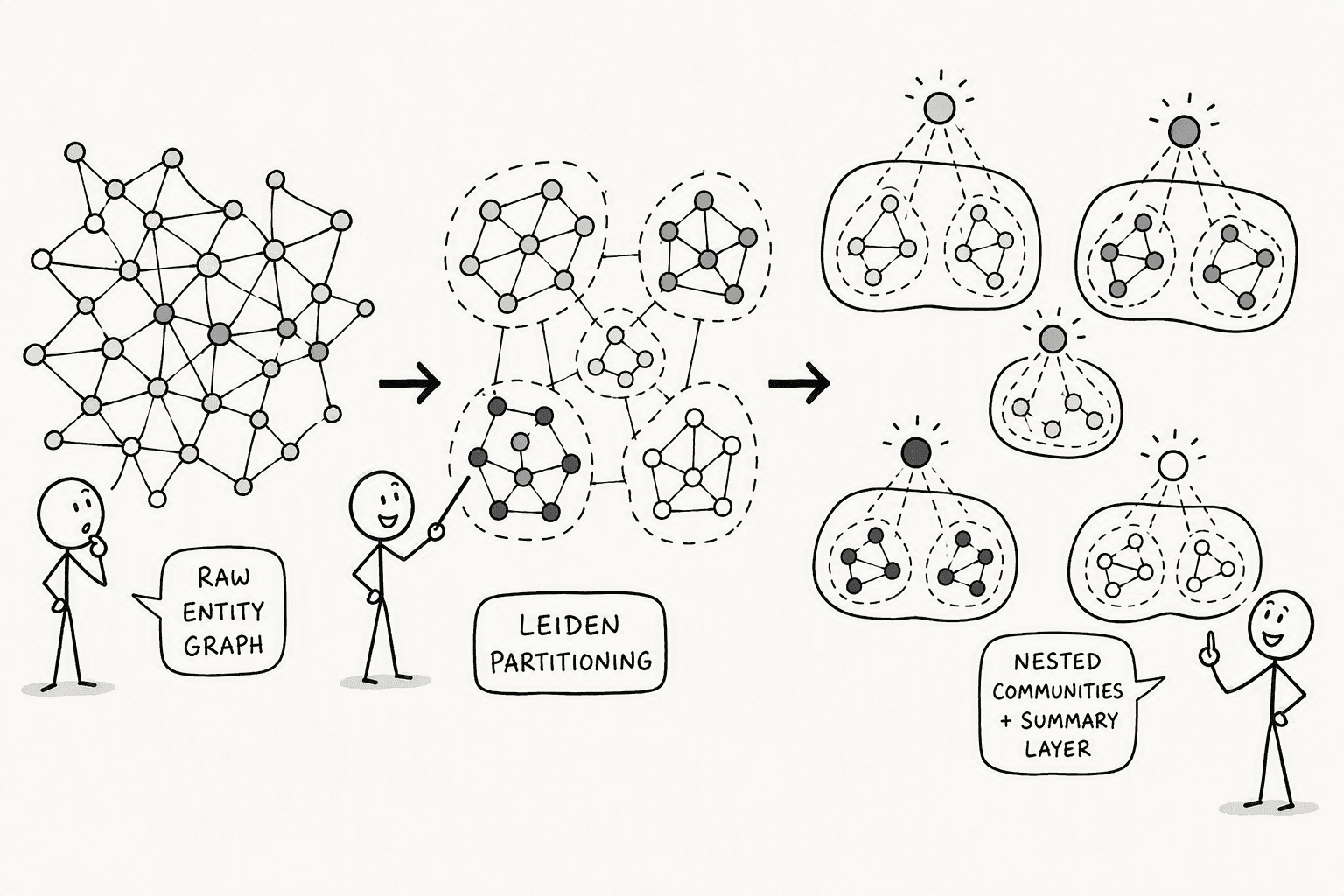
The extraction phase produces a mass of disconnected nodes. Without structure, you have raw ingredients but no recipe. Microsoft's approach applies hierarchical clustering of the graph using the Leiden technique to partition this mass into nested communities. This pre-computes the intelligence the system will draw on later.
- Execute the Leiden algorithm: Run the hierarchical partitioning on your raw entity graph to build a tree of tight-knit information clusters.
- Generate multi-scale summaries: For each community, at each level of the hierarchy, synthesize raw data points into plain-text descriptive narratives that capture the macro-level concepts.
- Store Reusable Reports: The output is a folder of parquet files. These summaries sit dormant, encoding the high-level meaning of thousands of pages without forcing the model to re-read every chunk at query time.
- Map global semantics: This step builds the ability to answer semantic questions. Instead of asking "find me paragraph X," you can ask "what is the strategic risk over the last decade" and the system already has the answer sitting in a community report.
Step 5: Implement Hybrid Retrieval to Combine Graph Summaries with Vector-Similarity Search
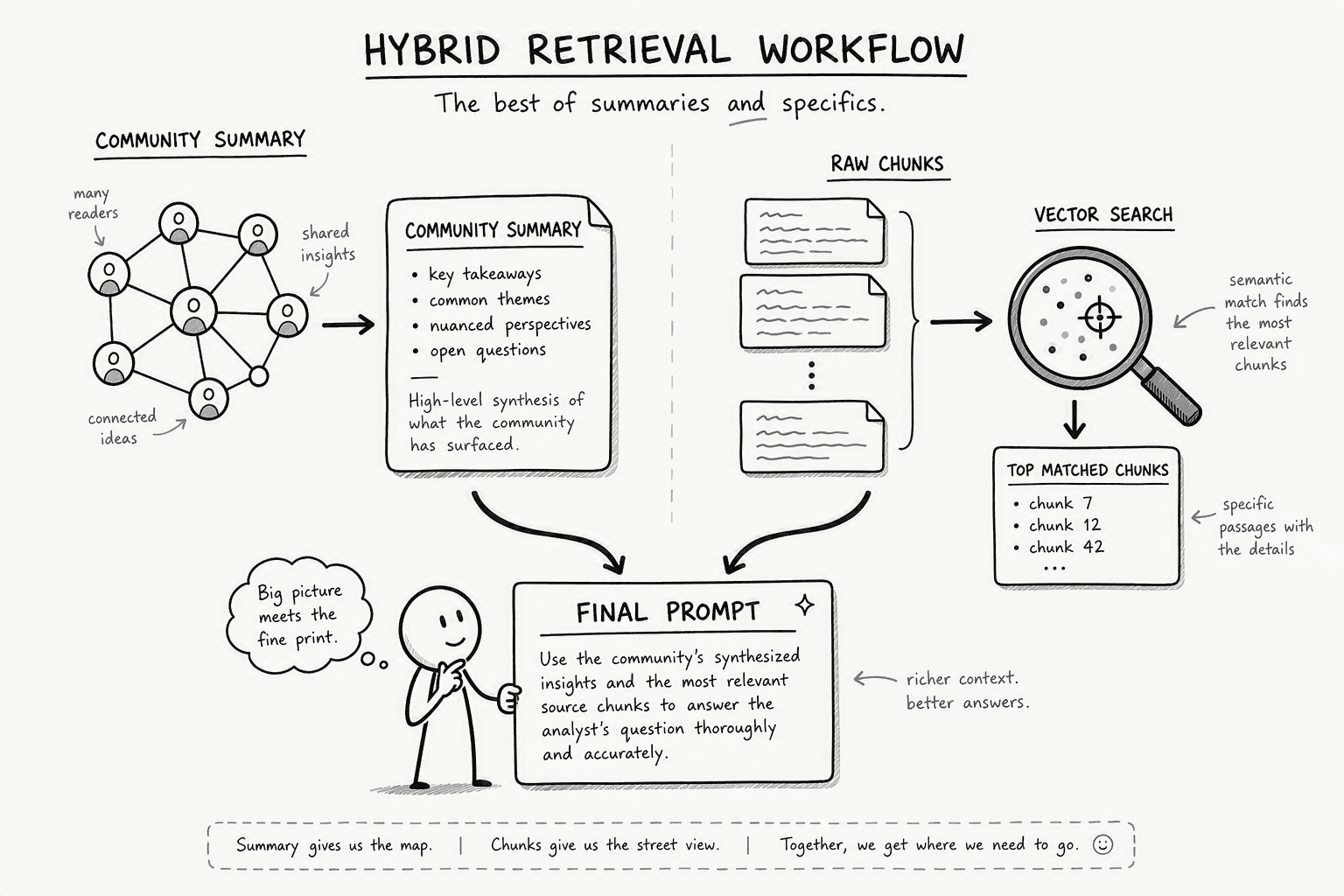
Pure graph traversal sounds elegant, but the benchmarks are brutal: it simply does not beat dense retrieval on its own. The real performance boost comes from fusion. A hybrid KG-RAG design retrieves both semantic community summaries and raw TextUnits matched via vector similarity, then combines them in the final prompt. This directly eliminates a major GraphRAG blind spot where a community summary might generalize a concept that a specific vector chunk contradicts with newer context.
A query engine can map a question to relevant communities through a global search fan-out, while a parallel vector-similarity search pulls the top matching text chunks directly. A systematic evaluation comparing RAG and GraphRAG found that hybrid strategies, whether routing a query to the better-suited approach or integrating evidence from both, yield consistent improvements over either method used alone. This mirrors production architectures where a multi-stage workflow ranks evidence and synthesizes an answer while keeping latency well below what full graph-based inference alone would cost.
Step 6: Apply Lightweight Planning Prompts to Reduce Pilot Failure Rates and Accelerate Deployment
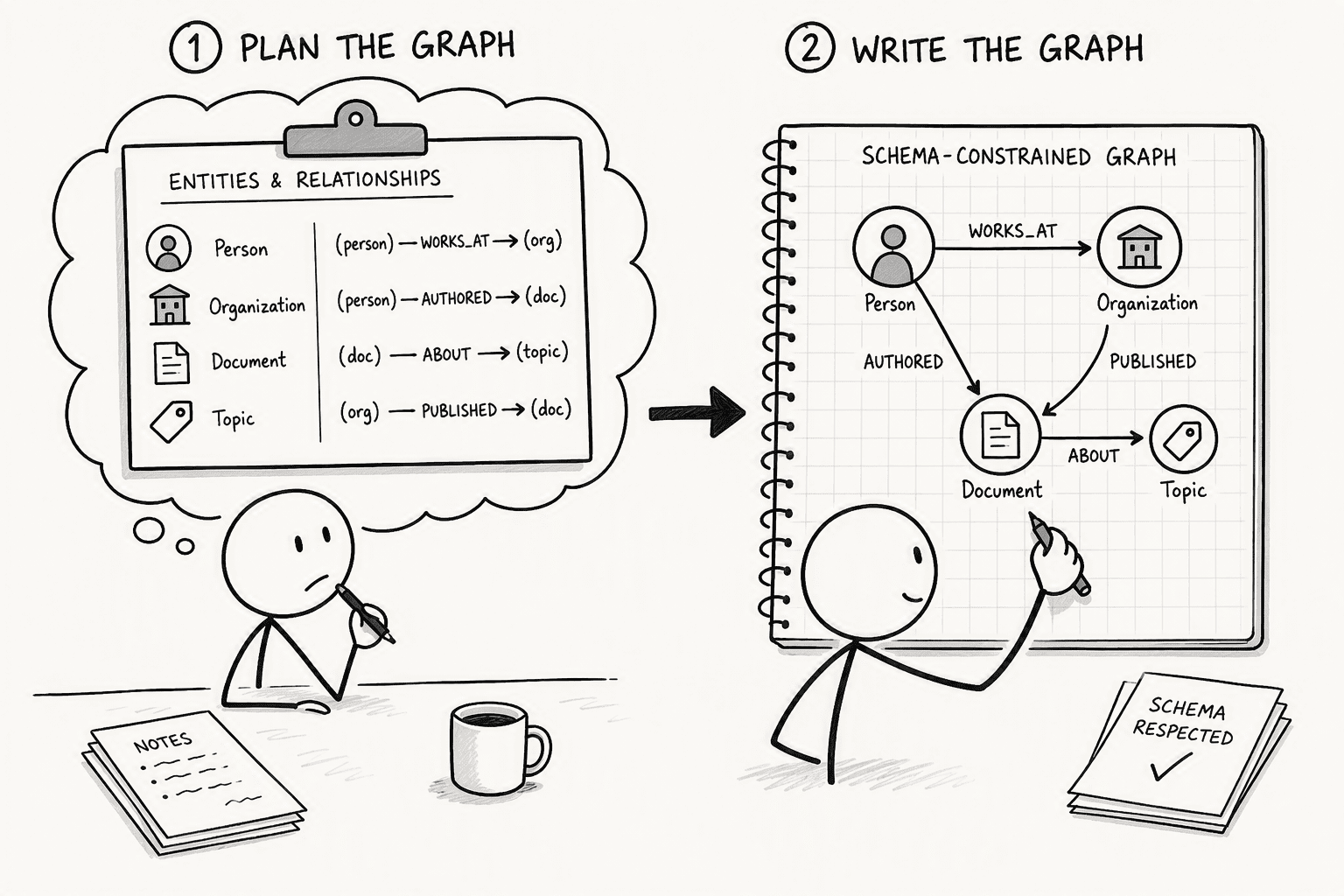
Every indexing step above depends on the LLM generating a stable, consistent schema. Run it without guardrails and it will silently hallucinate edge types or merge distinct entities, which corrupts the graph in ways that are hard to catch later. Wrapping the extraction call in a planning prompt, where the model has to outline the entities it intends to extract before writing a single node, catches this upfront instead.
Treating the model as a reasoning engine rather than a writer for schema mapping means asking it to read a sample chunk, list the factual entities, specify any direct cross-references, and explain why one chunk references another before generation starts. Making that reasoning chain explicit tends to drop the rejection rate for malformed output close to zero. The planning prompt should define the exact schema, node types, edge types, before generation begins, rather than hoping the model structures data correctly and checking afterward.
Step 7: Evaluate Performance with Domain-Specific Benchmarks and Production Metrics
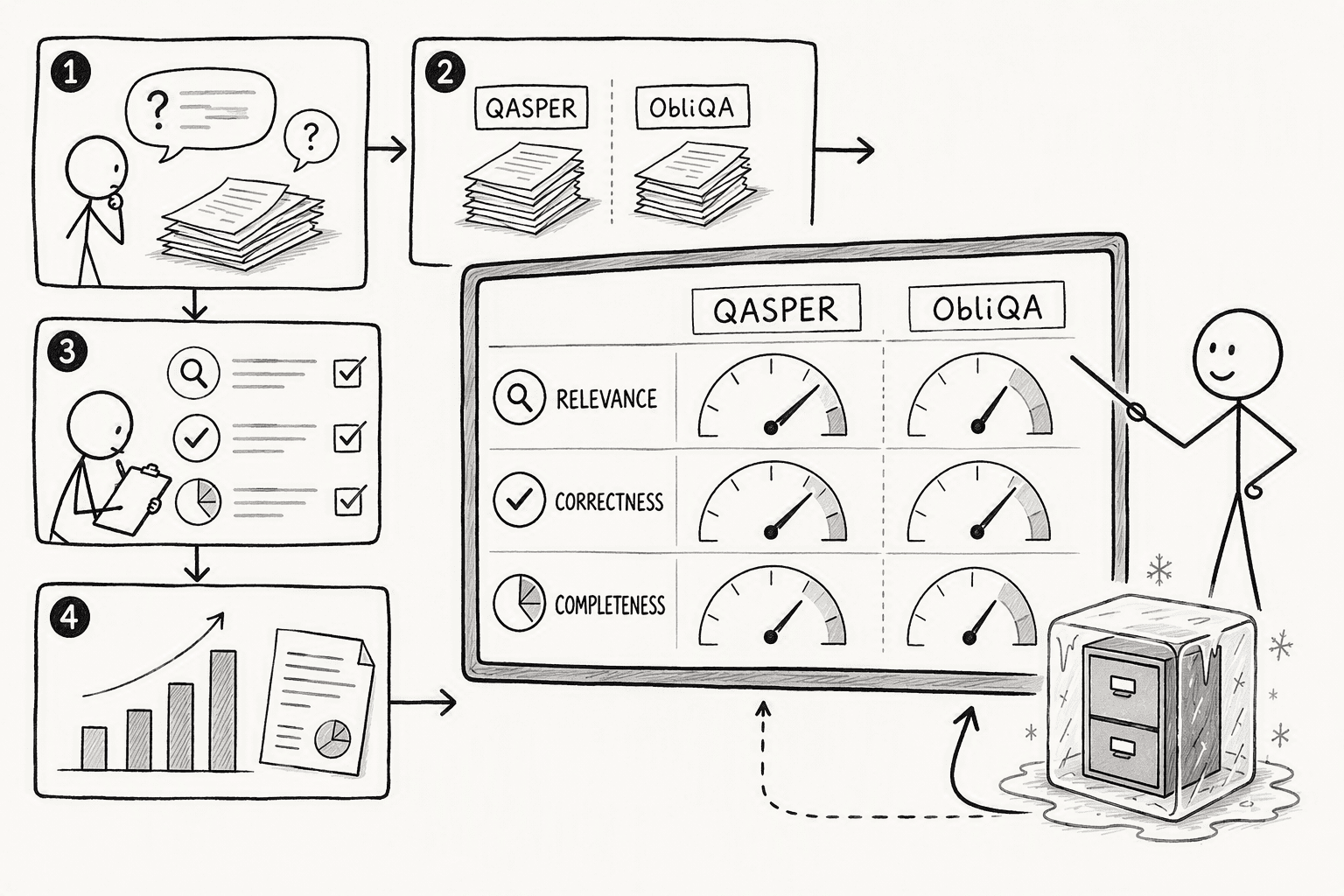
A generic relevance score doesn't reliably confirm whether a GraphRAG system is actually working. Domain-specific benchmarks like QASPER and ObliQA are a sharper test, since they measure multi-hop reasoning and structured content understanding rather than surface-level similarity. Evaluating against a frozen, reproducible corpus keeps results comparable over time.
The real test is whether a global search's answer actually traces back to connected evidence, not whether it sounds plausible. A vector-only setup can hallucinate a false connection between two unrelated facts; a hybrid GraphRAG setup can instead walk the graph edge to the specific record that supports the answer. That gap between retrieval precision and answer fidelity is exactly what keyword-based metrics tend to miss, so evaluation should trace the graph walk behind an answer, not just the answer itself.
Where a managed layer fits in
The seven steps above add up to a real engineering project each with its own tooling and failure modes. Before building all of it in-house, it's worth weighing that cost against a tool built to provide governed, GraphRAG-style retrieval without assembling the pipeline yourself.
GraphRAG vs standard RAG covers this tradeoff in more depth, including how a managed semantic layer like PromptQL handles governance and deployment for teams that would rather adopt this capability than build it step by step.
Conclusion
GraphRAG isn't a drop-in upgrade to vector search, it's a serious data-engineering commitment that converts unstructured documents into a structured, analyzable web of meaning before a single query ever runs. The value sits in the pre-computed community summaries that bridge gaps flat retrieval can't close. Get the sequence right, security decided early, extraction constrained by a planning prompt, retrieval fused rather than graph-only, and evaluation tied to whether the reasoning actually holds up, and the result is precise, multi-hop reasoning on real, structured data.
Frequently Asked Questions
What is GraphRAG and how does it differ from naive RAG?
GraphRAG is a structured approach that extracts a knowledge graph from text, clusters it into communities, and pre-computes summaries. Unlike naive RAG which merely retrieves isolated text snippets via vector search, GraphRAG uses a hierarchical structure of entity relationships to synthesize holistic, multi-hop answers.
What are the key benefits and limitations of GraphRAG compared to standard RAG approaches?
GraphRAG excels at global thematic questions and multi-hop reasoning over structured artifacts like financial forms, where naive RAG fails. Its primary limitation is the intensive LLM resource consumption during the offline indexing phase, making it overkill for simple factoid lookup tasks.
What are the main architectural components required to implement a GraphRAG system?
A production system requires an indexer to slice documents into TextUnits and extract entities; a community detection engine using the Leiden algorithm to create nested clusters; a summarization module; and a hybrid query engine that fuses graph community summaries with sparse vector-similarity text retrieval.
What tools are needed to implement GraphRAG?
At minimum: a document conversion tool for complex formats like PDFs, an indexing framework to extract entities and relationships (Microsoft's open-source GraphRAG toolkit is a common starting point), a graph database to store the result, and a way to run hybrid retrieval that combines graph summaries with vector search.
Can GraphRAG be implemented without a dedicated graph database?
Technically parts of the pipeline can run without one, but a dedicated graph database makes storing and traversing the extracted entities and relationships far more practical at production scale than trying to represent that structure in a relational or document store.
Sources
- graphrag/docs/index.md at main · microsoft/graphrag · GitHub - github.com
- Getting Started - GraphRAG - microsoft.github.io
- Neo4j integrations - Docs by LangChain - docs.langchain.com
- How we built an agentic GraphRAG for financial disclosures with Docling | Red Hat Developer - developers.redhat.com
- GraphRAG Notebook Tutorial | Arango Documentation - docs.arango.ai