04 Sep, 2026
•
8 MIN READ
What Is a Knowledge Graph in AI? A Practical Guide
Key Takeaways
- Definition: a knowledge graph is a network of explicit, real-world entities connected by defined relationships, a queryable map of facts rather than a blob of probabilities
- Hallucination defense: grounding LLM queries with a knowledge graph achieved 87.74% agreement with human judgment at the fact level in a recent benchmark, effectively blocking a model from inventing plausible falsehoods
- Hybrid architecture: the enterprise sweet spot pairs an LLM's ability to parse messy language with a knowledge graph's ability to enforce strict semantics, a pattern often called Graph RAG
- Maintenance reality: schema evolution is a real, ongoing cost, changing what an entity actually means has far-reaching consequences for data already stored and for any software built on the old definition
What is a knowledge graph?
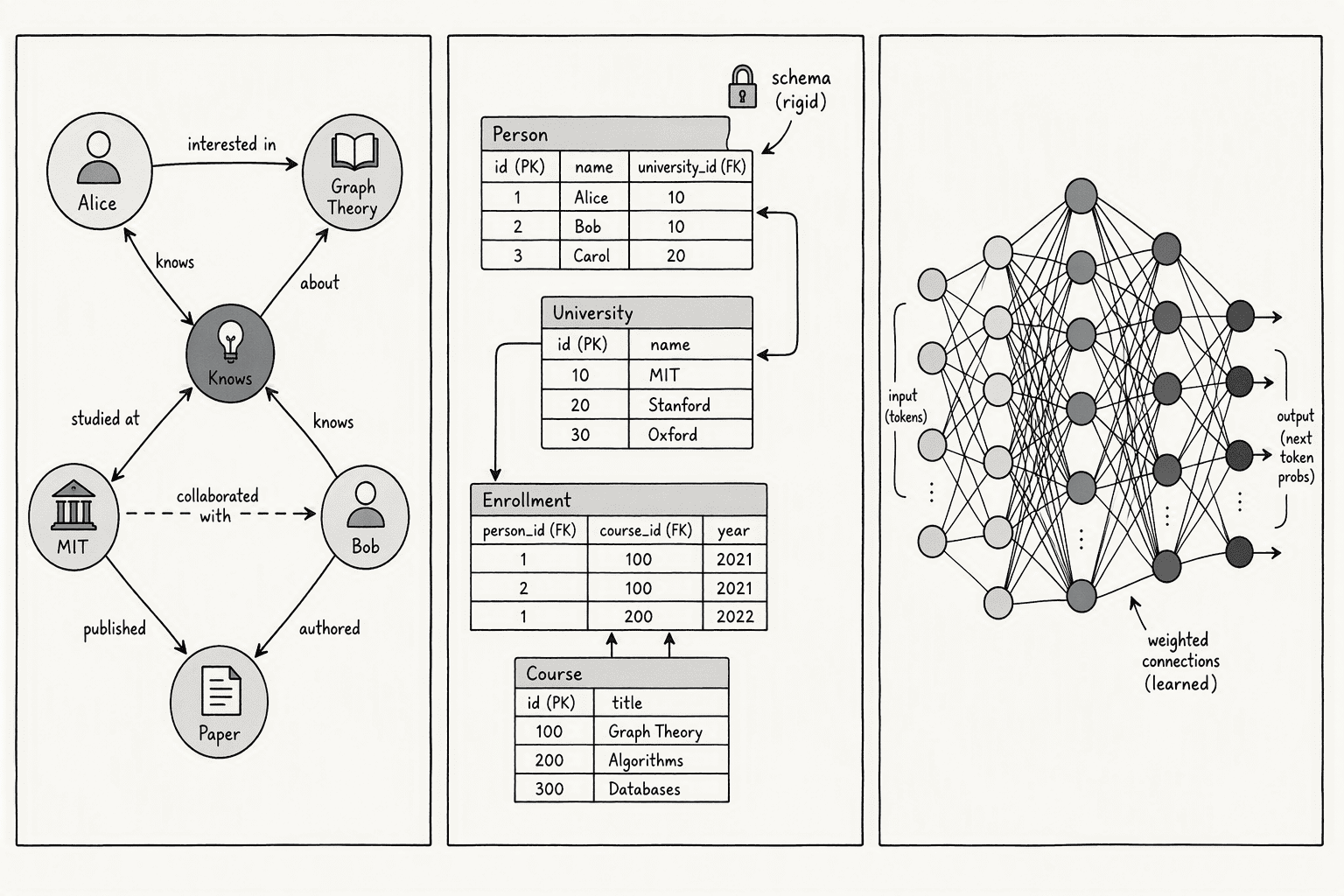
- The model and the graph split the work: The model handles the unstructured, conversational side of an interaction, while the graph supplies deterministic, verifiable context underneath it.
- That same structure pays off on compliance: The mechanism that keeps outputs factual also creates an audit trail of every assertion, so an incorrect figure can be traced back to its source in minutes rather than days of sifting through logs, which is why the technology shows up most where correctness is non-negotiable: biotech firms mapping proteins to drug interactions, supply-chain platforms connecting parts to hazardous-material restrictions before a shipment triggers a violation.
What a knowledge graph is not
| Knowledge Graph | Relational Database | Large Language Model | |
|---|---|---|---|
| Core structure | Nodes (entities) and edges (named relationships) | Rigid tables, rows, and foreign keys | Billions of numerical weights in a neural network |
| Data logic | Explicit semantic triples (subject-predicate-object) | Schemas designed for ACID transactions | Statistical distribution of token sequences |
| Knowledge retrieval | Deterministic traversal of known paths | Query joins across defined columns | Generative next-token prediction, with potential for non-facts |
| Primary value | Connecting context and inferring new facts from existing paths | High-speed operational processing and record-keeping | Understanding and generating unstructured natural language |
The core components of a knowledge graph
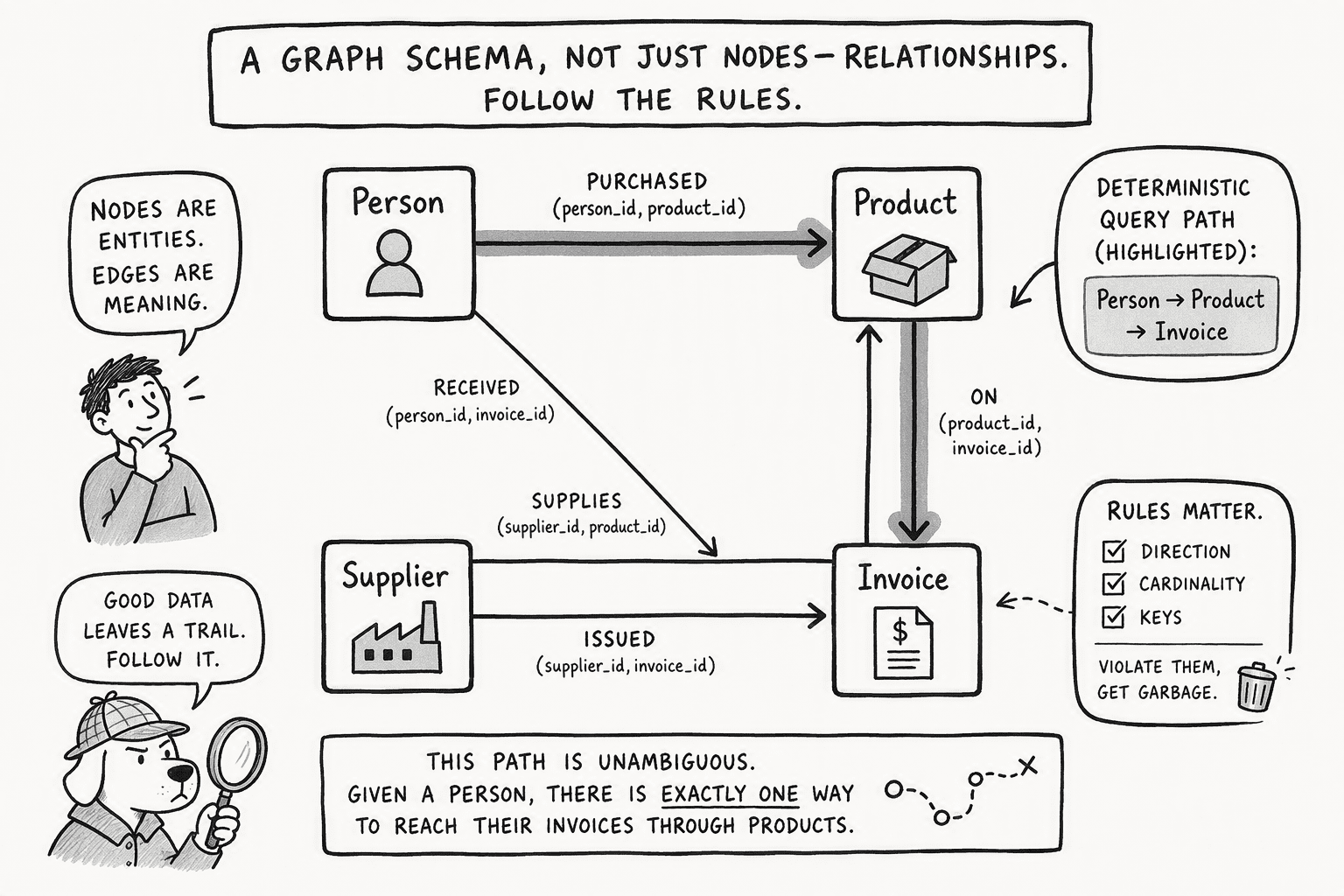
- Schema: defines what types of things exist in the graph, Person, Product, Invoice, and so on.
- Ontology: sets the rules governing how those types relate to each other, a Product is "sold by" a Supplier, never the reverse.
- Deterministic traversal: when a query hits the graph, it travels explicit paths built on those rules, a hard-coded pointer chase, not a statistical approximation of a relationship. Asking for "raw material costs for suppliers in Texas with overdue invoices" sends the engine hopping from Supplier nodes to Material nodes, checking the overdue status property on connected Invoice edges. The same input produces the same correct result regardless of how the question is phrased, a guarantee an opaque vector database of embeddings simply can't offer.
- Schema evolution: an entity category defined too narrowly at the start is a common, real failure mode. A schema that initially restricts an "Artist" entity strictly to a human "Person," for instance, breaks the moment a business needs to represent a non-human creative agent, a virtual performer, an AI-generated persona, anything outside the original assumption. Fixing that means evolving the ontology itself, and that migration touches stored data, API contracts, and any UI component built on the old assumption. A graph built to bend without breaking is what makes that survivable.
Importance of knowledge graphs
- It makes the collaboration between a language model and structured data actually work, instead of the model guessing at answers a well-modeled graph could just retrieve
- It holds up under the kind of scrutiny production systems eventually face, schema changes, edge cases, and the moment someone asks how an answer was actually derived
How LLMs and knowledge graphs work together
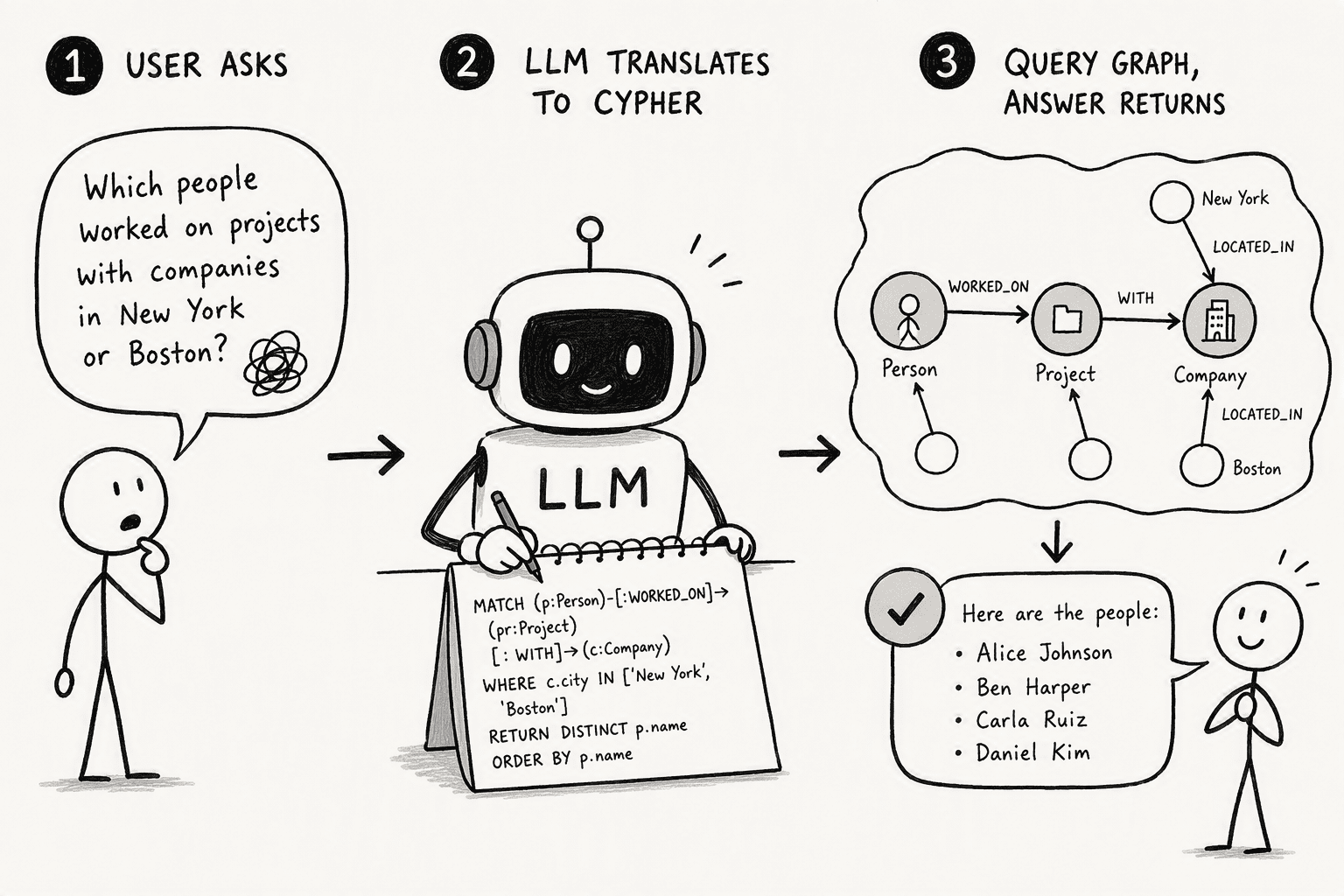
- Natural language to graph code: A model receives a question like "which suppliers flagged for compliance risk shipped late," and translates that messy syntax into a precise query language like Cypher, often called text-to-Cypher.
- Deterministic retrieval: The knowledge graph executes that strict query against its explicit nodes and edges, returning a concrete list of entities, no statistical fill-in-the-blank.
- Contextual wrapping: The model takes the verified list from the graph and wraps it in a fluent response a person can actually read.
How PromptQL builds and uses a knowledge graph
- Data-plane trust: Sending corporate data to a public API endpoint means asking a legal team to accept an architecture where facts leave the building entirely, a compliance red flag most auditors catch on the first pass. A knowledge graph, architecturally, is just a database, it doesn't require an external intelligence service to function. PromptQL deploys in a customer's own cloud via BYOC or on-prem, running a plan-based execution agent inside that same boundary.
- No raw data exposure: The AI agent connects to the graph, runs inference against it, and can even write code, but the sensitive reads stay inside the perimeter. Nothing is anonymized and sent away, no raw database credentials are exposed to the model, and only the result of a query ever leaves, never the unvetted underlying data.
- Context layered on top: The knowledge graph provides the deterministic, traversable structure, and that structure feeds directly into the context layer work covered elsewhere, where corrections and business context get layered on top as a team actually works, captured continuously rather than modeled once and left to go stale.
Conclusion
Frequently Asked Questions
What exactly is a knowledge graph in AI, and how is it different from a regular database or a language model's training data?
What are the real-world enterprise use cases for knowledge graphs in AI that justify the investment?
Why are knowledge graphs considered a solution to AI hallucination and how do they improve factual accuracy?
What are the main challenges or limitations of building and maintaining a knowledge graph for AI?
- Changes to entity definitions have far-reaching consequences, they affect stored data and all dependent software that assumes the original schema.
- Socially, there are few standards for managing cross-stakeholder taxonomy wars, making ontology governance a prolonged negotiation between departments.
How are modern AI systems combining knowledge graphs with large language models (LLMs) to overcome limitations of both technologies?
Sources
- How to Evolve a Knowledge Graph? - web.stanford.edu
- Adoption of knowledge-graph best development practices for scalable and optimized manufacturing processes - PMC - pmc.ncbi.nlm.nih.gov
- KGHaluBench: A Knowledge Graph-Based Hallucination ... - arxiv.org
- What Is a Knowledge Graph? | IBM - www.ibm.com