You've been here before. The same alert fires again, the fourth time this quarter, and you're the only one who knows exactly what to run to fix it, because you're the one who figured it out during a panic-driven 3 AM call months ago. The fix lives in your head, in an old Slack DM, and in a closed ticket nobody can find. Now imagine you're out for a week. The next person to hit this doesn't get your fix. They get to rediscover it from scratch, under the same pressure you were under the first time.
This is tribal knowledge, and it's the most fragile asset in any operations team. A bus factor of 1 is a critical risk running through your entire production stack, and it means you keep fighting the same fires because the extinguisher map only exists in someone's memory, never published anywhere else.
A post-incident correction has to become an executable, verified artifact, not something that lives and dies in your head. This guide walks through a structured pipeline that turns a raw Slack thread during an incident into a hardened runbook that runs in a sandbox and stops the recurrence dead. The output is something a machine can execute, and that's what actually breaks the cycle of relearning the same fix every time someone takes PTO.
Key Takeaways
Every correction can become a reusable artifact if you move from 'fix and forget' to 'fix and codify.' Here is the seven-step framework:
- Capture raw context: Log the exact command, the pre/post metrics, and the decision rationale inside the incident channel while the pressure is still on.
- Structure the plan: Abstract away hostnames and timestamps. Turn the prose into ordered API calls or CLI commands.
- Embed guardrails: Add variables for environments and pre-flight checks to stop a Staging fix from running verbatim in Production.
- Validate through dry-runs: Execute the plan in a read-only sandbox to move trust from faith to verified fact.
- Publish a versioned artifact: Store it in a central, searchable repository that everyone on the team can find and access.
- Embed a review cadence: Assign a maintainer and schedule quarterly reviews to fight knowledge rot and retiring clutter.
- Measure recurrence reduction: Track incidents of a specific type before and after the runbook publication; that reduction is your ultimate KPI.
Why a correction is actually a signal, not just a fix
The instinct during an incident is to fix it and move on. But when a human corrects a system, that correction contains knowledge that should flow back into shared context, not just patch the one instance in front of them. The command that resolved the outage, the alternative that was considered and rejected, the specific log line that gave away the root cause, all of that is a signal about how the system actually behaves, not just a one-time fix.
The distinction that matters is between fixing the immediate incident and fixing the system so the same incident doesn't quietly recur three months later with a different engineer starting from zero. A correction treated as a signal gets captured, structured, and published. A correction treated as just a fix disappears the moment the channel goes quiet.
How to turn corrections into reusable team knowledge
Step 1: Capture the raw correction, context, and decision rationale in a shared thread
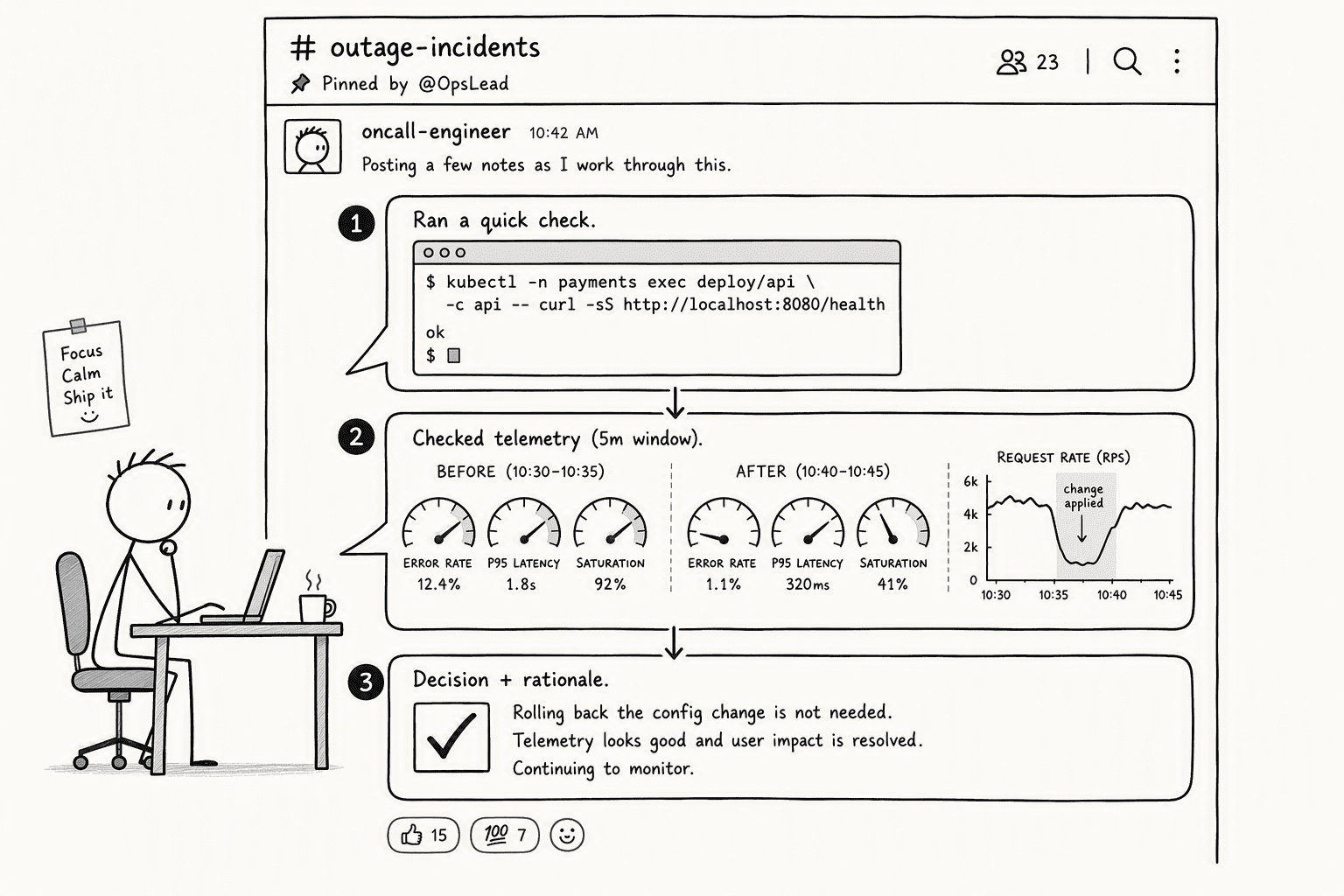
Capture the fix while the adrenaline is still active, not days later in a sanitized post-mortem. Memory smoothing is the enemy of accuracy.
Here is the minimal template to pin in the incident channel during resolution:
- Log the exact intervention: Paste the precise CLI command or script you ran. Skip the summary; the raw command is what an on-call engineer needs to replay the event.
- Snapshot the telemetry: Record the key metric values before and after the fix so the baseline is visible.
- Surface the alternatives: Note the commands you considered and explicitly rejected. This captures the 'don't do this because' logic and marks a line between a quick fix and a self-inflicted outage.
- Link the sources: Reference the exact log lines or traces that led to the decision, preserving the diagnostic path.
- Tag the domain owner: Add the service name and the maintainer to the thread so the context ties to a living ownership model.
Step 2: Convert the correction thread into a structured, executable plan
A Slack thread is narrative prose. A runbook is a sequence of executable actions. The translation requires reading the thread and stripping out the human-to-human reassurance. A thread that says "sshed into pod-7a-east and bounced the queue consumer" becomes an API call to restart a deployment in a specific region. This is converting tacit knowledge into explicit code.
The structure requires a plan skeleton. Break the fix into ordered steps and define each as either an HTTP request, a CLI command, or a pipeline trigger. Remove hard-coded hostnames. Replace timestamps with relative logic. The goal is a plan generic enough to run on any cluster but specific enough to fix the symptom without human guesswork, a plan the machine can read, not just documentation a person has to interpret.
Step 3: Enrich the plan with triggers, variables, and environment-specific guardrails
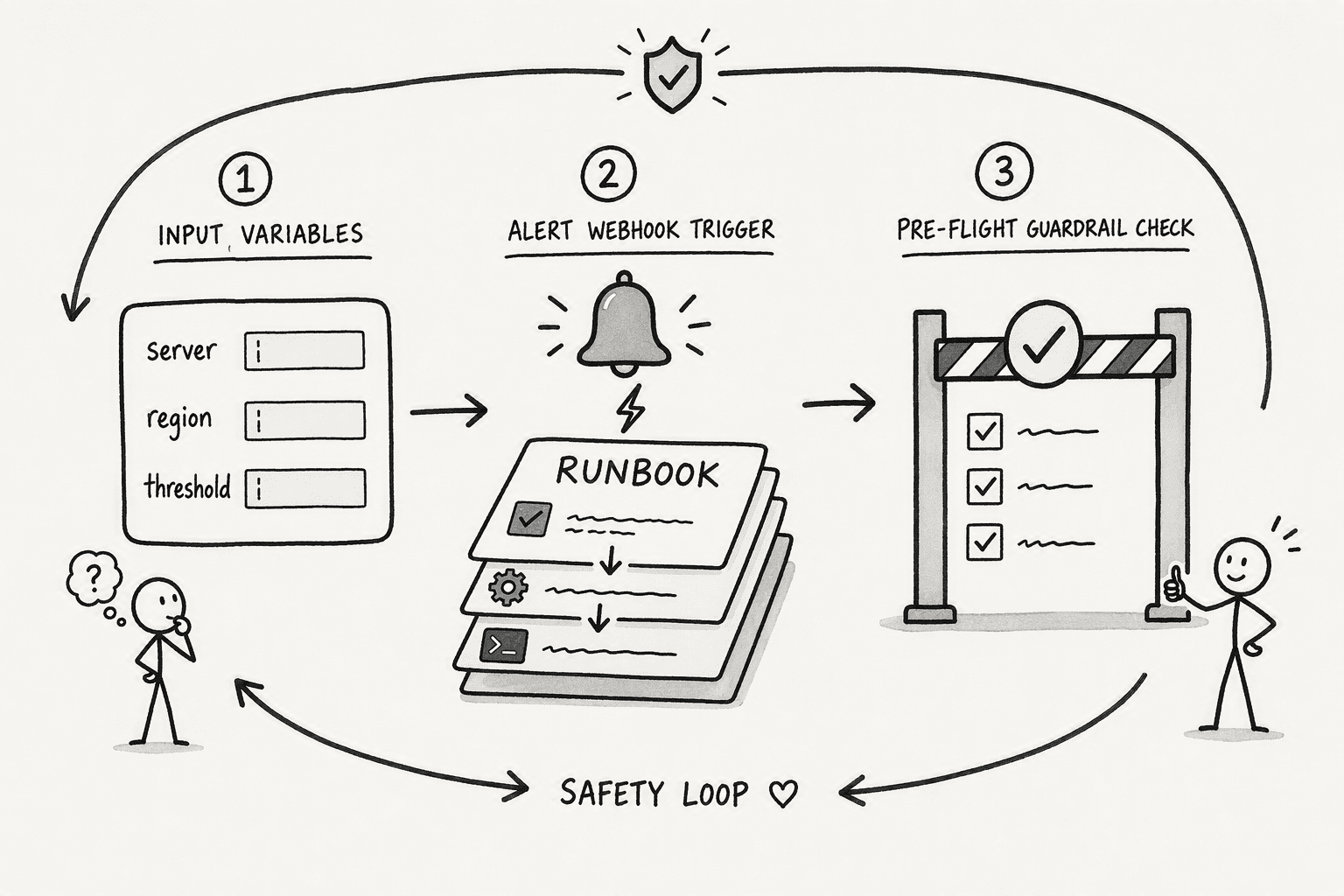
A raw script needs safety catches. Add these three layers:
- Input fields: Introduce variables for target server names, regions, or thresholds that can be passed per execution.
- Trigger binding: Tie the runbook to the specific alert webhook that fires when conditions are met, manual execution is for experiments; automatic triggers are for 3 AM.
- Pre-flight guardrail: Write a step that verifies you are not pointing at the primary database if you intend to run against a replica. Skip this check and a routine restart becomes a production outage.
Step 4: Validate the plan with plan-based execution and dry-run testing
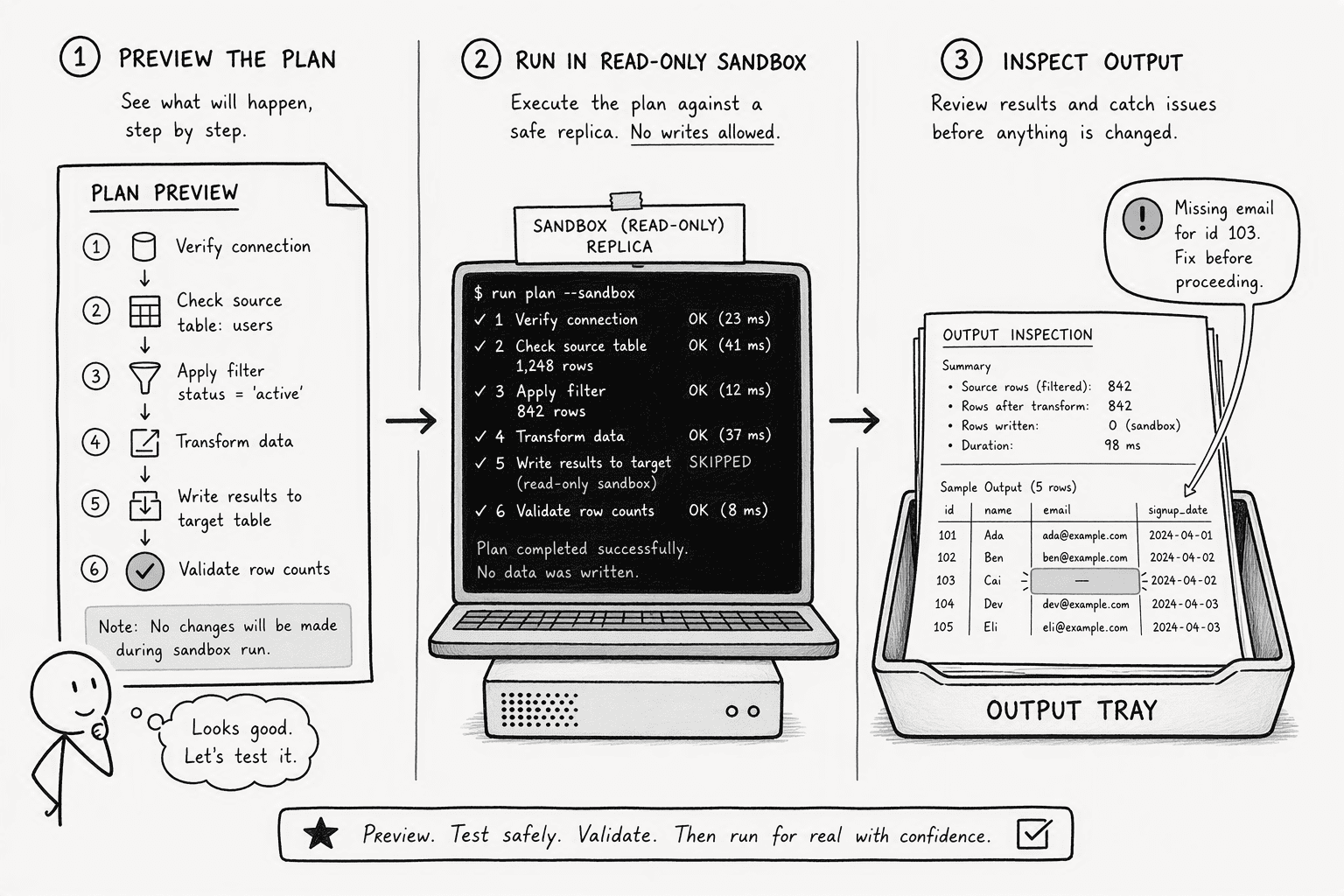
Never trust a runbook you have not watched fail in a sandbox. Validate it with these steps:
- Run a dry-run: Use a tool with plan-based execution that shows the ordered steps before they run, allowing you to review and approve or reject them.
- Test in sandbox: Execute the plan in a read-only mode or dedicated staging environment against a replica.
- Inspect outputs: Watch for logic gaps, like a jq filter expecting a JSON field that does not exist in older API versions, fix them, and repeat the dry-run.
- Graduate the runbook: Once it passes consistently, it moves from a hopeful suggestion to a trusted operation, cutting MTTR by removing hesitation during production incidents.
Step 5: Publish and surface the verified plan as a discoverable, version-controlled artifact
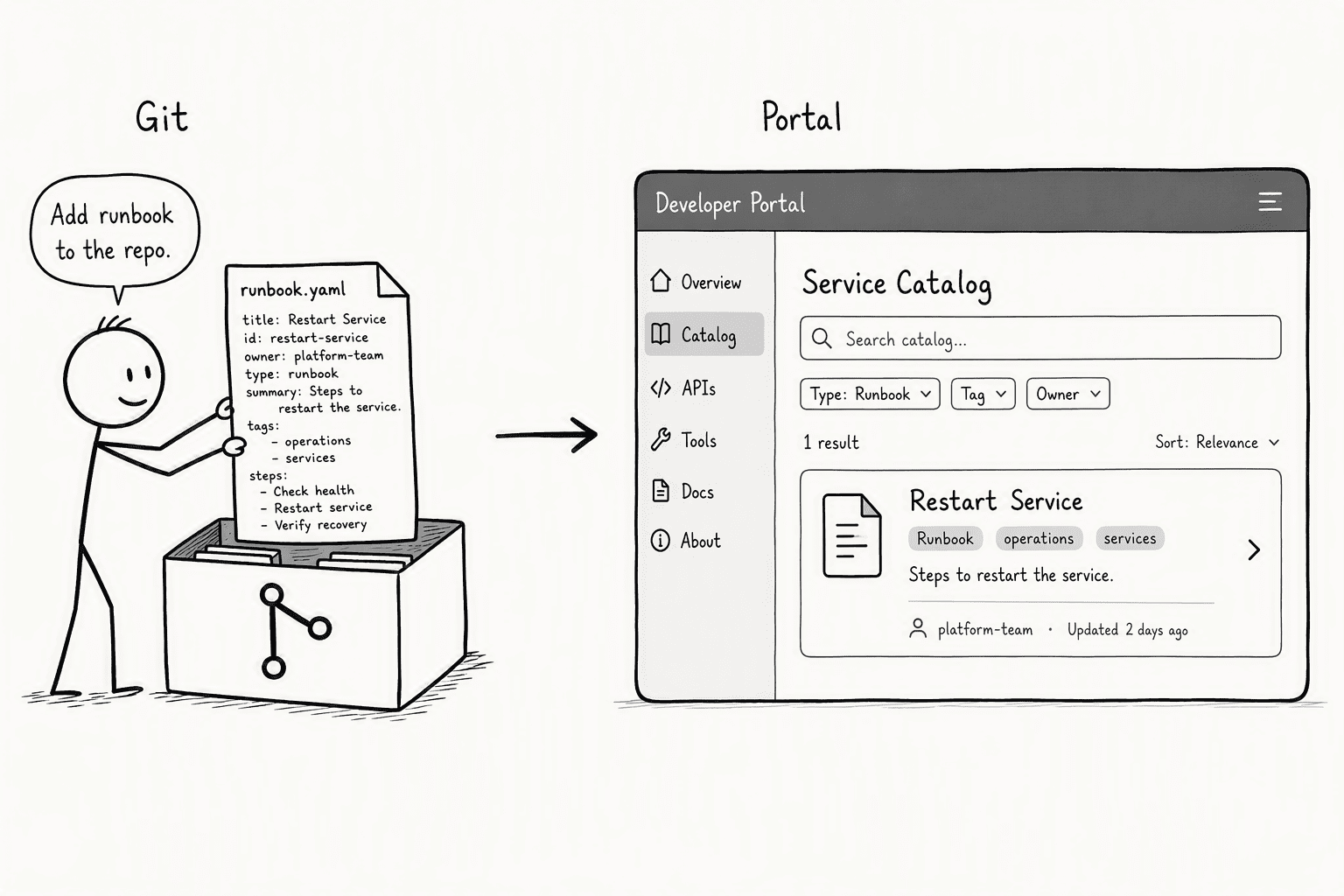
The runbook must live where the team looks, not where they have to remember to search. Storing it in a private Git repo without indexing is just digital tribal knowledge. You store the YAML definition in a version-controlled repository and use a service catalog or an internal developer portal to surface it. A central repository that is searchable and accessible to the entire team transforms a Slack thread into a corporate asset.
You can use a tool like PromptQL that lets you point the whole team at the same shared context. Drop the runbook link into a shared thread. When the next engineer asks the agent how to remediate a specific alert, the agent retrieves the verified plan instantly. You move from 'ask Sarah' to 'ask the registry.'
Step 6: Review, refresh, and retire knowledge through embedded team cadences
A runbook left untouched for a year is a liability. It becomes a war story about a past failure that no longer applies to the current infrastructure. You need a lightweight lifecycle. Here is how to structure your review decisions:
| Decision | Criteria | Cadence | Owner Action |
|---|
| Keep as-is | Runbook executed successfully in the last 90 days; production environment unchanged. | Quarterly automated review prompt. | Maintainer confirms validity. |
| Update | Underlying infrastructure migrated; API endpoints deprecated. | Immediate trigger on infrastructure change. | Maintainer updates variables and actions, then reruns dry-run validation. |
| Retire | Underlying bug permanently patched; service fully decommissioned. | Quarterly manual audit. | Maintainer moves artifact to an archive repository and removes from the active catalog. |
Step 7: Measure impact with recurrence and recovery metrics
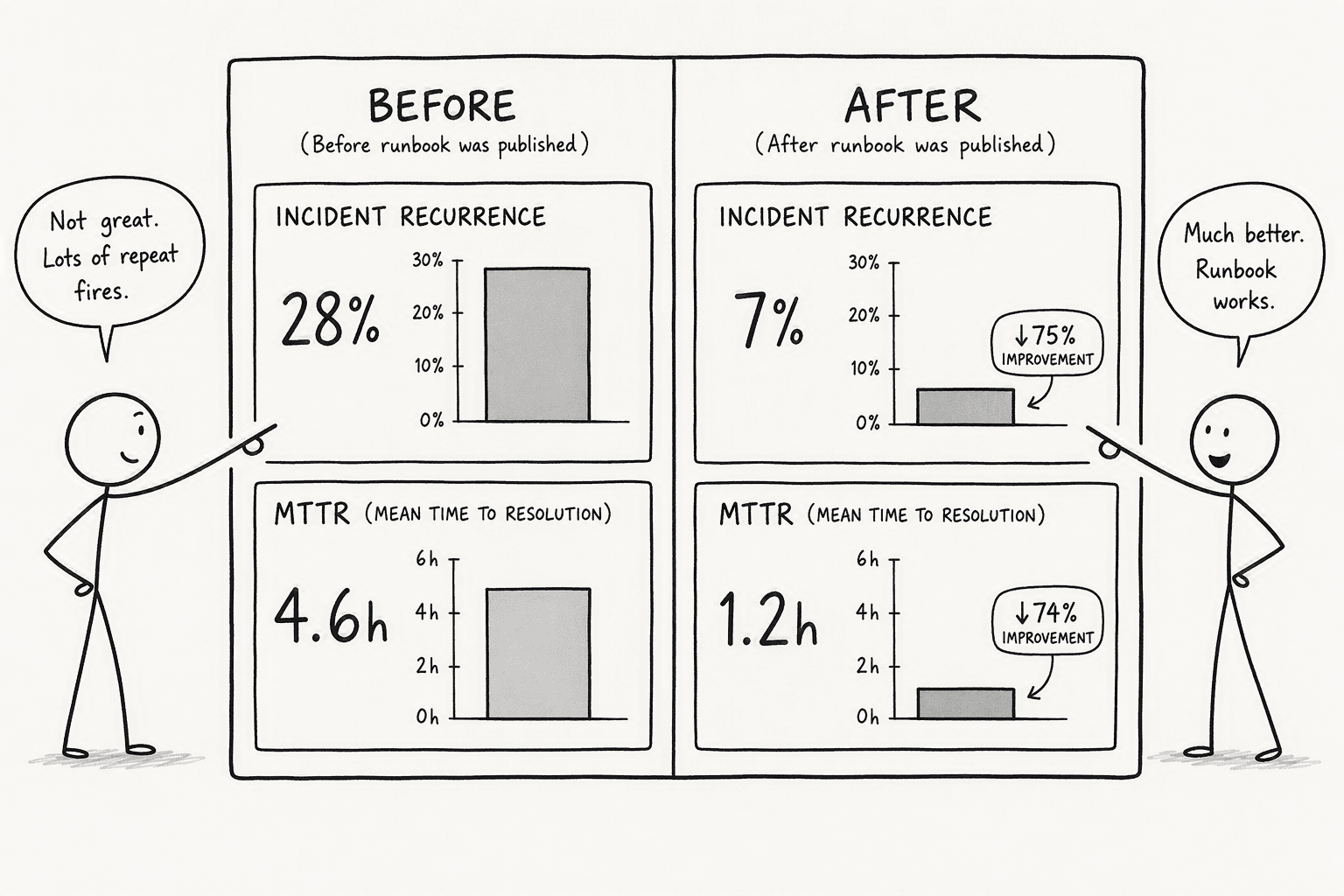
You need to close the loop with a number.
The most honest metric is recurrence reduction. Count how many times a specific incident type fired before the verified runbook was published, then count how many times it fired in the same window afterward.
Mean time to resolution is the velocity metric. Runbooks can significantly reduce mean time to resolution and improve operational efficiency. When a runbook automates the first ten minutes of diagnosis and triage, the MTTR graph bends downward, visible in a dashboard that correlates runbook execution counts with incident duration.
The hours spent converting a Slack thread into a structured plan accumulate into real ROI. Every correction document becomes a posterior term that updates the organization's operational belief system.
How PromptQL turns corrections into reusable knowledge
PromptQL is built around exactly the gap this guide walks through: a correction made in the flow of real work becoming permanent, discoverable knowledge instead of disappearing into scrollback the moment the channel goes quiet.
PromptQL Tag handles this directly:
- Captures corrections as human-reviewed, cited wiki entries, one shared, versioned, cross-linked knowledge base rather than something that fragments per channel or per incident thread
- Updates the answer for the whole team, so a correction made once by one engineer means the next person who hits the same alert gets it right the first time, without re-explaining or rediscovering it
- Becomes a reusable skill, fact, or semantic-layer improvement, shared team-wide with citations, revision history, and notifications, the same underlying shape as the runbook lifecycle in Step 6, just captured automatically instead of requiring a separate publishing step
Instead of a runbook someone has to remember exists, a teammate can work with the agent inside a shared thread, correct it once when something's wrong, and have that correction stick for everyone who asks a similar question afterward.
Conclusion
The process starts with a raw command pasted in a chaotic channel and ends with a versioned, verified artifact that an AI can execute in isolation. A learning organization's competitive advantage comes down to one habit: refusing to fix the same thing twice. It asks 'how do we make this the last time we have this outage?' and then turns that answer into software. The artifact is the proof. The real value is the muscle memory of capturing, hardening, and sharing.
Frequently Asked Questions
What does it mean to turn a software incident or operational mistake into reusable team knowledge, and how does it differ from a postmortem?
Reusable knowledge is different from a postmortem. It means:
- Transforming the raw fix and decision rationale: Capture the exact command, the why, and the guardrails.
- Creating an executable, version-controlled artifact: Derive it during the incident, not days later.
- Enabling safe execution: Ensure a machine or another human can execute it safely.
Which concrete steps convert a correction into a living artifact that the whole team actually uses?
Capture and formalize knowledge with this workflow:
- Capture raw commands and rejected alternatives directly in the incident channel.
- Abstract the fix into an ordered script with variables and environment-specific guardrails.
- Validate the script with a dry-run in a sandbox.
- Publish the verified plan into a searchable central repository or agent-accessible shared context.
How can AI agents and plan-based execution help codify lessons from corrections without manual documentation drudgery?
AI agents can parse the raw Slack thread and propose a structured plan with pre-flight checks. Plan-based execution shows the ordered steps before they run, letting you approve logic without writing syntax. This reduces the manual toil of translating prose into CLI commands and keeps the focus on verifying outcomes.
What team structures, review cadences, or cultural norms prevent knowledge rot after a fix is documented?
Assign a named maintainer for each runbook artifact. Embed a quarterly review trigger into existing sprint cycles or reliability standups. Establish explicit criteria for retiring artifacts when bugs are permanently patched or services are decommissioned. Move from 'fix and forget' to a culture that treats stale documentation as a risk.
How do enterprises measure whether turning corrections into shared knowledge is reducing repeated incidents or speeding up recovery?
Track the recurrence rate of specific incident types before and after a runbook is published. Correlate runbook execution counts with a decreasing mean time to resolution. If a runbook automates the initial triage, the MTTR graph should decline. Recurrence reduction is the primary indicator of real institutional immunity.
What are the common traps that cause teams to repeat the same mistakes despite having written runbooks?
Storing runbooks in private repos or closed Slack channels renders them invisible. Failing to replace hard-coded environments lets a staging fix break production. Not scheduling maintenance reviews allows scripts to rot when APIs deprecate. The biggest trap is treating the runbook as a final artifact instead of a living component with a lifecycle.
Sources
- PromptQL | About us - promptql.io
- Overview | Docs | PromptQL - promptql.io
- Create Runbooks | Harness Developer Hub - developer.harness.io
- Prevent Knowledge Loss Best Practices | 2026 - docs.gitscrum.com
- SREcon 2018 - www.usenix.org