Finding your next role comes with an impressive amount of unpaid admin.
You search for openings, read the same job description wearing twelve different company logos, and save a few promising ones. Then you upload your résumé to a website that immediately asks you to type out your résumé.
Somewhere around tab number 37, “exploring my next opportunity” starts feeling like a second job.
If you joined WOMEN x AI’s AI Career Lab: Your Next Move on September 23, this is a practical follow-up: put AI to work on the research and preparation that come after those conversations.
Laura Cruickshanks speaking at WOMEN x AI’s AI Career Lab.
We’ll use PromptQL, an AI workspace you can give tasks to in plain English, to build a job shortlist. Then, where Jev is available, we’ll use it to evaluate a larger pool of opportunities.
You can follow along even if this is the first time you’ve heard of either. Your collection of browser tabs counts as sufficient preparation.
Start with the background you’ve already written
Before AI can recommend useful jobs, it needs to understand your experience, skills, and the work you’ve done.
Which sounds suspiciously like another task.
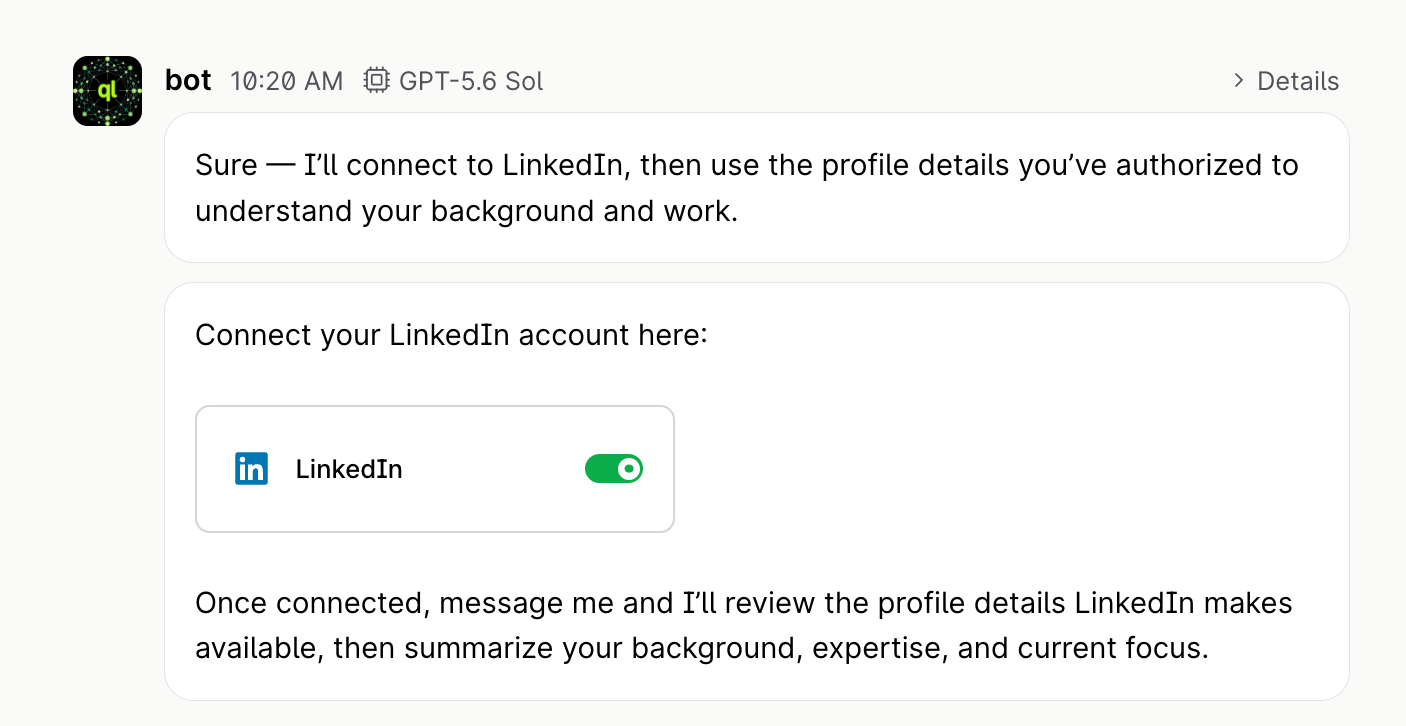
If LinkedIn is available in your PromptQL workspace, try:
Connect to my LinkedIn, then tell me which profile details you can actually access. Summarize my background and ask me to correct anything missing.
Approve the connection if you want to. Check the resulting summary rather than assuming it contains your entire résumé. You can add a résumé or explain anything important that is missing.
There is one thing your profile may not explain: what you want next.
Perhaps you’ve spent years in customer success and want to explore product operations. Perhaps you enjoy your work but want a different industry. Perhaps your only fully formed preference is “fewer meetings that could have been emails.”
Tell PromptQL. Your profile describes where you’ve been; your preferences guide where to look. A few honest sentences will do.
Turn that context into 10 jobs worth considering
Now give PromptQL a concrete assignment:
Based on the background I've confirmed, find up to 10 current jobs I should consider.

Ask about my target roles, preferred location, remote-work preferences, and deal-breakers first. Include adjacent roles where my skills could transfer.

For each job, show the company, role, source and application link, why it fits, and any gaps. Check whether the listing is still open; mark anything you cannot verify.
Give it time to research. You’re asking it to connect your background to actual openings and explain the connection. The explanation is the useful part. A title alone tells you very little.
React to the shortlist as you would to suggestions from someone helping you search:
“More like the third role. I’m interested in that kind of work, but I’d prefer an individual-contributor position.”
That feedback can make the criteria clearer for the next pass. Ten roles is a useful start because you can actually read them and decide whether they make sense.
But once the matching looks useful, a reasonable question follows: could we search more widely?
Before we open another 990 tabs, meet Jev
Jev is TypeSafe AI’s model for structured decisions. Instead of writing prose, it takes information you supply and returns choices, scores, or yes/no probabilities. That makes it a candidate for repeated checks: whether a role uses your skills, matches your seniority, meets a location preference, or lacks enough information to judge.
A general-purpose language model can also evaluate listings. Jev is worth testing when the same decision needs to be made many times. PromptQL can use its Jev integration in workspaces where it has been provisioned; you can ask your bot whether it is available before relying on it.
Why the difference matters at 100—or 1,000—jobs
For ten listings, the evaluation work may feel small. Across 1,000, you're repeating checks many more times. Jev is designed for fast structured decisions, but the speed, quality, and cost of your complete job search also depend on obtaining listings and reviewing results. Don't assume an advertised benchmark predicts your own outcome.
To try a wider search, ask:
If you can obtain 100 current job listings, use Jev (if available in my workspace) to evaluate them against my confirmed background and preferences.

Include adjacent roles where my skills transfer. Classify each as strong fit, possible fit, or unlikely fit; flag missing information and low-confidence judgments for review.

Show the top 10 with application links, brief reasons, and gaps. Explain the criteria used. If Jev is unavailable or you cannot verify 100 listings, tell me and work with the listings you can verify.
Review a few of the “possible fit” results, especially during a career pivot. An interesting opportunity may need explanation; adjust the criteria when the recommendations overlook something you care about.
Take the shortlist one step closer to an application
Once a few roles stand out, stay in the same conversation. Use that context to prepare your next step:
Help me prepare applications for these three roles: [choose roles].

For each one, suggest which parts of my experience to emphasize and draft responses to the application questions I provide.

Also draft a short message I could send to a relevant contact asking about the role or an introduction.

Use only my actual experience. Ask me for missing details, and keep everything as drafts for me to review.
Read the drafts, add the details that sound like you, and choose what to send. A specific example from your experience usually does more work than another paragraph about being a “passionate, results-driven professional.”
You now have something useful to bring back to people you met at the event: a clearer sense of the roles you’re exploring, a few actual openings, and a specific ask someone can respond to.
Go send it. Your bot can keep working through the listings.