Turning memory on for a whole team sounds like giving everyone the same shared brain. But the really isn't that.
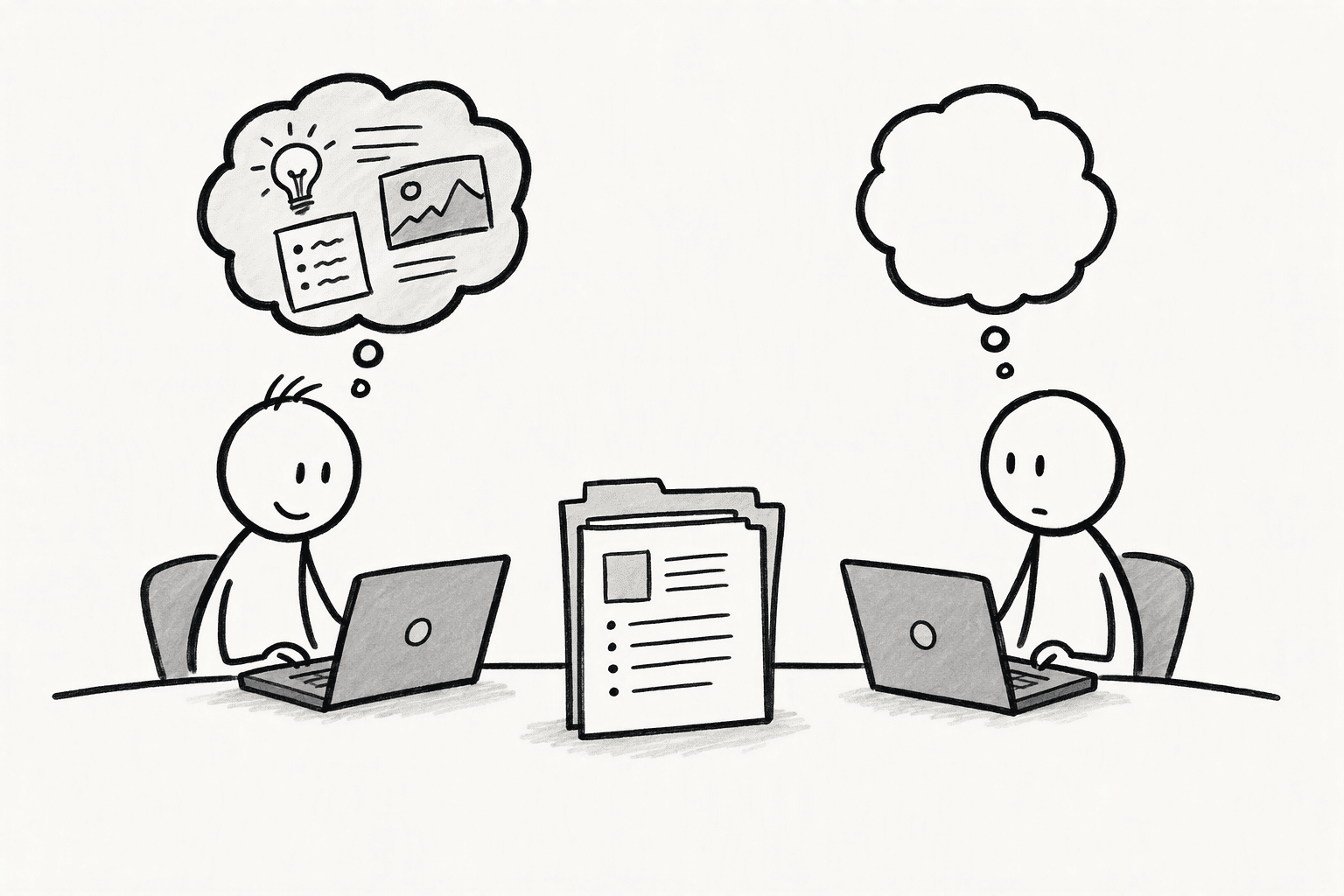
In ChatGPT, memory belongs to the individual. OpenAI's Business FAQ says memories aren't transferable to other users, even within the same workspace. So, a team of 8 with memory on has 8 differently informed AI assistants.
That is the biggest reason the same question gets different answers, but not the only one. This guide covers 6 reasons for the inconsistency.
Key takeaways
- Memory is personal: Each person's ChatGPT remembers only their own chats and saved memories, even within 1 workspace.
- Memory keeps changing: What ChatGPT derives from past chats shifts over time, so even 1 person's answers can change.
- Shared projects are walled off: A shared project uses project-only memory and can't see any member's personal memory.
- Setup and randomness add variation: Models, modes, tools, plans, and the model's own run-to-run variation all move the answer.
- Consistency needs a shared source: Definitions and decisions have to live somewhere every person's AI reads.
Why ChatGPT answers differ across a team
Each part of how ChatGPT personalizes an answer is tied to the individual, not the team. The 6 reasons below discuss exactly that:
1. Memory belongs to each person, not the team
OpenAI's Business memory FAQ says memories are not transferable to other users, even within the same Business workspace.
Workspace owners can turn memory on or off for everyone, but that controls whether memory exists, not whether it is shared.
For example, a teammate who spent a month explaining your pricing model to ChatGPT has an assistant that knows it, and the next teammate's AI doesn't.
What helps is treating the definitions a team depends on as shared documents, kept in a context layer or a shared project, not as personal memories.
2. Each memory is built from that person's own chats
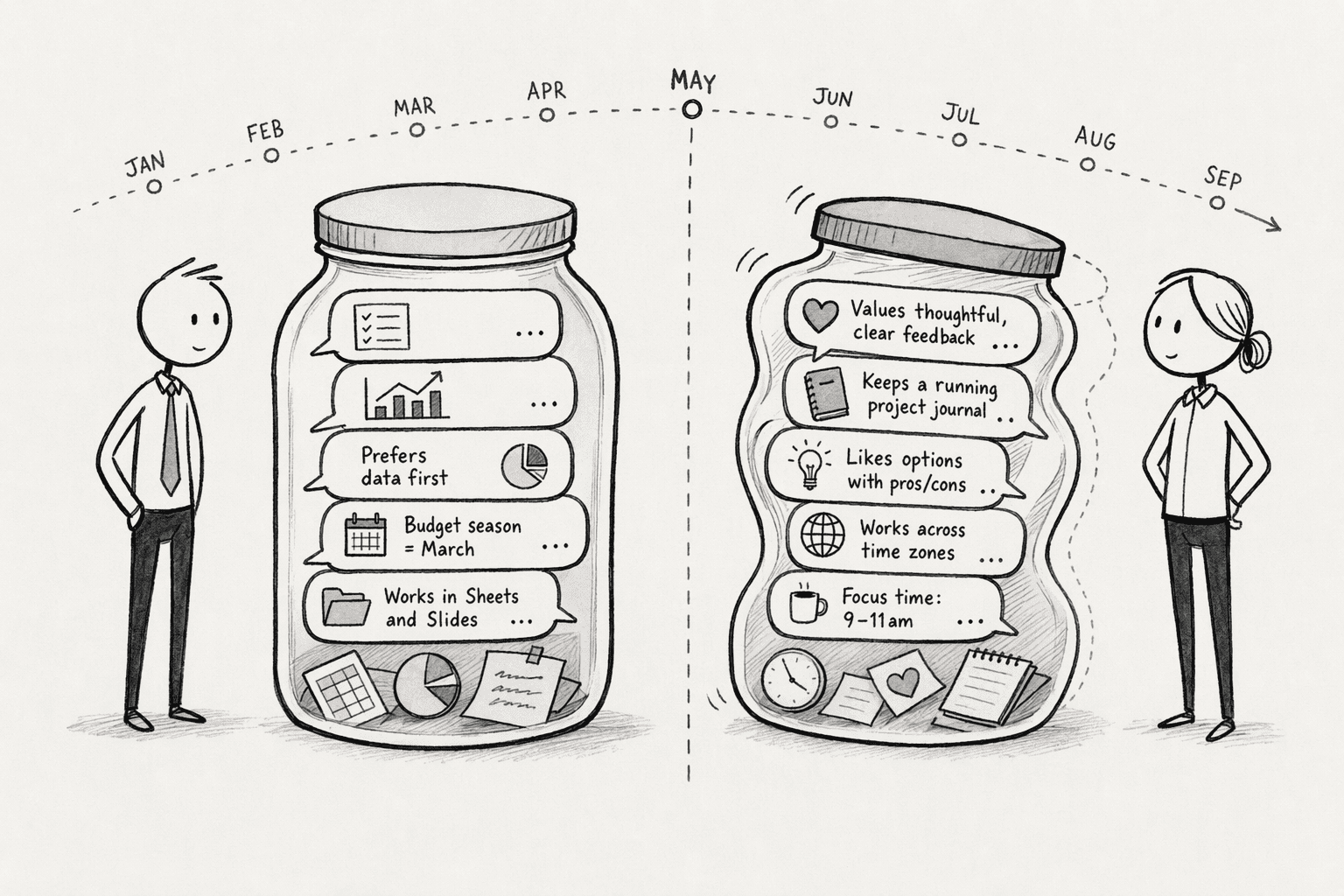
ChatGPT has 2 kinds of memory: saved memories, which are details a person told it to remember, and reference chat history, which uses relevant information from past conversations.
OpenAI says that information derived from chat history can change as ChatGPT updates what it considers most useful to remember, so 2 people in the same role end up with different remembered context, and the same person's memory can shift from 1 month to the next. The memory summary is only a high-level view that may not include everything ChatGPT can reference.
What helps is reviewing and correcting each person's memory summary on a schedule, and keeping a list of what the team has agreed on somewhere shared.
3. A stack of personal context adds up
Memory is not the only personal input. OpenAI notes that saved memories are part of the context ChatGPT uses, like custom instructions, so each person's answer reflects their custom instructions, saved memories, and referenced chats together.
For example, a product manager whose custom instructions say "be concise" and an engineer whose say "show your reasoning" will get differently shaped answers to the same question.
What helps is comparing custom instructions across the team, and using a Temporary Chat, which doesn't use saved memory, when a question needs a standard answer.
4. Shared projects are walled off from personal memory
Shared projects automatically use project-only memory and cannot access an individual member's memories or context from outside the project, and they can't be switched back to default memory.
A question asked in the shared project and the same question asked in a regular chat can therefore draw on different context: the project's files and chats in the first, a person's own memories in the second.
What helps is putting the shared definitions and documents in the project, and agreeing which questions belong there.
5. Settings, tools, and models differ from chat to chat
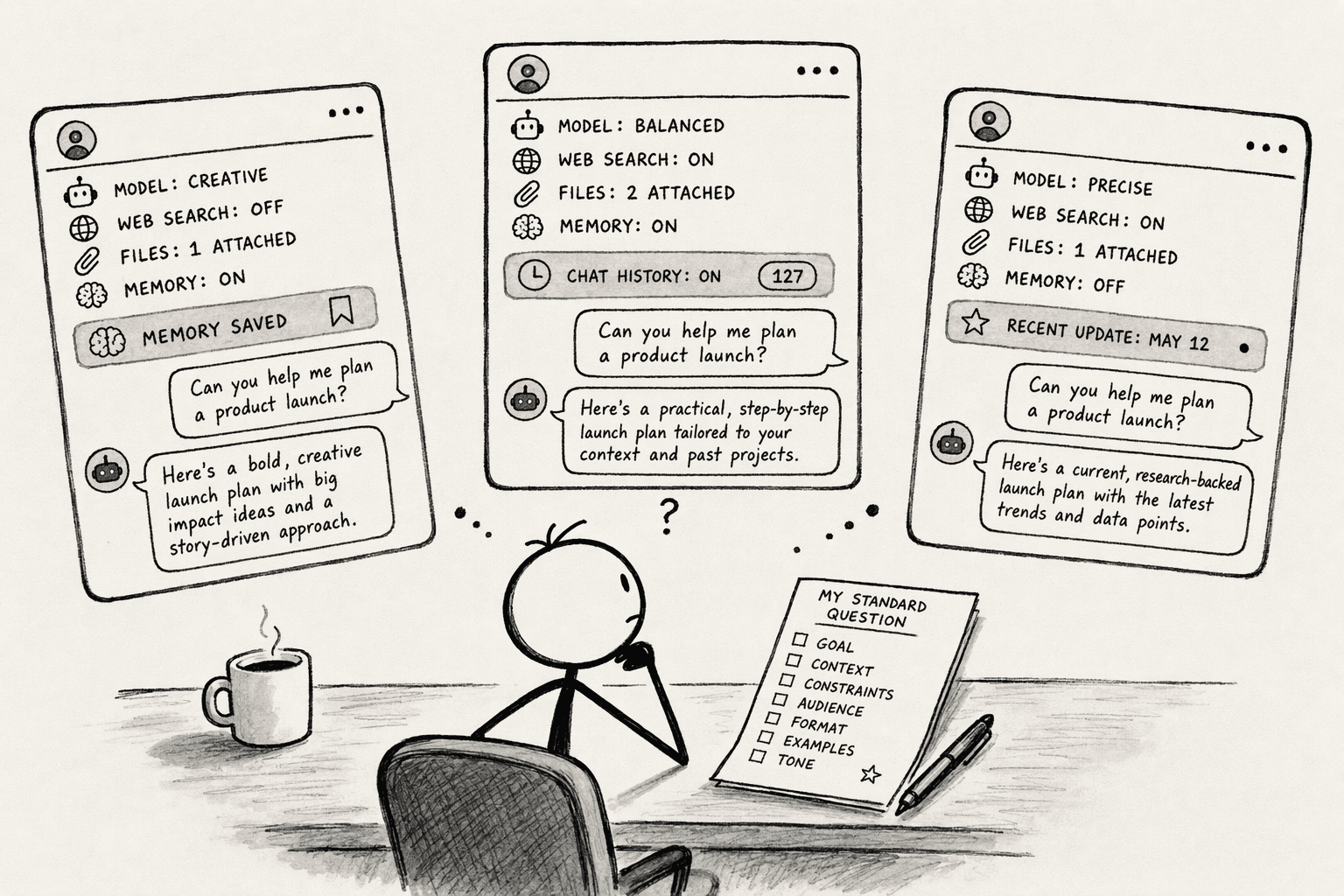
The same question is not always the same request. People can be on different models or modes, with web search or connected apps on or off, with different files attached and different wording.
Memory features also vary by plan, and models and features change over time, as OpenAI's release notes show. On the free tier, for example, ChatGPT has saved memories only, while Plus and Pro also reference chat history, and the same person can get a different answer after an update.
What helps is agreeing on a standard way to ask the questions that matter: the model or mode, the sources to use, and the wording.
6. The model itself varies from run to run
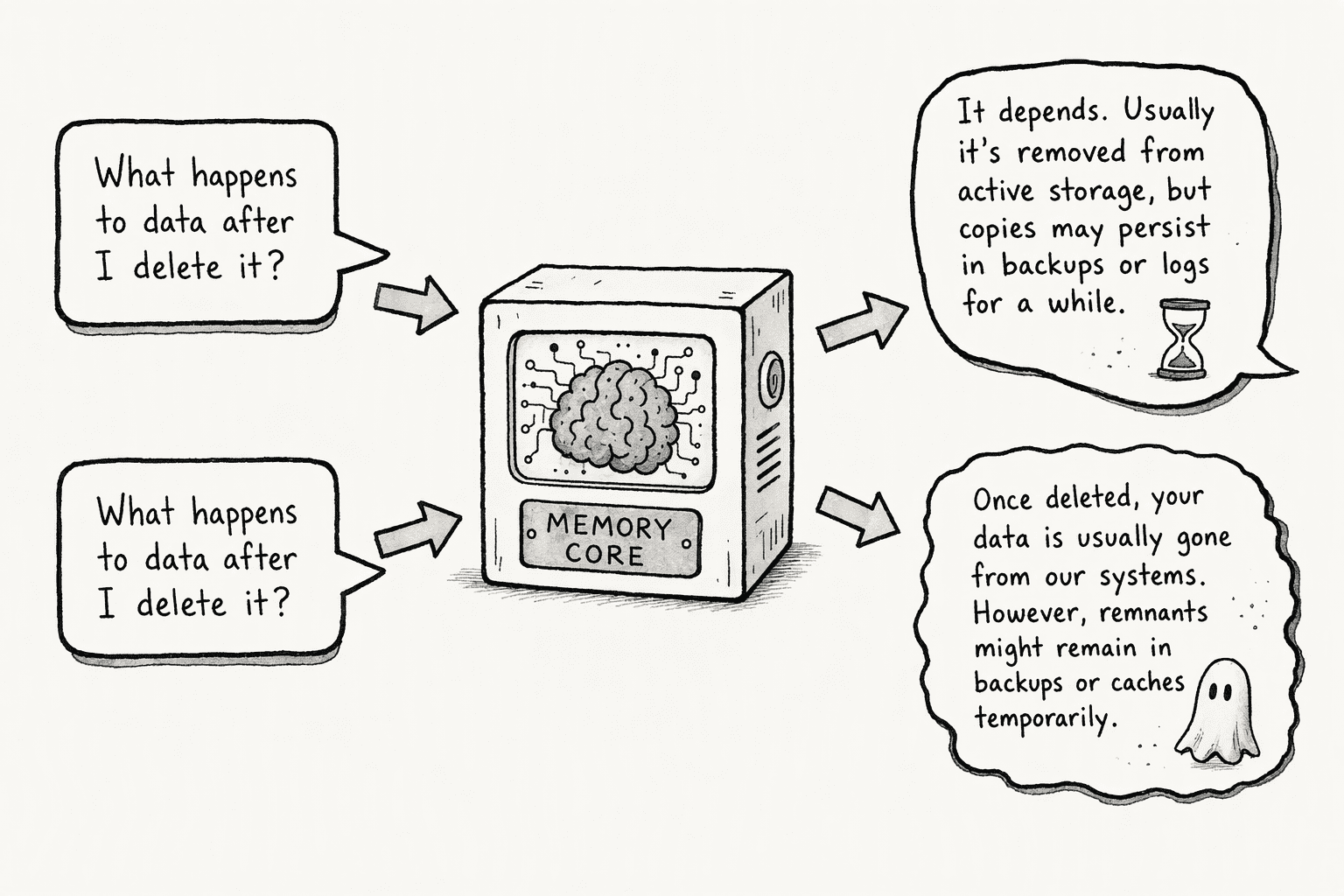
Even with identical context, the same question can get different answers.
In a Washington State University study, researchers ran 719 hypotheses from business journals through the free versions of ChatGPT 10 times each, and across 10 identical prompts it consistently got only 73% of the statements right.
That study covered scientific hypotheses with the free versions and didn't involve memory, but it shows run-to-run variation is real. Thinking Machines explains part of why: the same prompt run 1,000 times at temperature 0 on an open model gave 80 different completions, because the result depends on how the server batches requests.
What helps is putting the facts in the prompt or a shared source and using the model to phrase them, and checking that the facts match, not the wording.
How PromptQL helps make a team's answers consistent
PromptQL moves context out of individual memories and into a shared place.
- Shared context: The team works in shared threads with 1 wiki, not 1 memory per person.
- Persistent corrections: A correction made once is captured as a cited wiki entry, so the next answer starts from it.
- A consistent setup: Teams choose the model for each channel or task.
- Answers from the data: The model plans and code runs against connected data, so a number can be checked.
In practice, 2 teammates who ask the same question on different days start from the same definitions and corrections, use the model the team chose for that channel, and can see the plan and data behind the number. When someone spots a mistake, they fix it once in the thread, and nobody after them inherits it. Wording can still differ between answers, because no tool makes a language model identical from run to run, but the facts underneath no longer depend on whose memory the question happened to reach.
Conclusion
Start with the 5 questions your team asks most, such as how revenue is defined or what the launch criteria are. This week, ask each question to 3 teammates in their own ChatGPT and compare the facts in the answers, not the wording. Wherever the facts differ, write the agreed answer into a shared source, and repeat the check monthly so drift shows up early. Then use PromptQL to keep a shared source, with corrections captured as the team works.
Frequently Asked Questions
Why do two people on my team get different answers from ChatGPT even when both have memory turned on?
Memory is personal and isolated per user. Each person's ChatGPT builds its own private store of recalled facts and preferences, and the model decides independently which information to retain or overwrite. There is no shared team index, so two accounts construct two separate contexts and produce different responses from the same prompt.
How does ChatGPT's memory feature actually work?
It stores a small set of factual statements and preferences derived from your conversations, separate from chat history. ChatGPT decides which information is relevant to retain, silently overwrites entries when context shifts, and auto-trims old items once a capacity threshold is crossed. It is an opaque, per-user scratchpad, not a managed knowledge base.
What is the difference between personal AI memory and a true team workspace?
Personal memory is a private store visible only to one user. A team workspace provides shared context where every participant sees the same reasoning chain, intermediate outputs, and final answers. Access is scoped to each person's data permissions, so two people with identical privileges get identical, auditable results from the same prompt.
What causes identical prompts to produce different responses even with temperature set to zero?
Batch sensitivity is a key source of output variation:- GPU contention reorders math: When other users share the same GPU, the order of floating-point operations shifts, tipping near-tie predictions between candidate tokens.
- Proven by research: A 2025 Thinking Machines Lab study found this hardware-level nondeterminism is the dominant cause of output variation, making a server's current load change the literal words in your answer.
Do shared projects fix inconsistent answers?
They help for questions that belong in the project, because everyone draws on the same project files and chats. Shared projects use project-only memory, so they can't see anyone's personal memory, and questions asked outside the project still draw on personal context.
Sources
- Policy-based access for the agent era - promptql.io
- Why ChatGPT Gives You a Different Answer Every Time ... - medium.com
- AI gets a D: Study shows inaccuracies, inconsistency in ChatGPT answers | WSU Insider | Washington State University - news.wsu.edu
- Memory in ChatGPT | OpenAI Help Center - help.openai.com
- ChatLog: Carefully Evaluating the Evolution of ChatGPT Across Time - arxiv.org
- Why ChatGPT Loses Context Between Sessions (and How to Fix It) | MemoryLake - www.memorylake.ai