Introduction
Imagine two reps ask the same AI assistant for last quarter's win rate. One gets 54 percent. The other gets 61. Nobody told the assistant how your company defines a win, so each answer rests on a guess. Multiply that by twenty people asking similar questions, each carrying different mental math, and you have a dashboard built on sand.
That friction is expensive. When your own team can't reproduce an answer, decision-making stalls and people stop trusting the tool. Yet it is easy to blame the model.
The real problem is narrower and more fixable. Inconsistent AI answers stem from five root causes, and only one lives inside the model itself. Even that one is real: a Washington State University study had free ChatGPT judge 719 hypotheses from business journals, repeating each query ten times, and it consistently estimated only 73% of the statements accurately. That study was about research hypotheses, not team metrics, but it shows why you cannot count on a model to repeat itself.
The other four causes live in how your team supplies context, defines metrics, controls data access, and carries conversation history.
This article walks through a systematic, six-step approach to close that gap. By the end, you will see AI inconsistency as a governance problem your team can solve.
Key Takeaways
Most inconsistency comes from missing business guardrails, not from the model itself. Five drivers sit behind contradictory AI answers, and only one of them is inherent to the LLM. The other four are definition gaps, access rules, and context problems you control. Fix those, and you stop chasing phantoms.
- Root cause diagnosis: Non-deterministic sampling is the single driver built into the model. The remaining four, different user context, unstated metric definitions, different data access, and divergent chat history, are business-context problems you can solve.
- Shared definitions library: Centralize what "win rate," "fiscal quarter," and "active pipeline" mean so every rep prompts from the same starting assumptions.
- Role-based data access: A rep sees their own book; the CRO sees the whole company. That spread is legitimate variation. The calculation underneath must be identical.
- Auditable execution: When an answer carries a traceable record of the plan and query that produced it, contradictory outputs become bugs you can fix instead of unsolved mysteries.
- Versioned knowledge bases: Replace scattered personal glossaries with a single, version-controlled source of truth so two colleagues don't slowly drift toward two answers from the same question.
Step 1: Diagnose the Five Root Causes of Inconsistent AI Answers
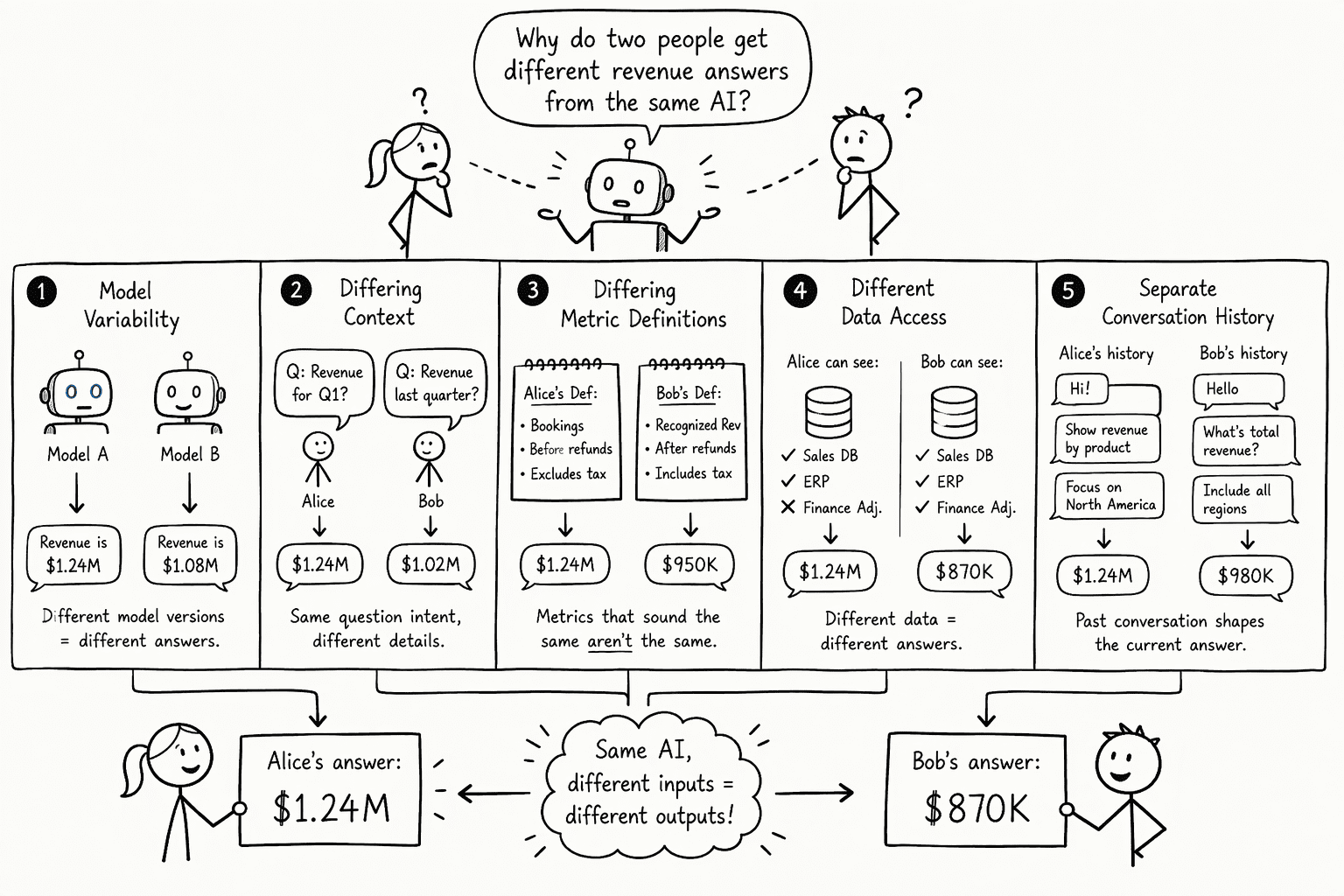
The first step is naming what you are actually fighting. AI gives different people different answers for five reasons: the model varies its output by design, each person supplies different context, each person carries a different definition of the metric, each person reaches different data, and each person has a different conversation history. Only the first reason is the model's fault. The rest are your team's.
Non-deterministic output is the one you cannot fully eliminate. Language models generate text word by word, choosing from many plausible next tokens instead of retrieving one fixed answer. Even settings meant to be deterministic don't fix it. In a study of non-determinism in LLMs, none of the models tested consistently delivered repeatable accuracy across tasks, much less identical output strings. Treat that as a given and design around it.
The real damage comes from the other four. When a rep asks for pipeline without specifying the fiscal calendar, and a VP asks with a different one, the answers diverge. When "active customer" lives only in someone's head, each person gets whichever interpretation the model happens to pick. When the AI reaches whichever export the user happened to download, the numbers cannot align. And when two people have asked twenty different follow-ups in separate threads, the assistant is navigating two different maps.
So, treat the first root cause as a given. Diagnose and fix the other four, and you remove the variance you can actually control.
Step 2: Establish a Multiplayer AI Workspace with Centralized Definitions and Context
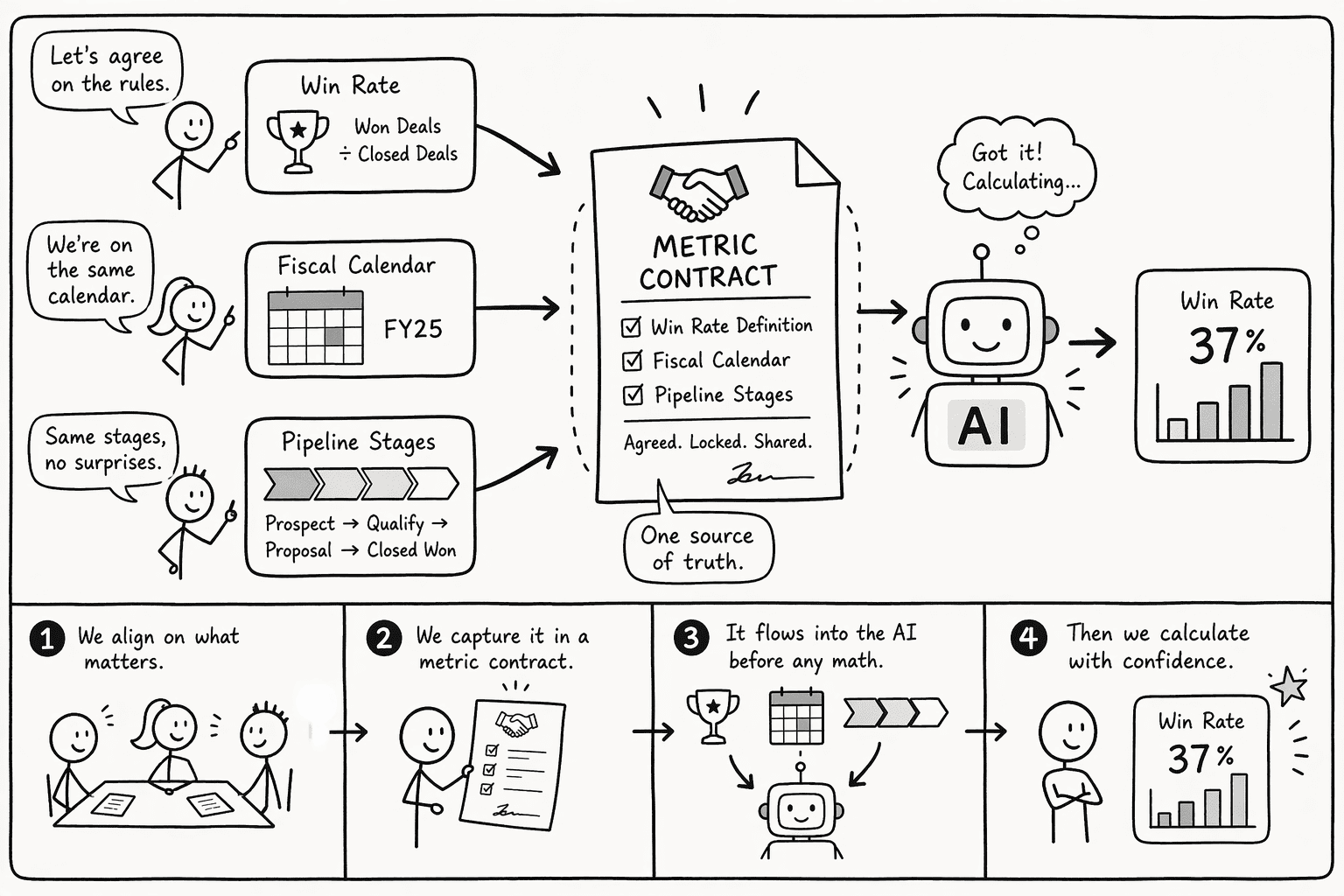
Most teams skip this step because it sounds like a documentation project. It is actually a reconciliation project. You need one place where "win rate," the fiscal calendar, and every pipeline stage are written down as machine-readable definitions the AI reads before it computes anything.
Write the metric definition explicitly: what one row represents, the numerator, the denominator, the time window, and the filters. When a definition is missing, the AI fills the gap with a guess, which is how two people end up with two different win rates.
PromptQL gives your team a place to keep these definitions. Its wiki shares knowledge and ways of working across people and bots, and when someone corrects an answer in a thread, PromptQL can capture the correction as a cited wiki entry, which a person approves, edits, or rejects. The next person's answer starts from that entry, so everyone works from the same definition.
Shared context works best when the team has agreed on its definitions first. Without that agreement, you're just broadcasting ambiguity to everyone who queries the data.
Step 3: Implement Role-Based Identity and Data Access Controls
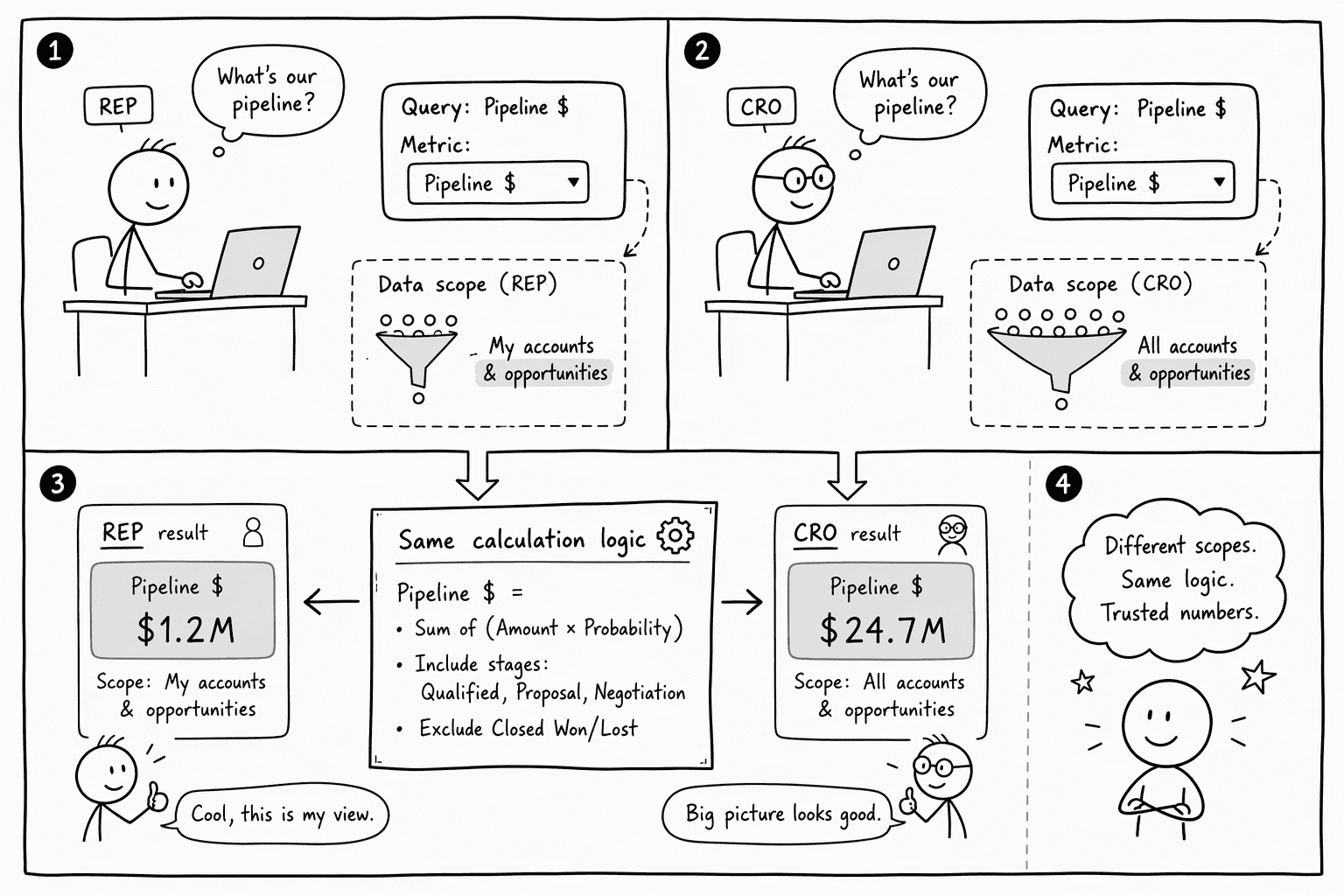
A rep asks "what is my pipeline" and sees their own book. The CRO asks the same question and sees the whole organization. That variation is correct. It only breaks when the underlying calculation changes between those two views. The definition must stay identical; the scope changes based on who is asking.
This separation matters because it removes the fear that multiplayer AI means everyone sees everything. PromptQL acts with each user's permissions, and users cannot ask the bot to access another user's data, so a whole team can work from one multiplayer AI without exposing records anyone shouldn't see.
The mechanism is role-based access control tied to the query layer. PromptQL enforces permissions at the data layer, not in the model. A rep's query runs against the same definition as the CRO's, but the data it can reach is scoped to what that rep already has access to in the CRM.
When a rep and a CRO get different revenue totals, you need to know whether the metric definition diverged or the data scope diverged by design. One is broken. The other works as intended.
A system with role-based identity and a shared definition library lets you diagnose which scenario you are in. This step handles the problem about who can see what, cleanly and auditably.
Step 4: Deploy Auditable, Plan-Based Execution with Deterministic Runtimes
Until every answer carries an audit trail, contradictory outputs are just arguments. You need to see what plan ran and what query produced the number.
With PromptQL, you can see the plan and query behind each answer, and its approach is deterministic plan execution: it generates a human-readable query plan, then executes it against your source data.
Here is how that compares with the opaque alternative most teams are stuck with.
| Feature | Auditable, plan-based execution | Opaque probabilistic generation |
|---|
| Intent visibility | The plan and query behind each answer are visible | You see only the final answer |
| Execution | A generated plan is executed deterministically against source data, so the number traces to a query | The model produces the number itself, and it can differ from run to run |
| Corrections | A reviewer's fix becomes a cited wiki entry with revision history that the next query reads | Corrections are conversational nudges that vanish when the thread ends |
| Repeatability | The same plan runs the same way against the same data | Even settings meant to be deterministic can produce different outputs on different runs |
Step 5: Maintain versioned knowledge bases and shared wikis as a single source of truth
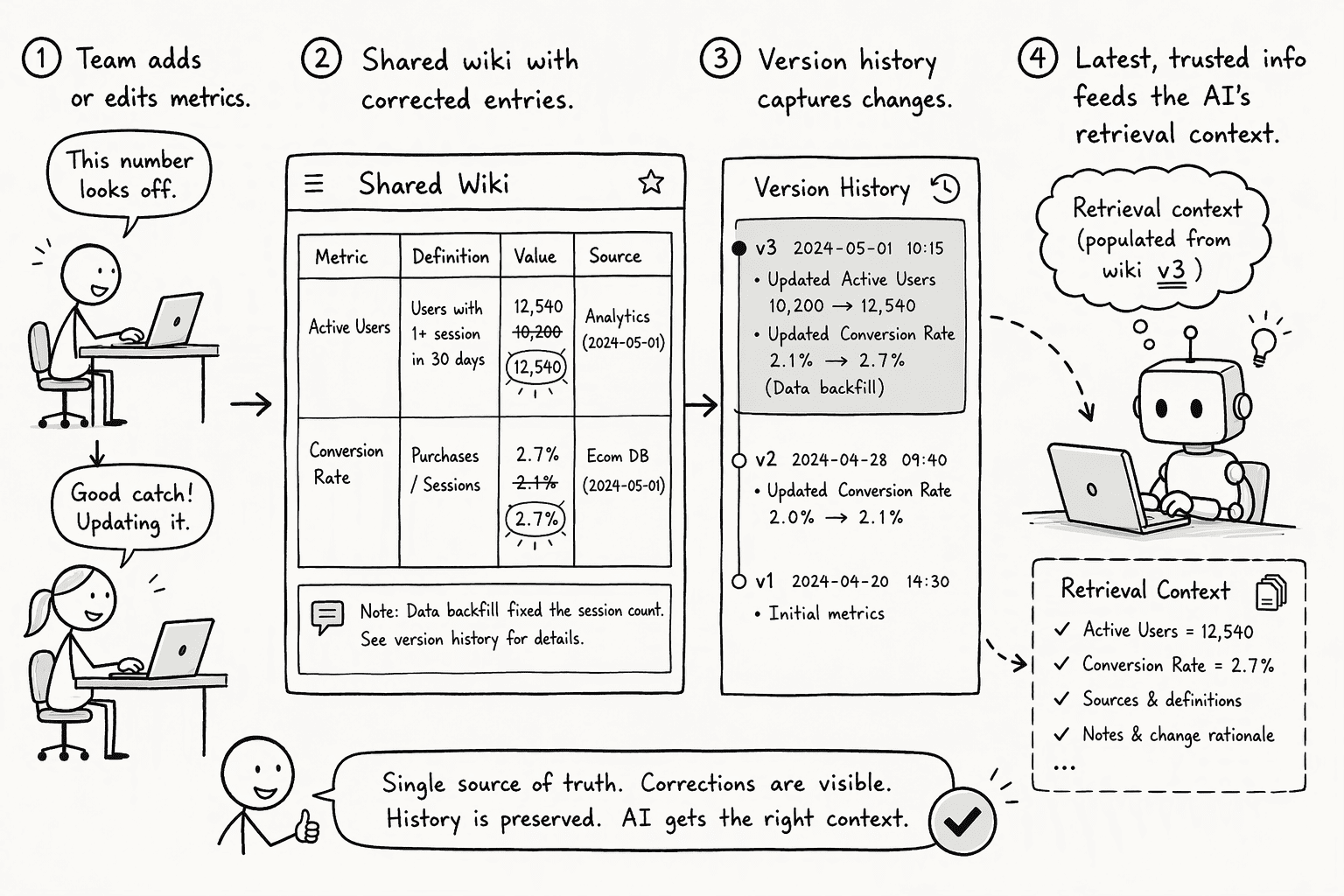
A definition library only works if it stays current and everyone queries the same version. Build the knowledge base as a living artifact the AI draws from directly.
Here is what that looks like in practice:
- Start with a shared wiki that the AI can read. Every time someone defines a metric or clarifies a business rule, that entry can become part of what the AI reads. No more Slack threads that fade.
- Capture corrections as versioned entries. When a reviewer catches a wrong calculation, the fix can be captured as a cited wiki entry with revision history. The next query starts from the corrected version.
- Keep revision history. When a definition changes, the old version stays traceable, so you can see what changed and when instead of untangling months of accumulated chat history.
Step 6: Choose a Consistency Framework: Contrasting Probabilistic Generation with Deterministic Execution
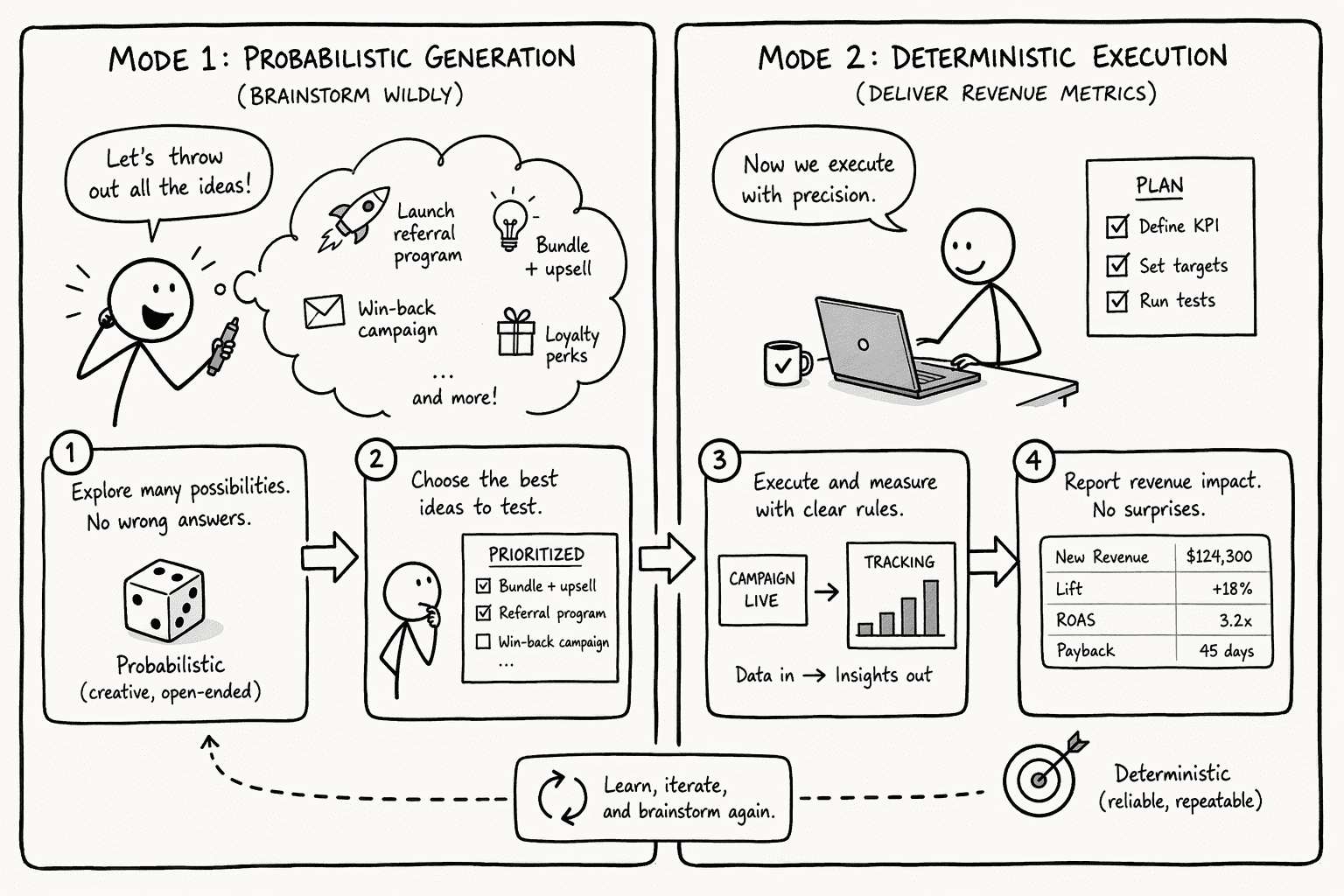
Not every AI answer needs to be a carbon copy of the last one. When you ask for a summary or a brainstorming list, variation is a feature that gives you different angles. But when you ask for last quarter's closed revenue, variation is a liability. The distinction comes down to what kind of work you are doing.
Business metrics need a calculation you can trace. The number must not change because the model sampled a different word.
Route metric questions through a plan-based runtime that executes a plan against your data, and let open-ended questions use general-purpose generation.
PromptQL's approach to data questions is deterministic plan execution: it generates a human-readable plan, then executes it against your source data.
You do not need to eliminate all phrasing variation. You need to eliminate the variation that changes the answers your team acts on.
Conclusion
Four of the five root causes of AI inconsistency live squarely in your business, not in the model. Shared definitions, role-based access, auditable execution, and versioned knowledge bases close the gap that matters: the variation your team can control.
The work is simple. Give the model you already have the same context, the same rules, and the same guardrails every single time.
Frequently Asked Questions
What causes team members to get different AI answers to the same question?
Five factors drive inconsistency:
How can a multiplayer AI workspace enforce consistent answers across an organization?
A shared workspace keeps business definitions like win rate and the fiscal calendar in one place, so every query starts from the same logic. In PromptQL, the wiki shares knowledge across people and bots, and corrections become cited wiki entries, which replaces scattered personal glossaries.
How does controlling AI identity and data access prevent inconsistent outputs?
Role-based identity scopes what data the AI can reach while keeping the underlying metric calculation identical. A rep sees their own pipeline; a CRO sees the whole org. The variation is intentional and legitimate, not a broken calculation.
What does an auditable, plan-based execution environment look like for team AI use?
It shows the plan and query behind each answer, so you can see how a number was produced. Code runs in a sandbox, and a reviewer's correction gets captured as a cited wiki entry with revision history. Contradictory outputs become traceable rather than mysterious.
How can versioned knowledge bases and shared wikis standardize AI context?
A shared wiki with revision history gives the AI a single source of truth that everyone queries. When a definition changes, the old version stays traceable, and the team always draws from the latest agreed version, which reduces knowledge drift.
What role does deterministic runtime play in making AI outputs repeatable?
PromptQL generates a human-readable plan and executes it deterministically against your source data, so a number traces to a query instead of to model sampling. The model can still vary its wording, but the figure your team acts on comes from the executed plan.
Sources
- Why AI Gives Different Answers to the Same Prompt - www.howaimodelswork.com
- Why AI gives different answers to the same data question - aianalystlab.ai
- When your bot gives two different answers to the same question | Isara - www.isara.ai
- Why AI Gives Different Answers Across Your Team - Von Labs - vonlabs.ai