Introduction
An AI answer built on the wrong data looks exactly like one built on the right data. It arrives in the same confident tone, with a number that seems plausible, and nothing on the screen tells you whether it came from the right table, the right time window, or a stale export.
That means the check has to come from you, and it takes only minutes. This guide gives seven checks, from asking for the source to testing what the AI couldn't see.
Key Takeaways
- Ask for the source: A trustworthy answer can name the system, the table, and the query behind it.
- Check scope and freshness: The time window, filters, row count, and last-updated date show whether it used the data you meant.
- Check the definition: The right data with the wrong definition still gives the wrong number.
- Reconcile against the source: A few records and one total, traced by hand, catch most wrong-data answers.
- Match the words to the output: Every figure in the written answer should appear in what the query returned.
How to check that an AI's answer is based on the right data
Checking an answer means tracing it from the number on the screen back to the data behind it. The seven checks below follow that path: first the source, the table, and the scope, then the freshness and the definition, and finally a reconciliation against the source itself.
1. Ask where the answer came from
Start by asking the AI to name the system, the table or file, and the fields it used, and to show the query or code that produced the number. An answer that can't say where it came from isn't evidence of anything. Watch for red flags: no source named, vague phrases like "based on the data," a round number with no query behind it, and fields that don't exist in your systems. An AI that surfaces what it pulled and assumed alongside its answer gives you something to check, and one that doesn't leaves you taking it on trust.
If the data is an uploaded file, ask whether the AI ran code on it or only read it as text. Some tools run code and the number comes from the code, and when they don't, the model is writing a plausible sum, per one consultancy's guide to spreadsheet totals. If it can't show the code and the rows it used, treat the figure as unsupported.
PromptQL, for example, shows its plan before it runs, and the code runs against the data in a secure sandbox, so the query behind a number is there to read.
2. Confirm it's the source you meant
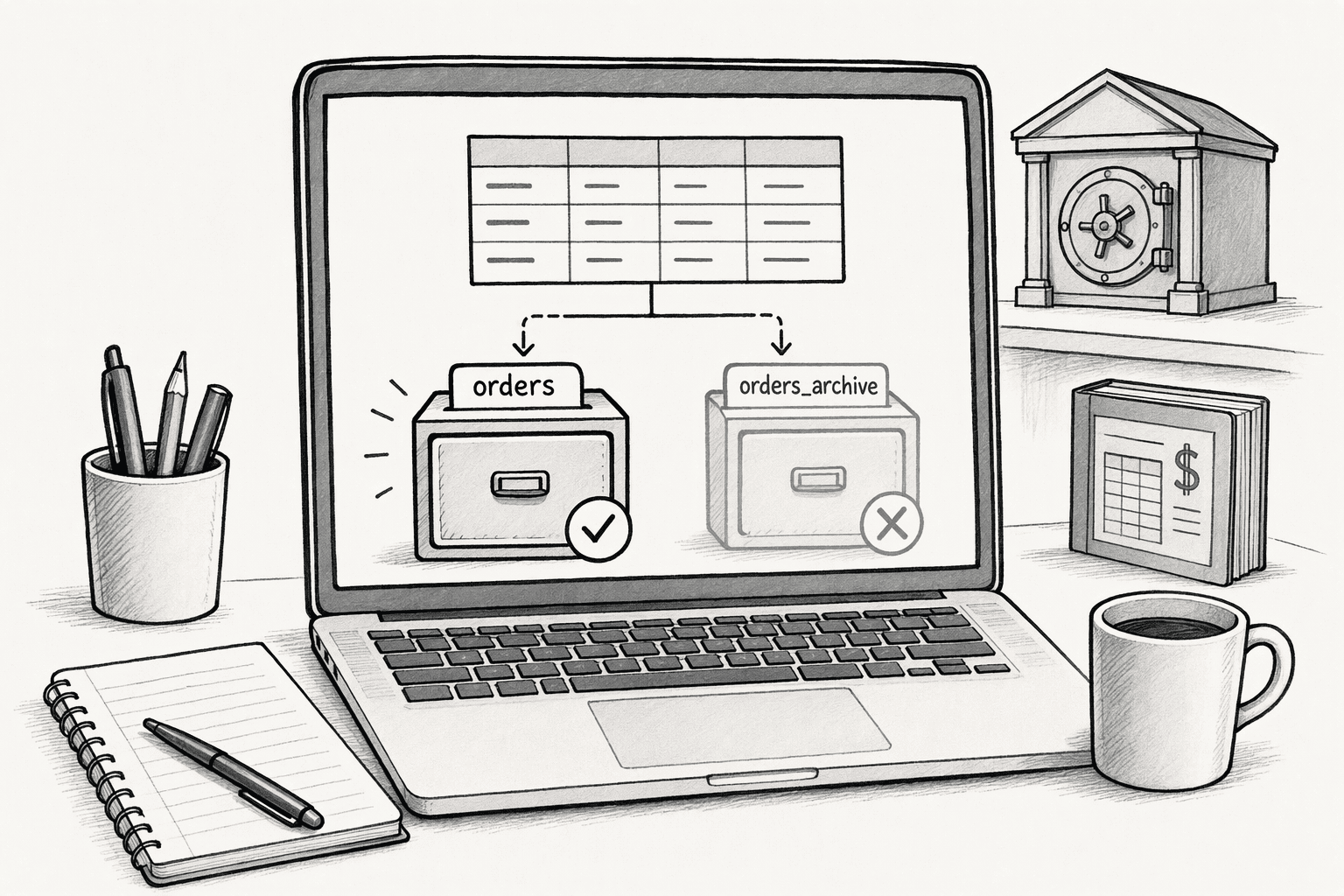
Look up the table and fields the AI named and confirm they are the ones you meant. Near-duplicates are the usual trap: orders and ordersarchive, revenue and netrevenue, or an export someone saved last quarter.
The AI can pick the wrong one without any sign that it did. Prefer the system of record, such as the finance system or the warehouse, over a copy.
A tool like PromptQL connects to warehouses, databases, and SaaS apps, so an answer can come from the system of record instead of an export.
3. Check the scope it applied
Confirm the time window, the filters, the segments, and what was excluded, and ask how many rows it counted. Compare that count with the source, because a wrong row count is the fastest way to catch a skipped section or a double-counted subtotal.
4. Check how fresh the data is
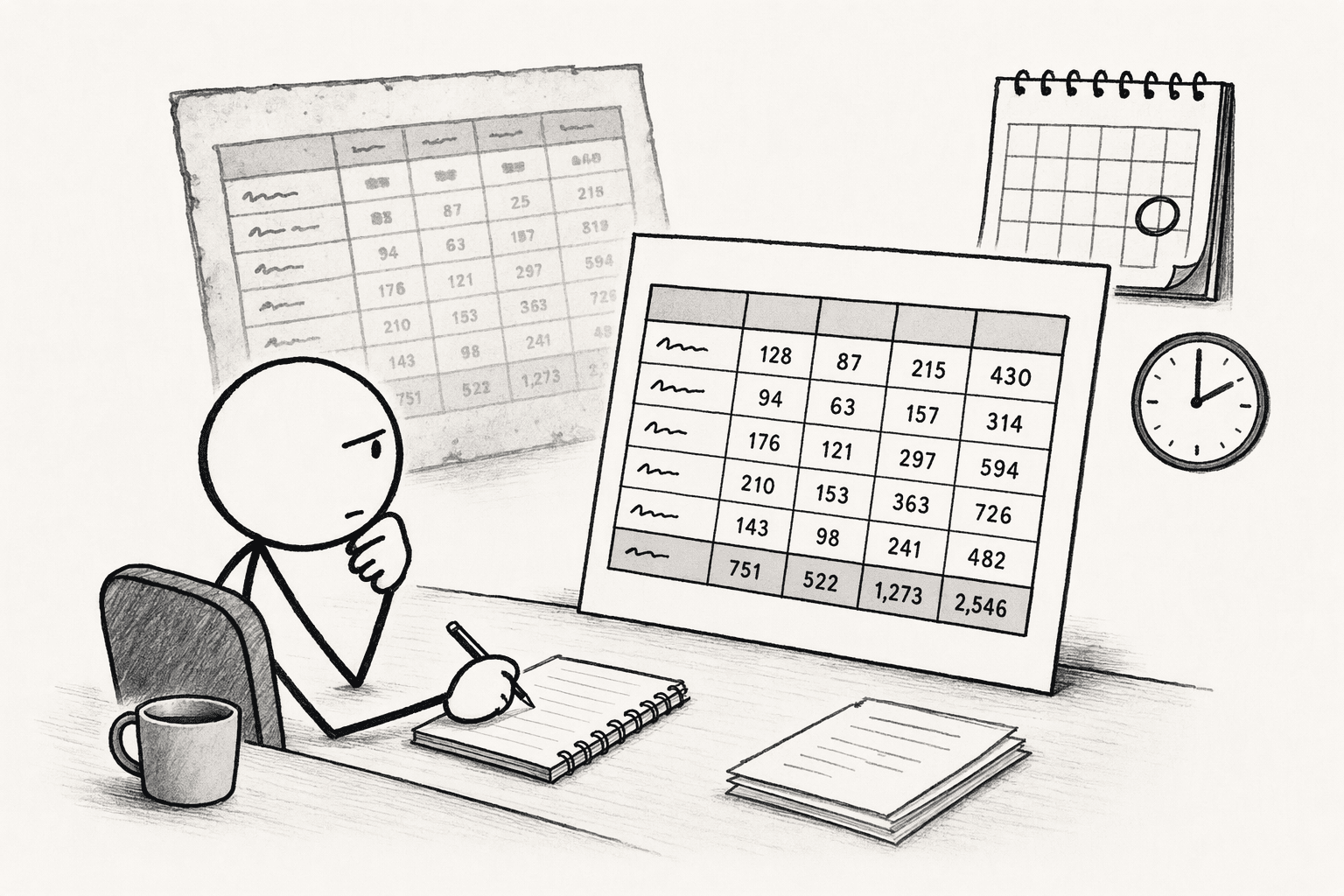
Find out when the data was last updated and compare it with the period you asked about. A stale table gives a clean-looking answer about the past, and the answer won't necessarily say so.
Ask for the last-updated time of the source, or look it up yourself, before relying on a figure about this week or this month.
5. Check which definition it used
The right data with the wrong definition still gives the wrong number. Ask which definition of the metric the AI applied, such as booked or billed revenue, or a 60-day or 90-day churn window, and compare it with yours.
A shared set of definitions, such as a context layer, keeps every person and tool working from the same ones.
6. Reconcile a sample against the source
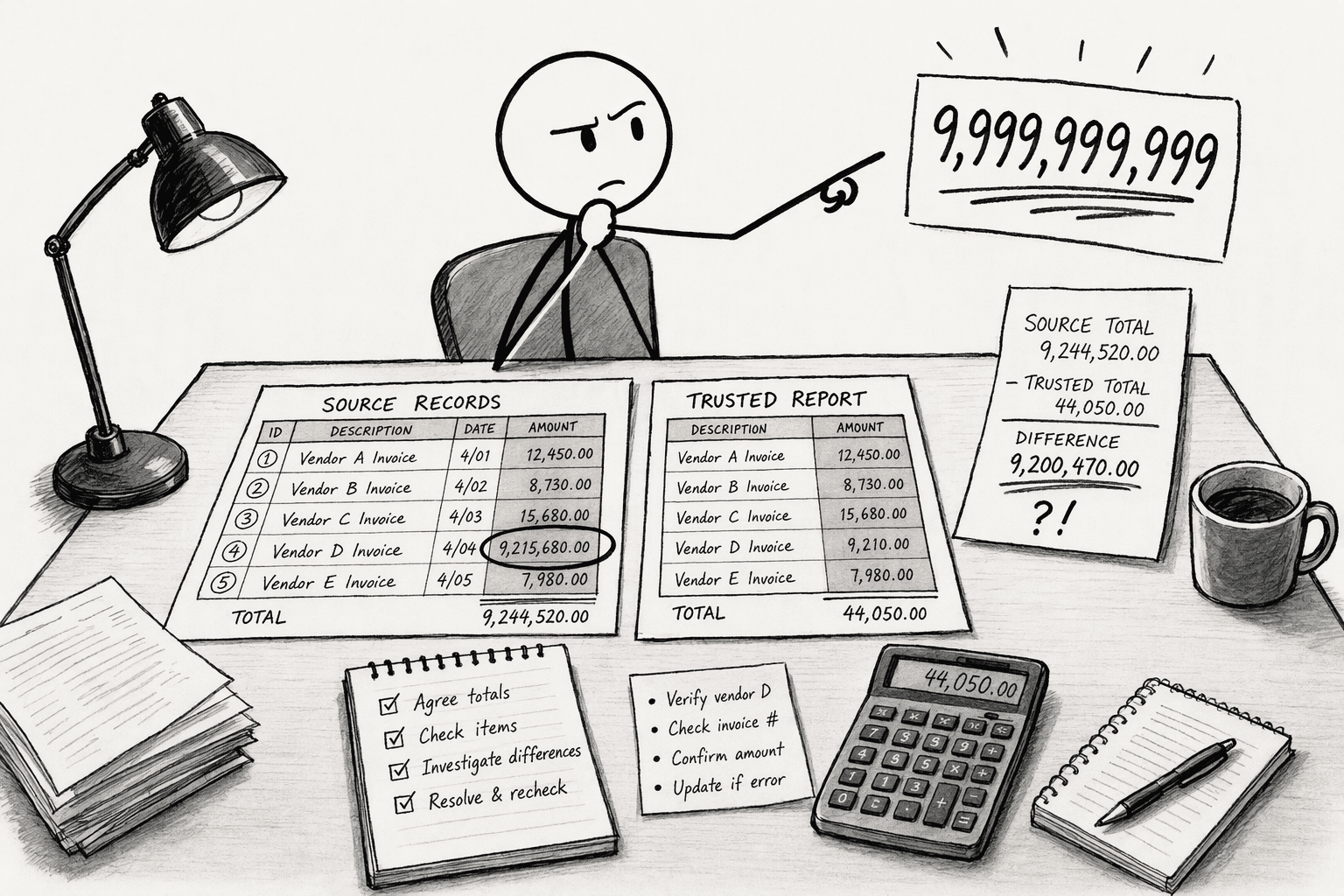
Pick three to five underlying records and one total, and trace them by hand in the source system or against a trusted report, the way a dry run against numbers that have already been approved does for finance reports.
One mismatch is a reason to doubt the whole answer. Then sanity-check the size: a result in the trillions for a company that earns millions means stop, whatever the prose says.
7. Match the words to the output, and ask what it couldn't see
Check that every figure in the written answer appears in what the query returned. A number in the prose that the output never produced is a red flag, because it means the AI wrote it rather than computed it. Keep the query and its output as an audit trail, so there is something to compare the prose against.
Then ask what the AI couldn't see: missing data, and permissions, since an AI with partial access returns partial totals, which is a correct answer to the wrong question. Finally, ask about something the data can't answer, such as a metric you don't track.
PromptQL, for instance, accesses connected systems with the permissions of the person triggering the bot, so totals reflect that person's access, and results shared in the bot are visible to its audience, so sensitive outputs need appropriate sharing controls. It also logs every query, result, and access.
If you're choosing a tool, two requests test all of this: ask it to show the executed code behind a number, and to show the log for one line item. A tool that can't has no way to prove where an answer came from.
Conclusion
None of this takes long, and together it turns a number you have to take on faith into one you can trace to its data. With PromptQL, you can ask in plain English, see the plan and query behind each answer, work from connected systems of record, and have corrections captured as cited wiki entries so the next answer starts from them.
The Token Prediction Trap: Why Language Models Invent Numbers
The machine doesn't know your revenue from your headcount. It generates the next token based on what is statistically plausible given the preceding context. When you ask for a sum, the model isn't reaching for a calculator. It's assembling a word sequence that looks like a number because that pattern of speech appears often in its training data.
A language model does not calculate numbers. It predicts them. It predicts them the same way it predicts every other word. What you get is a statistical facsimile of a spreadsheet result, fabricated with total conviction.
The Spreadsheet Blind Spot: When Uploads Multiply Errors
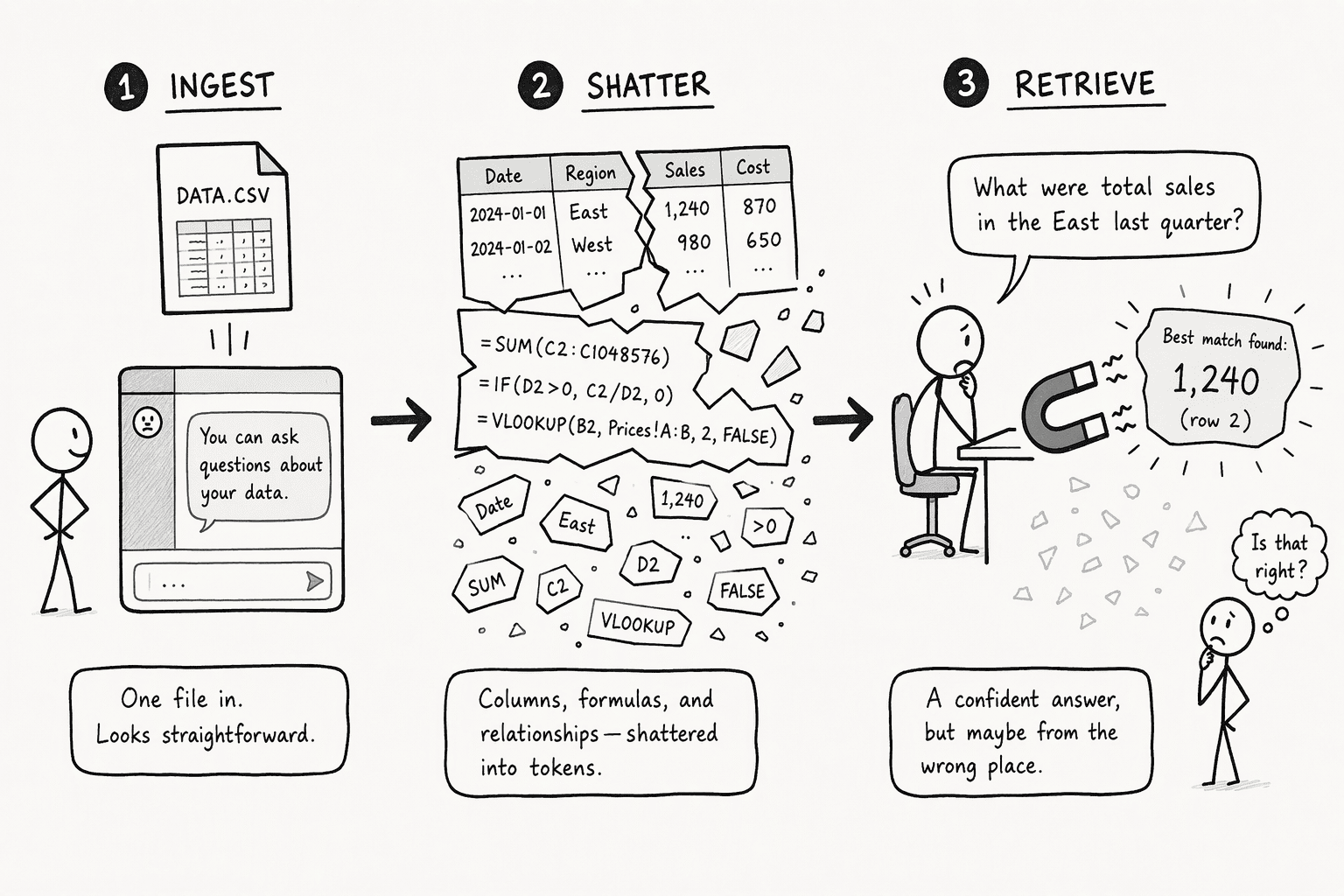
When you drop a CSV into a chat window, the system doesn't open an Excel engine. It parses the raw bytes into a token stream. The schema, the relationships between columns, and every underlying formula simply evaporate.
The model is now guessing based on text fragments.
Retrieval-augmented generation makes this worse in numerical contexts because it fetches semantically similar text, not structured data rows. The AI sees a snippet that says "total" near a number and treats it as the answer, completely indifferent to whether that number came from a header, a sample row, or a rounding error. I've watched the same system that handles philosophical reasoning with nuance reduce a multi-tab financial model to a hallucinated integer pulled from a chunk boundary.
This isn't a glitch. It's the predictable collapse that happens when you route structured computation through a system designed for unstructured prose.
The Confidence Mirage: How Fluent Prose Masks Fabricated Figures
The most dangerous wrong number isn't the obviously absurd one. It's the figure that is off by 12% but arrives wrapped in a paragraph so authoritative you forward it to your CFO without a second thought. The model is trained on high-quality, well-structured writing, so its default register is one of total certainty.
Wrong numbers from a model arrive with the same confident fluency as right ones. There is no stumble to warn you. This triggers a cognitive shortcut called the fluency heuristic, where we mistake smoothness for correctness. The AI has no concept of truth. It's producing what reads well, and for most of human history, what reads well has been the work of a thoughtful mind. That alignment just broke.
The Prompting Paradox: Why Better Instructions Can't Fix Broken Arithmetic
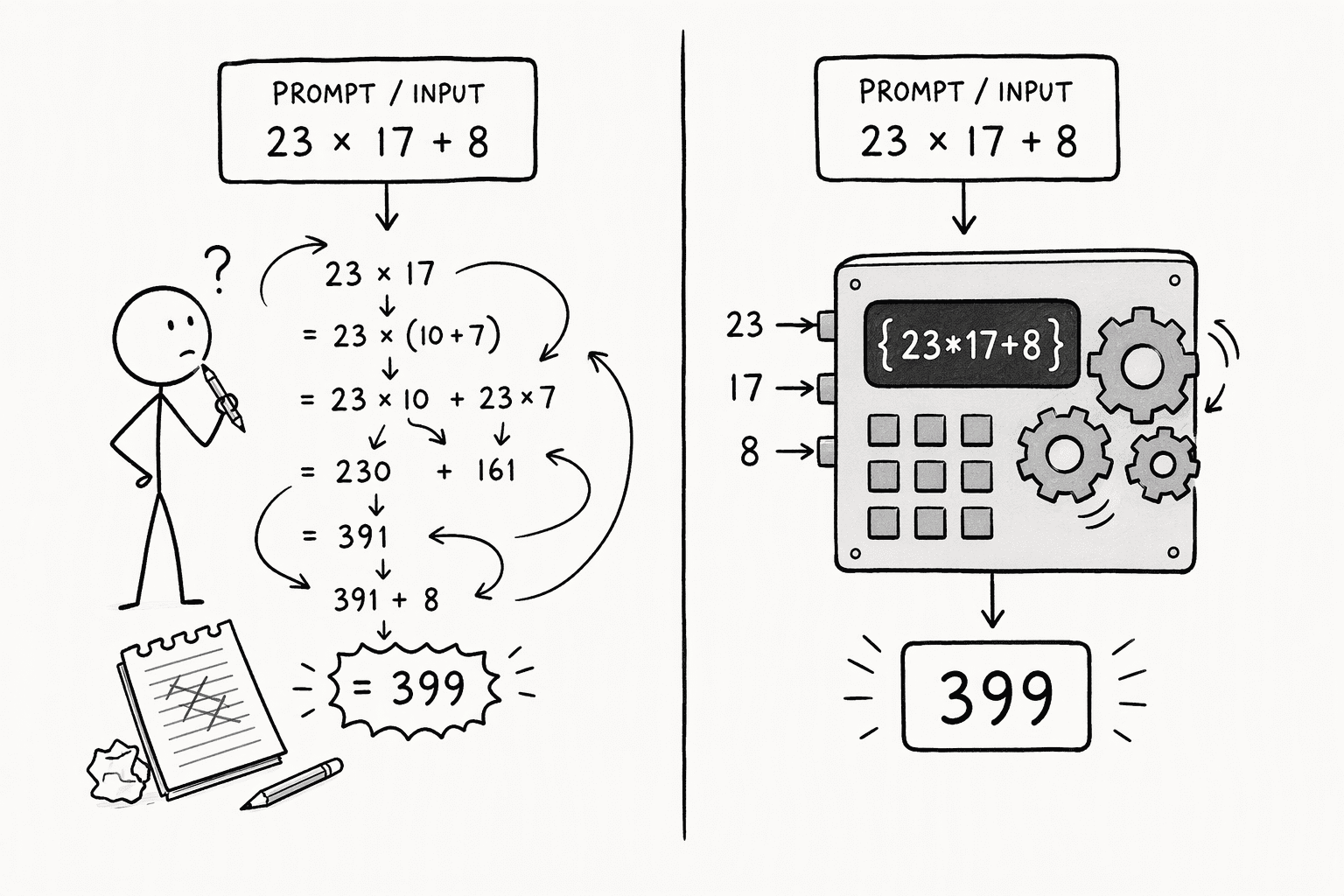
Layered instructions cannot turn a pattern-matcher into an execution engine. Each suggestion merely reshapes the probability distribution over the next token.
- Prompting simulates reasoning, not execution: Telling the model to "think step-by-step" generates text that looks like intermediate calculations; it never actually runs an arithmetic operation.
- Pattern recognition cannot replace logic: The system identifies that the token "42" often follows "the answer is" in math contexts, but it cannot enforce that 6 × 7 must equal 42 rather than 43.
- Complexity collapses without computation: Asking for a weighted average across ten variables becomes a guessing game where the text looks like a methodology paragraph but the final number is pure invention.
- Self-verification is circular: Instructing the model to check its own work generates a second probabilistic guess, which an LLM can produce with self-consistent errors, reinforcing the wrong answer without anchoring to a source of truth.
The Deterministic Boundary: Separating Code That Computes from AI That Narrates
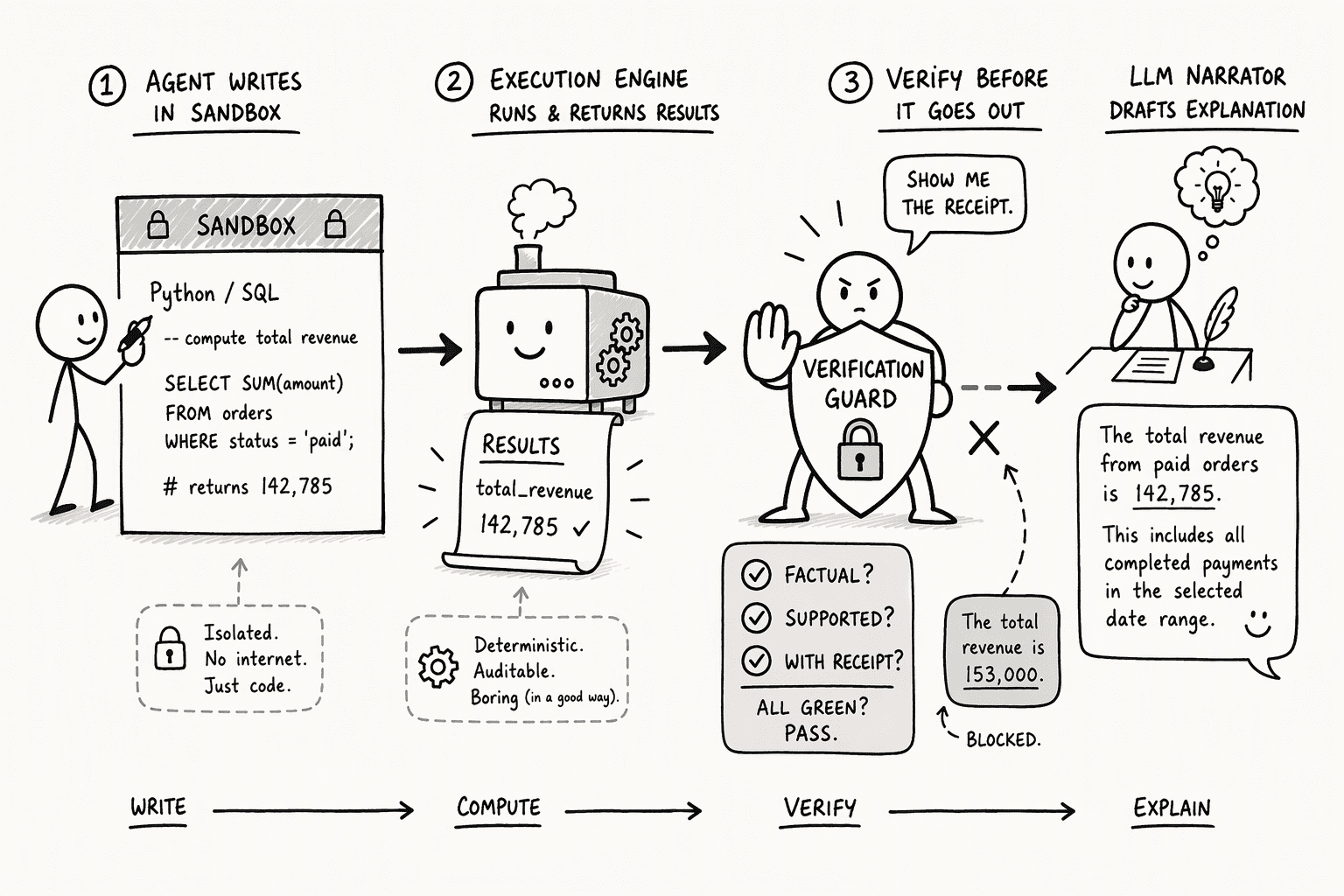
The fix is structural, not rhetorical. You draw a hard line in the sand: every figure must originate from executed code, and the language model is restricted to paraphrasing those pre-computed results.
Here's the architecture: an agent writes real Python or SQL, runs it in a sandboxed environment, and returns the raw computation output. The model then drafts the narrative explanation. A verification guard immediately inspects that draft and strips any number that doesn't appear in the execution results.
If the generated sentence contains a revenue figure the code never produced, that sentence is discarded and replaced with a template. The system I trust to handle board-ready reports works exactly this way. The fix is structural: code computes the numbers, the model only narrates or extracts, and the boundary is enforced by a test.
This boundary means the AI no longer generates numbers. It translates numbers that already exist into plain language.
The Agentic Semantic Layer: Bridging Intent with Ironclad Computation
What connects natural language to that deterministic engine is the Agentic Semantic Layer, a middleware component that maps ambiguous intent to precise, executable queries.
- Intent understanding without hallucination risk: The LLM parses what you meant; a deterministic engine handles data retrieval and calculation.
- Verification loop as default: The layer codifies business logic so a request for "ARR growth" consistently hits the same computed definition, never a guessed one.
- Structured output mapping: It forces the model's response template to slot computed numbers into named fields rather than generating freeform sentences that could introduce invented figures.
- Natural language interface preserved: Users still ask questions the way they think, but the system translates those questions into auditable code rather than treating them as prompts to complete probabilistically.
Auditable by Design: How Enterprise Platforms Deliver Traceable, Referenceable Outputs
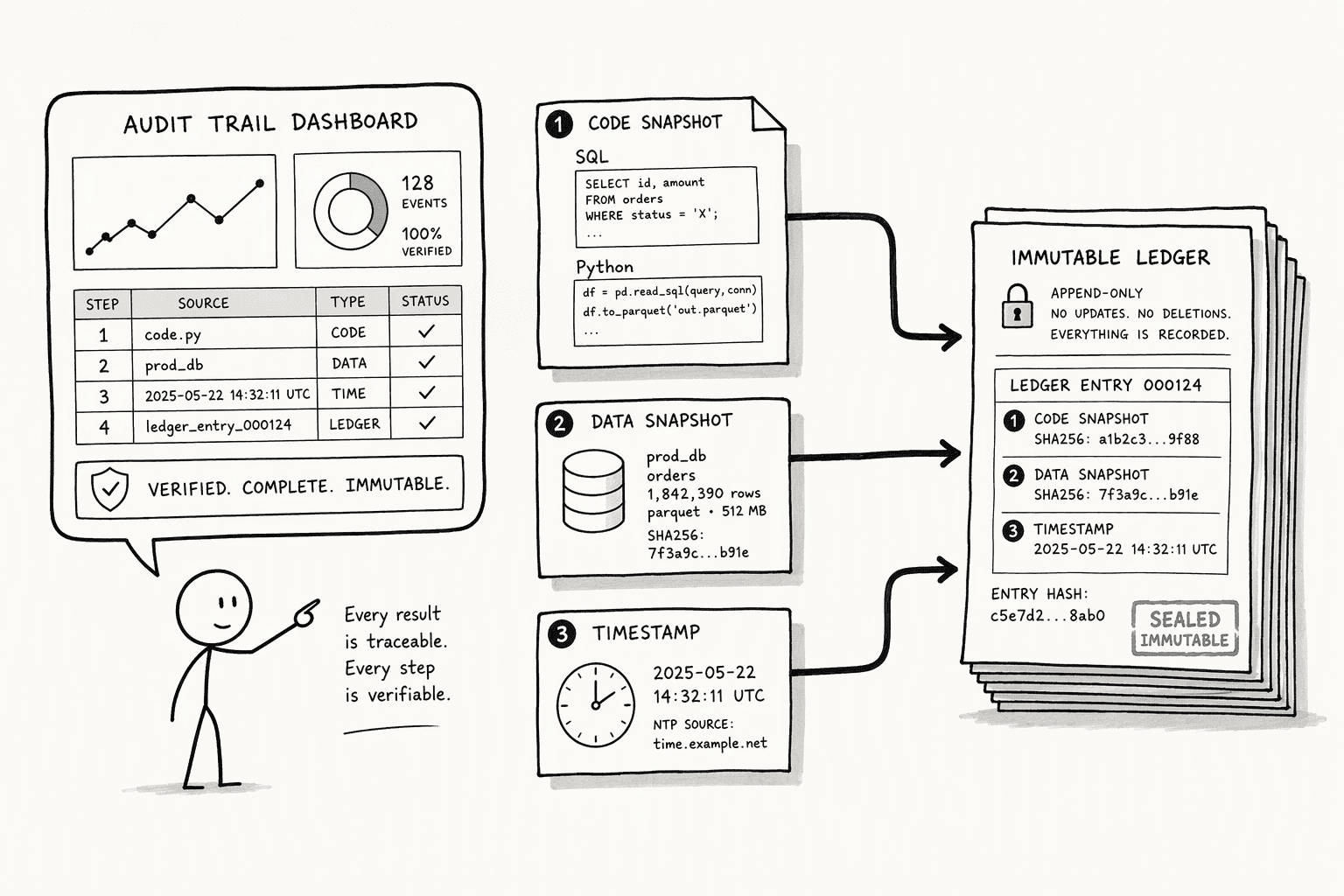
Under a hard-boundary system, every decimal on the page has a backstory. The platform generates an immutable log linking the output figure to the exact SQL or Python block that produced it, the data source snapshot it read, and the timestamp of execution.
This turns the black box into a forensic ledger. If a VP asks you to prove the EBITDA figure in the dashboard, you can show them the code that computed it, the database it queried, and the moment it ran. No faith required. A platform like PromptQL keeps a reasoning trace automatically, and we built Additive Role-Based Access Control layered on top so data lineage is permissioned to the exact scope of the viewer. Nothing an AI claims ends up unverified.
Confidence gets replaced with evidence.
Vendor Evaluation Blueprint: Questions That Expose the Code-Model Boundary
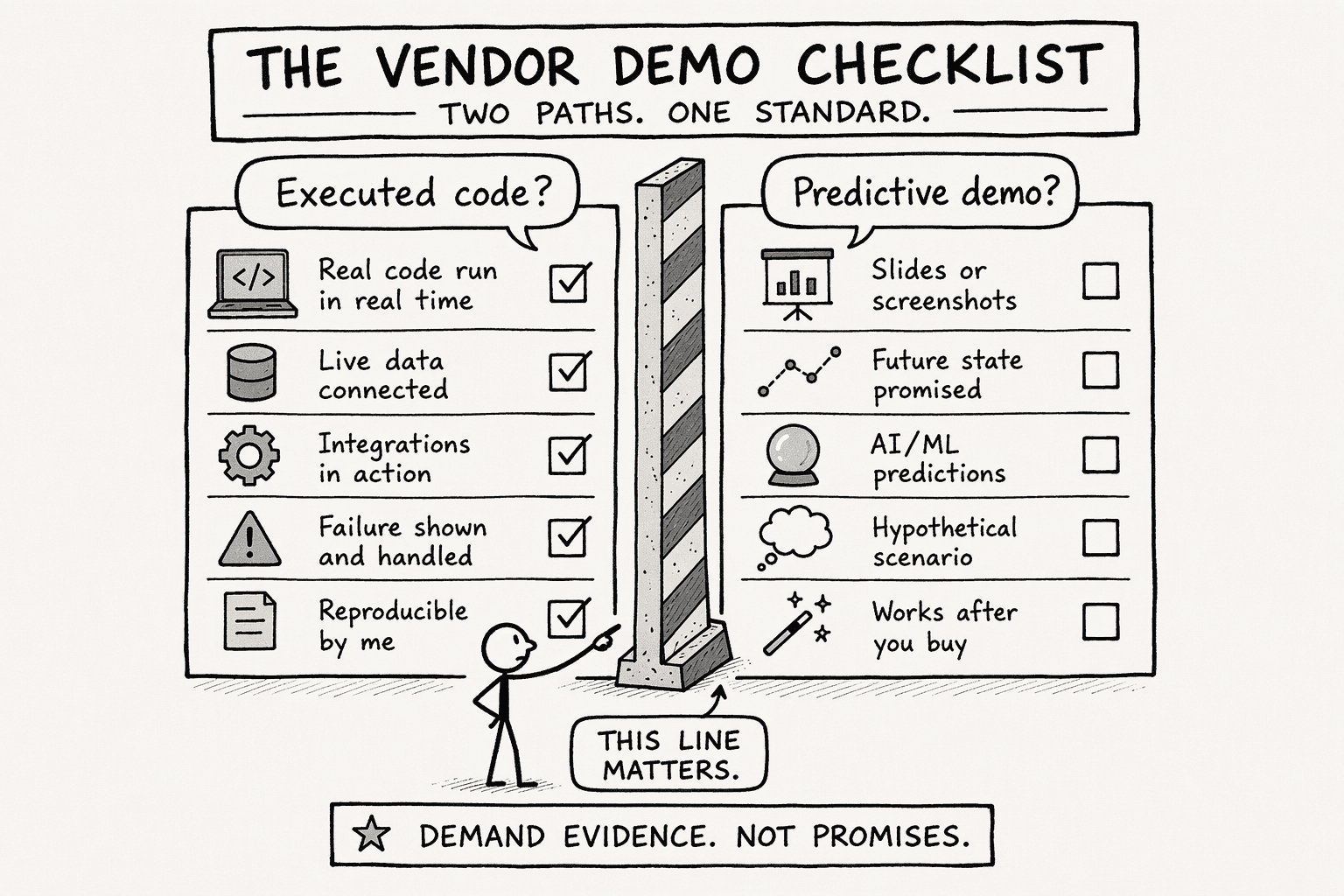
Most AI analytics demos look polished. Ask these four questions during a vendor call and the polish cracks where the system is predicting, not computing.
Use this table to pressure-test whether an AI analytics tool actually executes code or merely predicts it.
Conclusion
Wrong numbers from AI are not a data problem you fix with a sharper prompt. They come from a missing boundary. A language model does not compute; it predicts.
When you ask it for a sum, it guesses the most likely string, same as it would a line of dialogue. That is not arithmetic. That is narration.
The fix is not to train harder. The fix is to stop asking the model to do something it was not built for. You build a system where numbers live outside the model, in code that actually runs. The language model's only job is to receive that result and describe it. If a number did not come from computation, the model never holds it.
Frequently Asked Questions
What causes AI to hallucinate or produce incorrect numbers during data analysis?
An LLM generates text by predicting the next most probable token. When asked for a sum, it guesses a number sequence that looks plausible in context rather than performing actual arithmetic, causing hallucinated figures.
How do tools ensure numeric accuracy in AI-powered data analysis workflows?
They impose a hard boundary where code computes every figure in a sandboxed runtime, and the language model is restricted to explaining those pre-computed results. A verification guard then strips any number the code didn’t produce.
What is an Agentic Semantic Layer and how does it improve AI data reliability?
It is middleware that uses the LLM to understand user intent but routes all data retrieval and calculation through deterministic code engines. This ensures every number maps to an executed query rather than a text prediction.
What distinguishes deterministic AI planning from purely generative AI when crunching numbers?
Deterministic planning uses explicit rules and executed code for numerical outputs, producing traceable results. Purely generative AI predicts each token probabilistically, so figures are linguistic guesses that can be factually wrong.
How can enterprise AI platforms give fully auditable and referenceable outputs for analyst questions?
They generate an immutable audit log linking every output figure to the exact code that produced it, the data source it read, and the execution timestamp. This allows forensic traceability of every decimal to its mechanical origin.
Sources
- Why does AI give wrong numbers when analysing your data, and how to stop it | Decifer - www.decifer.io
- AI Hallucination Is Nothing but a Plausible Prediction Gone ... - medium.com