If you have ever asked an AI system a question that spans two or three connected facts and gotten a confidently wrong answer, you have run into the core limitation of standard retrieval. Vectorize some documents, run a similarity search, hand the top results to an LLM, and for single-fact questions, that setup works fine. The moment your question connects multiple entities across a timeline or a document boundary, it tends to fall apart.
This guide breaks down what RAG is, the two main approaches to it, and how to decide which one actually fits the shape of your data.
Key Takeaways
- Standard RAG retrieves isolated chunks. It converts documents to vector embeddings and pulls whichever ones are most similar to your query, with no model of how those chunks relate to each other.
- GraphRAG retrieves connected evidence. It builds a knowledge graph of entities and relationships upfront, then traverses that graph at query time to assemble multi-source answers.
- The accuracy gain is real but specific. Enterprise teams report accuracy improvements of 15 to 30 percent on complex, multi-hop analytical questions when moving from standard RAG to GraphRAG.
- The cost is also real. Graph construction and traversal typically add 2 to 5 times more compute than a single vector search, along with higher storage overhead and latency.
- The tooling is production-ready. Neo4j's graphrag-python package, Microsoft's GraphRAG library, LlamaIndex's knowledge graph modules, and the GraphRAG-Bench benchmark accepted by ICLR'26 all point to a maturing space, not an experimental one.
What is RAG?
Retrieval-augmented generation is a hybrid architecture. Instead of relying only on what a model learned during training, it reaches into an external knowledge base, pulls relevant context, and hands that context to the model so it can generate a grounded answer.
Grounding an LLM this way reduces hallucination, adds domain knowledge the model never trained on, and supplies current information instead of relying on stale, frozen parameters. There are two main approaches to how that retrieval actually happens.
1. Standard RAG
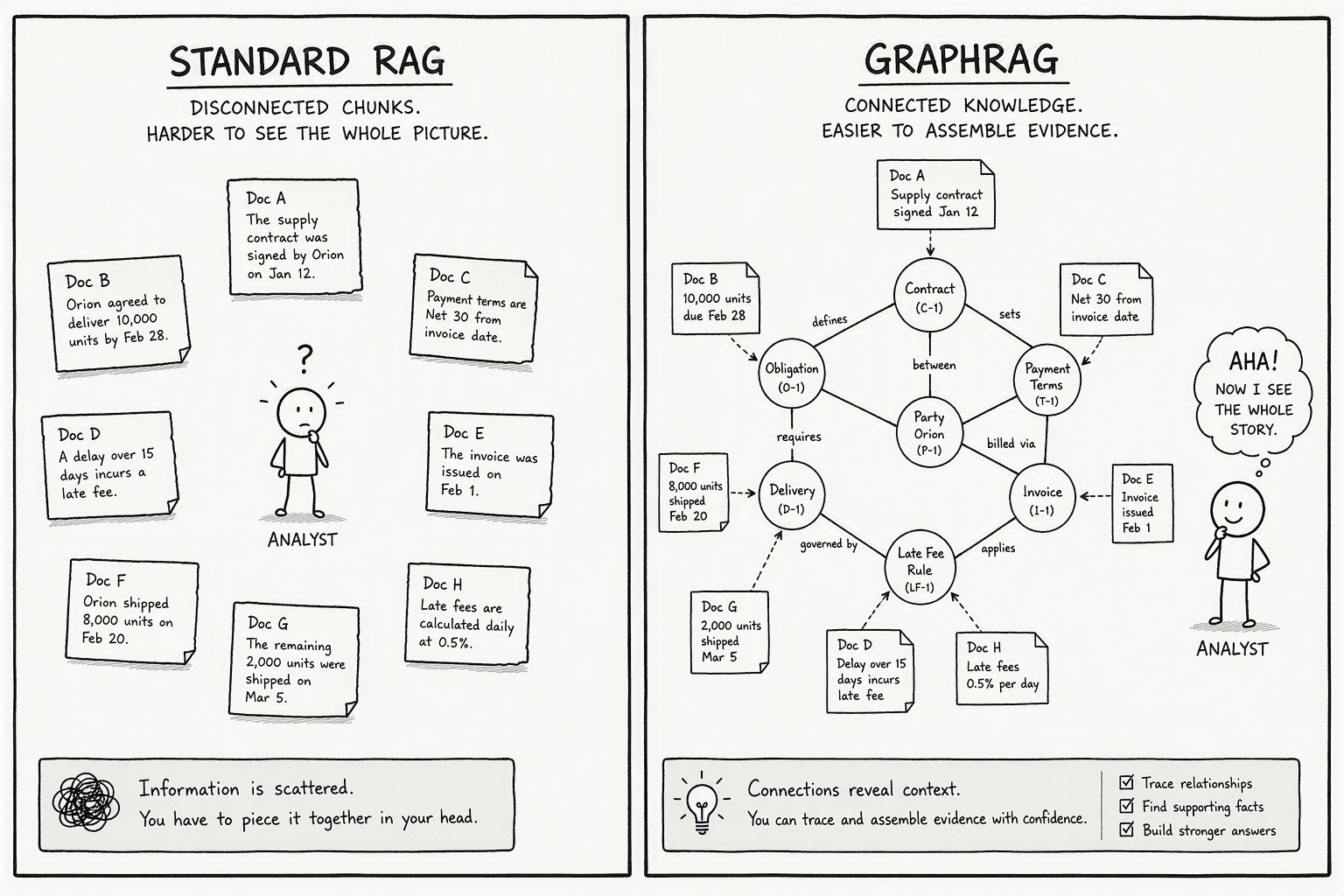
Standard RAG retrieves isolated text chunks through vector similarity and hands whatever lands in the top results to an LLM. Documents become embeddings, and the system fetches whichever chunks land closest to the query in vector space.
Here, every chunk is treated as independent. There is no model of how entities relate to each other across chunks, so if the answer depends on connecting information from two different sections, standard RAG has no mechanism for making that connection. That is exactly why it handles single-fact questions well, and exactly why it struggles the moment questions get more complex.
So, this is how it works:
- Chunk the source documents into smaller passages
- Convert each chunk into a vector embedding
- Store the embeddings in a vector database
- At query time, retrieve the chunks most similar to the question
- Generate an answer using the retrieved chunks as context
2. GraphRAG
GraphRAG constructs a knowledge graph from your documents upfront, extracting entities and the relationships between them, then traverses those structured connections at query time to assemble evidence from multiple sources.
Instead of treating a table as a bag of words the way naive chunking does, GraphRAG treats it as an entity with typed relationships to the filing date, the reporting period, and every other section that references it. The result is a system that reasons across an explicit structure of nodes and edges, capturing relational knowledge that flat vector search discards the moment documents get chunked.
So, this is how it works:
- Extract entities from the source documents: people, companies, locations, dates, and domain-specific concepts
- Create typed relationships between those entities, building a network where meaning lives in the connections rather than in embedding coordinates
- Detect communities of related entities and generate summaries for each one
- At query time, resolve the entities in the question and locate their corresponding nodes
- Traverse the graph, following edges to assemble a connected evidence chain, or draw on community summaries for broader questions
A query like "who leads the supplier mentioned in our risk section" becomes a walk across the graph: find the risk section node, traverse to the supplier entity, then traverse to that supplier's leadership node, and return the full chain as evidence. Standard RAG can only approximate that kind of connection through statistical co-occurrence. GraphRAG follows it directly.
GraphRAG vs Standard RAG
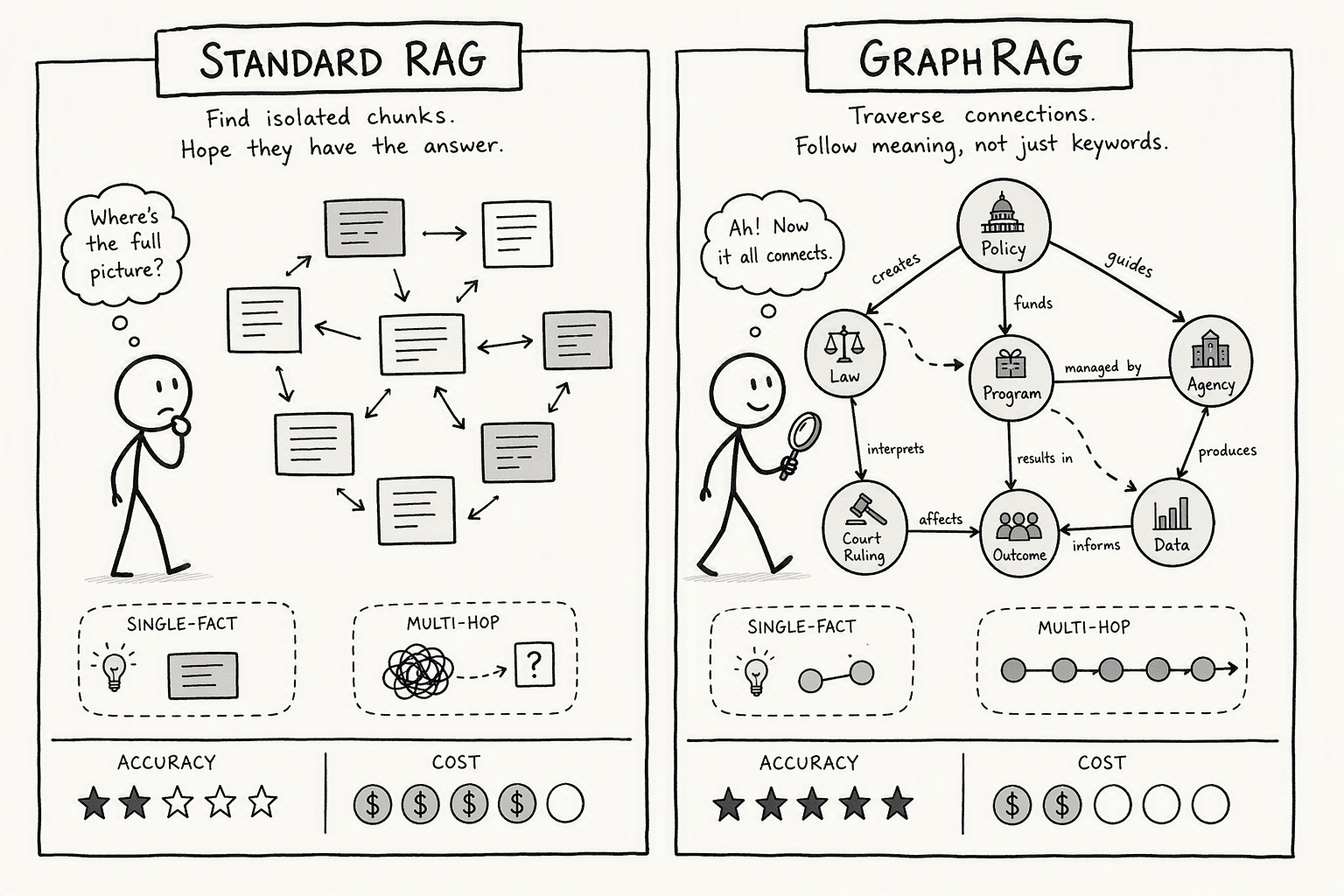
Here is how the two compare across the dimensions that matter most.
| Feature | Standard RAG | GraphRAG |
|---|
| Retrieval method | Vector similarity search on isolated text chunks | Knowledge graph traversal of entity relationships |
| Query handling | Best for single-fact questions | Excels at multi-hop, multi-entity questions |
| Accuracy on complex queries | Low; tends to miss cross-chunk connections | High; 15 to 30% improvement on analytical queries |
| Computational cost | Low; single ANN search | 2 to 5x higher; graph construction and traversal add overhead |
| Latency | Fast | Slower; depends on graph size |
| Ideal use case | Factual lookup in flat documents | Densely relational data (legal, medical, finance) |
| Tool maturity | Mature, widely available | Production-ready via Neo4j, Microsoft, LlamaIndex |
| Explainability | Low; retrieval is a black box | High; graph paths show reasoning chains |
Query modalities in GraphRAG
Standard RAG generally has one retrieval strategy: vector similarity, full stop. GraphRAG splits into three distinct query modes, and each is built for a different kind of question.
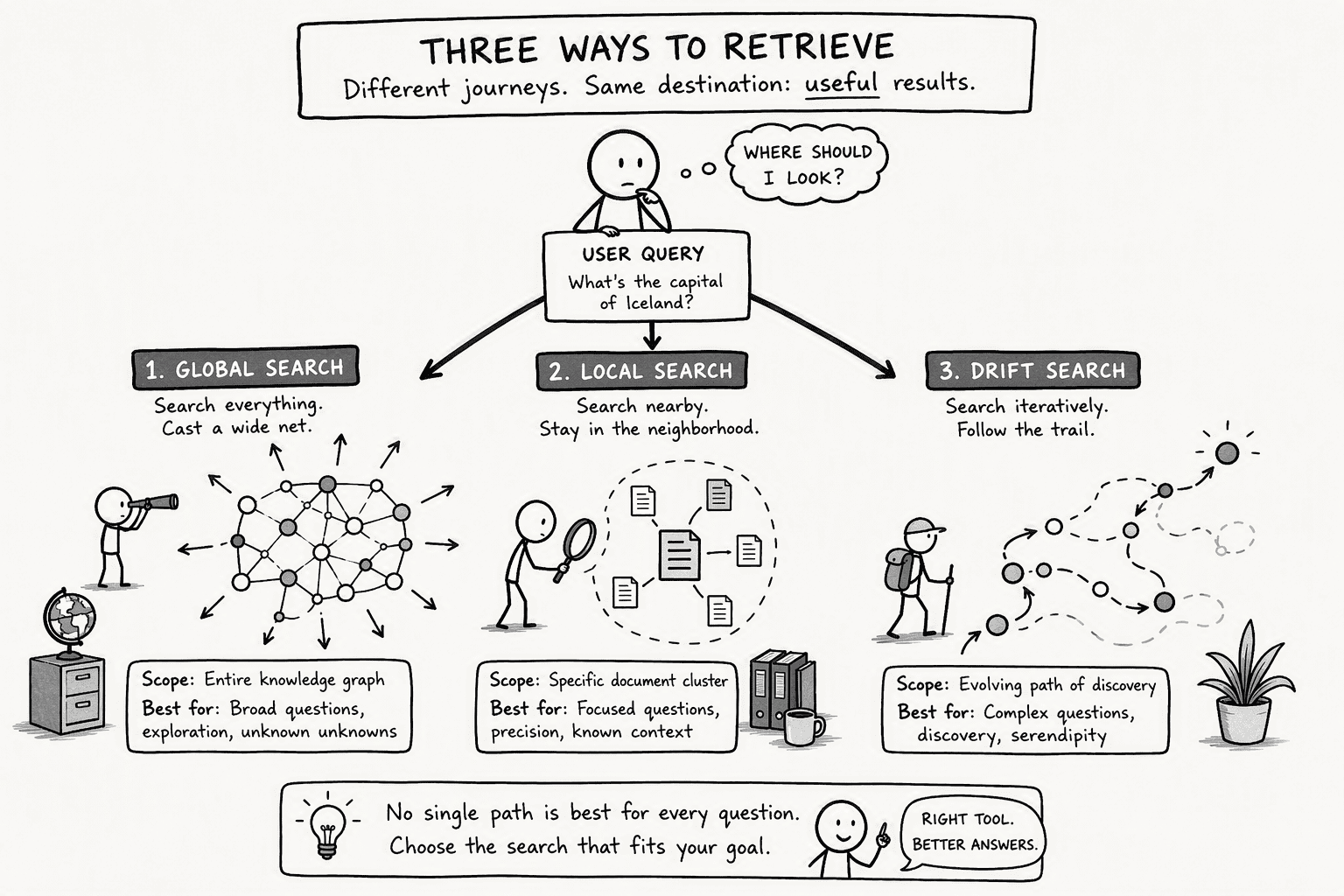
- Global search: Aggregates information across the full knowledge graph. When a question spans multiple communities, datasets, or document silos, this mode surfaces cross-cutting summaries. One 2025 analysis found GraphRAG reaching 86 percent accuracy on multi-hop summarization tasks, compared to 54 percent for a baseline vector RAG setup, with the gap widening as the number of hops increases.
- Local search: Stays narrow, pulling from a specific node's neighborhood. If someone asks about a single entity, policy, or event, this mode retrieves related properties and direct connections without noise from the rest of the graph. It is the closest equivalent to chunk-level retrieval, but it preserves explicit relationships instead of guessing at them through proximity.
- Drift search: Handles the in-between cases. A query starts at one node and expands outward step by step until enough context accumulates. A benchmark published at ICLR 2026 tested this pattern on multi-step reasoning tasks across 900 questions spanning corporate, legal, and scientific datasets, and found GraphRAG hit 81 percent answer coverage versus 62 percent for a standard RAG pipeline.
The practical takeaway: match the query to the modality, not the other way around. A simple entity lookup does not need a global traversal, a cross-document comparison will not work inside a narrow local neighborhood, and a question that starts specific but needs two or three hops will break against either extreme unless drift search is used.
Strengths, limitations, and when to use
Standard RAG
Strengths: Simple to set up, fast to run, and cheap compared to graph-based retrieval. It handles direct fact lookup well, since the answer usually lives in a single passage close to the query in vector space.
Limitations: It struggles the moment an answer requires connecting facts across document boundaries, since chunks are retrieved independently with no model of how they relate. It also performs poorly on corpus-wide or "what are the main themes" questions, since there is no mechanism for aggregating across the full dataset. PromptQL's own research on RAG failure modes found naive RAG scoring around 40% on a standard multi-hop reasoning benchmark, which lines up with the pattern described here.
Best fit: Straightforward, single-fact questions, smaller or less interconnected datasets, and situations where latency and cost matter more than connecting complex relationships.
GraphRAG
Strengths: Enterprise teams report accuracy gains of 15 to 30 percent on complex analytical questions, since graph traversal builds a chain of connected evidence instead of hoping the relevant passages happen to be neighbors in vector space. It is also significantly more explainable, since a graph path shows exactly which entities and relationships produced an answer, something flat vector retrieval cannot offer.
Limitations: Building the graph requires an entity and relationship extraction pipeline that has to process every document upfront, and storing the graph indices costs more than storing flat embeddings. At query time, entity resolution and traversal take more compute than a single approximate-nearest-neighbor search, generally landing at 2 to 5 times the combined indexing and querying cost. According to the GraphRAG-Bench benchmark accepted at ICLR'26, GraphRAG also frequently underperforms standard RAG on simple fact retrieval and creative generation tasks, since the added machinery brings overhead with no real payoff for those use cases.
Best fit: Densely relational data such as legal filings, medical records, financial disclosures, and enterprise knowledge bases, where the answer depends on connections between entities rather than any single paragraph. It is worth noting that the gap is narrowing in one direction: research on agentic, multi-round retrieval shows dense RAG systems can close some of the accuracy gap by introducing implicit structure through interaction, without ever building an explicit graph.
Running GraphRAG in production
GraphRAG's power is also its biggest enterprise risk. A system that can traverse arbitrary entity relationships across your entire knowledge base can, in principle, be asked for anything. That means governance needs to be structural, not just a policy on paper.
A few requirements matter most:
- Mediate every query through a semantic layer: No raw database credentials should ever reach the AI directly. A semantic layer sits between the model and the graph, translating natural-language intent into governed queries with scoped permissions.
- Use the LLM for planning only: The model should decompose a question into a traversal strategy, while the semantic layer actually executes it. This removes an entire class of hallucinated query paths, since the model never generates the final answer directly against raw data.
- Enforce row-level security end to end: Access scopes need to hold across retrieval, creation, and updates alike, not just at the initial query.
- Run in single-tenant infrastructure: Data should stay inside the customer's own cloud boundary rather than being shipped to a shared vendor inference endpoint.
- Audit every traversal: Since graph queries leave a structural trail, you can reconstruct exactly which entities and relationships were accessed for any given answer, producing a compliance artifact flat vector retrieval simply cannot offer.
Deployment matters just as much as governance here. Not every enterprise can send data to a shared cloud inference endpoint, and regulated environments typically need the full stack on-premises or in a dedicated VPC: the graph database, the semantic layer, and the reasoning model all run on infrastructure the customer controls. The AI layer never touches raw credentials directly, and every access path is governed rather than assumed safe.
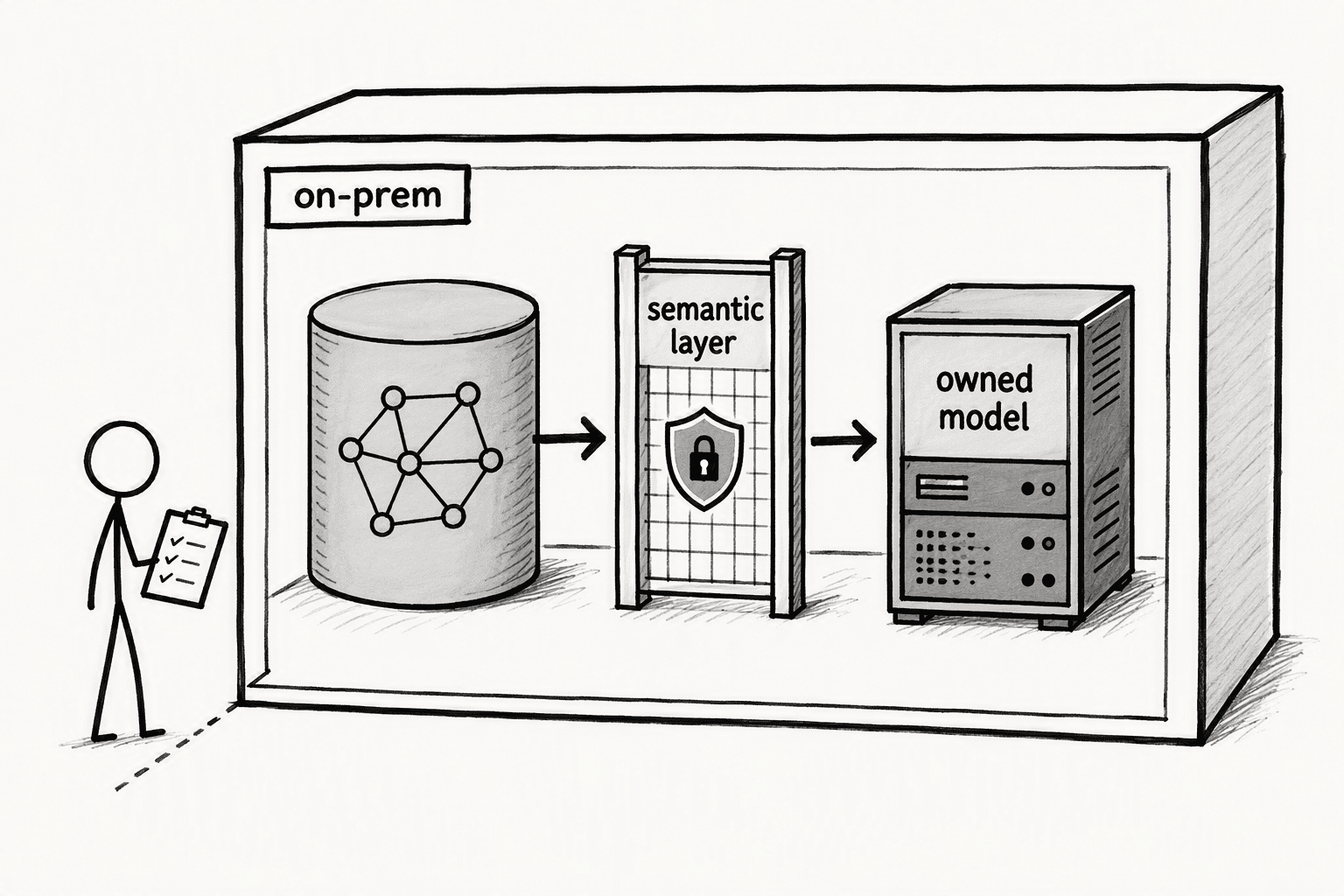
PromptQL is built around this model. It scopes every access through an agentic semantic layer that enforces permissions and audit at each step, deploys in the customer's own cloud, and lets teams choose their own reasoning model instead of locking into one vendor's endpoint. That's the same permission-aware approach we cover in how to set up a Slack AI bot that learns from corrections, where access follows the real person rather than a shared identity. See the full breakdown on PromptQL's architecture page.
How to decide which fits your team
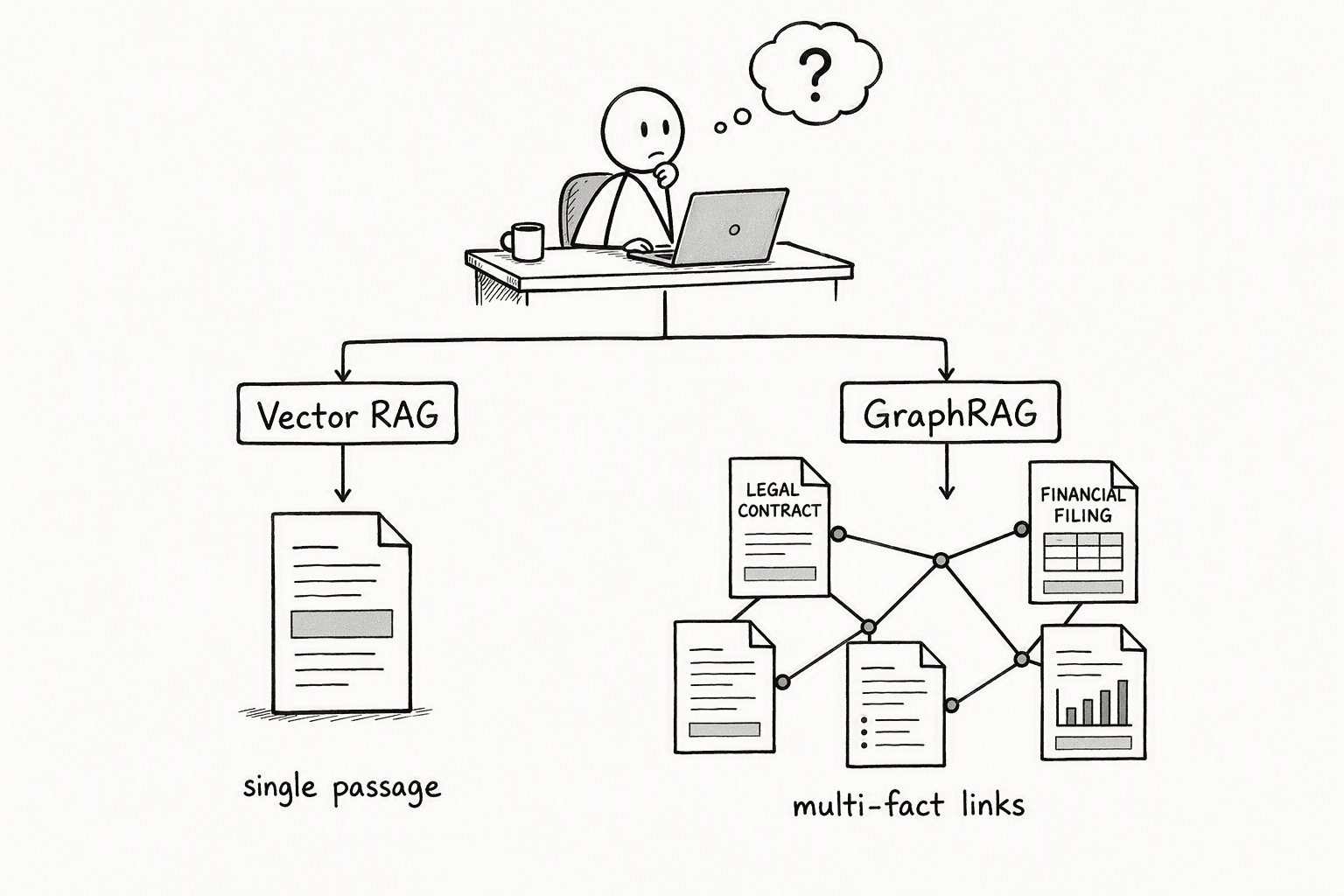
Run through this checklist against your own data and questions to decide which one is the right fit for you:
- Can most questions be answered from a single passage? If yes, standard RAG is faster, cheaper, and sufficient. If questions typically require connecting two or more facts across document boundaries, GraphRAG starts to earn its overhead.
- Do those connections follow structured relationships? GraphRAG only pays off when the facts you're connecting have a real relationship to trace, like a person to their company to that company's location, not just topical similarity.
- How badly does chunking break your data? Standard chunking turns a table into word soup and severs numbers from the sections that give them meaning. If your domain involves filings, clinical trial data, or contract repositories where entities and numeric values carry meaning through cross-references, a knowledge graph preserves those relationships in a way flat chunking cannot.
- Is your domain densely relational? Legal, medical, financial, and enterprise knowledge base data tend to reward the graph investment. Lightweight factual lookup or real-time chat tends to favor sticking with vectors.
- Do latency and cost outweigh the need for deeper connections? If speed and low compute cost matter more than tracing multi-hop relationships, standard RAG remains the pragmatic baseline.
If you're weighing AI agents more broadly rather than just the retrieval layer underneath them, our comparison of the best AI agents for Slack covers a similar decision framework for picking the right architecture for the job.
Conclusion
GraphRAG is a precision tool for connected data, not a blanket replacement for standard RAG. I use it when questions cross entity boundaries and the relationships carry the answer. I fall back to vector search when speed matters and the facts live in a single passage.
The compute overhead is real, and the accuracy gains only materialize when your data is genuinely relational. For the growing list of questions below, the answers are straightforward. Pick your architecture based on the shape of your questions, not the novelty of the technique.
Frequently Asked Questions
What is the difference between GraphRAG and standard RAG, and when should I use each?
Standard RAG retrieves isolated text chunks via vector similarity. GraphRAG builds a knowledge graph of entities and relationships, then traverses connections at query time. Use standard RAG for fast single-fact lookup. Use GraphRAG when questions require connecting multiple facts across document boundaries, especially in legal, medical, or financial data.
How does GraphRAG handle complex, multi-hop questions better than standard retrieval-augmented generation?
Standard RAG retrieves the top-k chunks and hopes they contain the full answer. GraphRAG models entities and edges explicitly, then walks structured paths like Person to Company to City. Instead of retrieving isolated passages by similarity, it follows relationship chains and assembles connected evidence.
What are the main limitations or trade-offs of using GraphRAG instead of standard RAG?
GraphRAG costs 2 to 5 times more compute for graph construction and query traversal, plus higher storage overhead. Latency increases because entity resolution and path traversal take more time than a single vector search. Recent benchmarks also show GraphRAG underperforms standard RAG on simple fact retrieval and creative generation tasks.
What kind of data and use cases benefit most from a graph-based retrieval approach?
Any domain where meaning lives in connections. Legal documents with cross-referenced clauses, medical records linking patients to conditions to treatments, financial filings where numbers depend on footnote relationships, and enterprise knowledge bases with dense entity hierarchies all reward the graph investment.
How has GraphRAG improved enterprise accuracy and contextual understanding compared to standard vector RAG in 2025 to 2026?
Enterprise teams report accuracy gains of 15 to 30 percent on complex analytical questions. GraphRAG's structured context reduces hallucinations and improves coherence by retrieving relationship-aware evidence instead of isolated chunks. However, agentic RAG systems are narrowing the gap through dynamic multi-round retrieval.
What tools or libraries are available today for implementing GraphRAG in a production US enterprise environment?
Neo4j's graphrag Python package supports multiple retrieval strategies including VectorCypherRetriever and HybridCypherRetriever. Microsoft's GraphRAG library is available on GitHub. LlamaIndex offers knowledge graph modules. PromptQL provides a managed semantic layer that deploys in your own cloud.
Sources
- [2604.09666] Do We Still Need GraphRAG? Benchmarking RAG and GraphRAG for Agentic Search Systems - arxiv.org
- GitHub - GraphRAG-Bench/GraphRAG-Benchmark: The official repo of GraphRAG-Bench for evaluating GraphRAG models. "When to use Graphs in RAG: A Comprehensive Analysis for Graph Retrieval-Augmented Generation". (ICLR'26) · GitHub - github.com
- Graph Retrieval-Augmented Generation: A Survey | GraphRAG - graphrag.com
- Road to NODES: Mastering Retrieval-Augmented Generation with the GraphRAG Python Package - neo4j.com
- How we built an agentic GraphRAG for financial disclosures with Docling | Red Hat Developer - developers.redhat.com