You get the Slack message on a Tuesday. A top performer is leaving. Instantly, you tally the project milestones they own and the client relationships they hold together.
But the real dread settles in later: every undocumented judgment call, every failed approach they'll never repeat, every shortcut they discovered over years. That dread is what NASA's Knowledge Capture and Transfer Working Group formally calls knowledge loss, a critical continuity risk where hard-won tacit expertise disappears permanently.
A systematic review of 91 empirical studies in The Learning Organization confirms this hits both organizational and unit levels, rippling across voluntary and involuntary departures. This article lays out the steps to stop the bleed before it starts, transforming a panic event into a structured, preservable knowledge transfer.
Key Takeaways
Grab these core principles before your next key person hands in notice.
- 90-day phased timeline: A structured countdown replaces a chaotic final-week scramble with a systematic transfer of operational intelligence.
- Critical knowledge targets first: Identify and document the top 20% of know-how that drives 80% of the role's value before day 30.
- Test-and-verify handoffs: Build shadowing, reverse-shadowing, and dry-run checkpoints into the final 30 days so gaps surface while the expert is still in the building.
- ROI on retention: Quantify what you preserved using turnover-cost formulas and project-velocity metrics to turn knowledge transfer from a fire drill into a funded program.
What gets lost when someone leaves
Documents capture what happened. They rarely capture why. A few things consistently disappear the moment someone walks out the door:
- The reasoning behind a decision: Which approach got reversed and why, which shortcut someone discovered after months of trial and error, or which client quietly hates a specific kind of request. That reasoning lives in someone's head until a deliberate process pulls it out, and most organizations have far more of this trapped expertise than they realize.
- Relationship context. A contact list with a name and an email address says nothing about who actually needs a phone call instead of an email, or which stakeholder relationship took months to rebuild after a rough patch.
- The last two weeks of runway. Waiting until someone's final stretch to start capturing any of this guarantees gaps, there simply isn't enough time to reconstruct years of context in a farewell sprint.
How to prevent knowledge loss when employees leave
1. Start the transfer early, on a real timeline
A structured, phased approach consistently outperforms a last-minute scramble. A practical structure looks something like this: early collection of tasks and tools in the first stretch of a notice period, deeper interviews to extract judgment calls and workarounds in the middle stretch, and a supervised handoff, shadowing and reverse-shadowing with a named successor, in the final stretch before departure. The goal is a transfer that gets tested while the source of that knowledge is still around to correct it.
2. Compile and verify the explicit digital assets
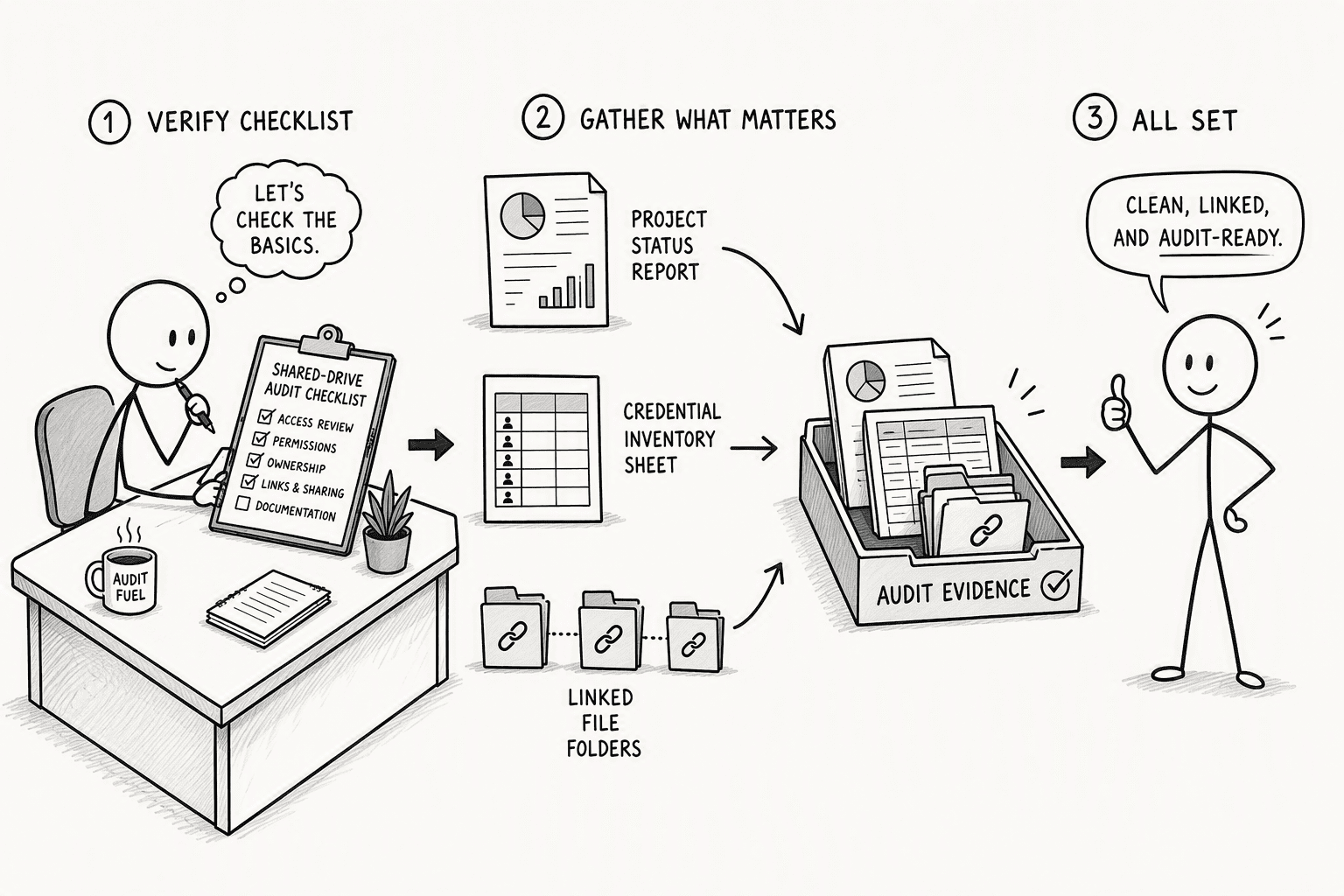
Pull together project status reports, an access credentials inventory, and any tools or scripts the role depends on, and verify each one is actually current. A file dropped into a shared drive on someone's last day is not the same as a confirmed, working asset. The goal is a snapshot a new person can open and trust, not a pile of documents they have to guess about.
3. Run a structured interview for tacit knowledge
A deliberate conversation extracts what a document never will: the decision that got reversed and the signal that triggered it, the approach that quietly failed, the political context behind why a certain request has to go through a specific person first. Treat it like field research. Ask about a decision that got reversed, and why, since the questions nobody thought to ask while someone was still around are usually the ones that mattered most.
4. Use AI to surface what interviews and documents both miss
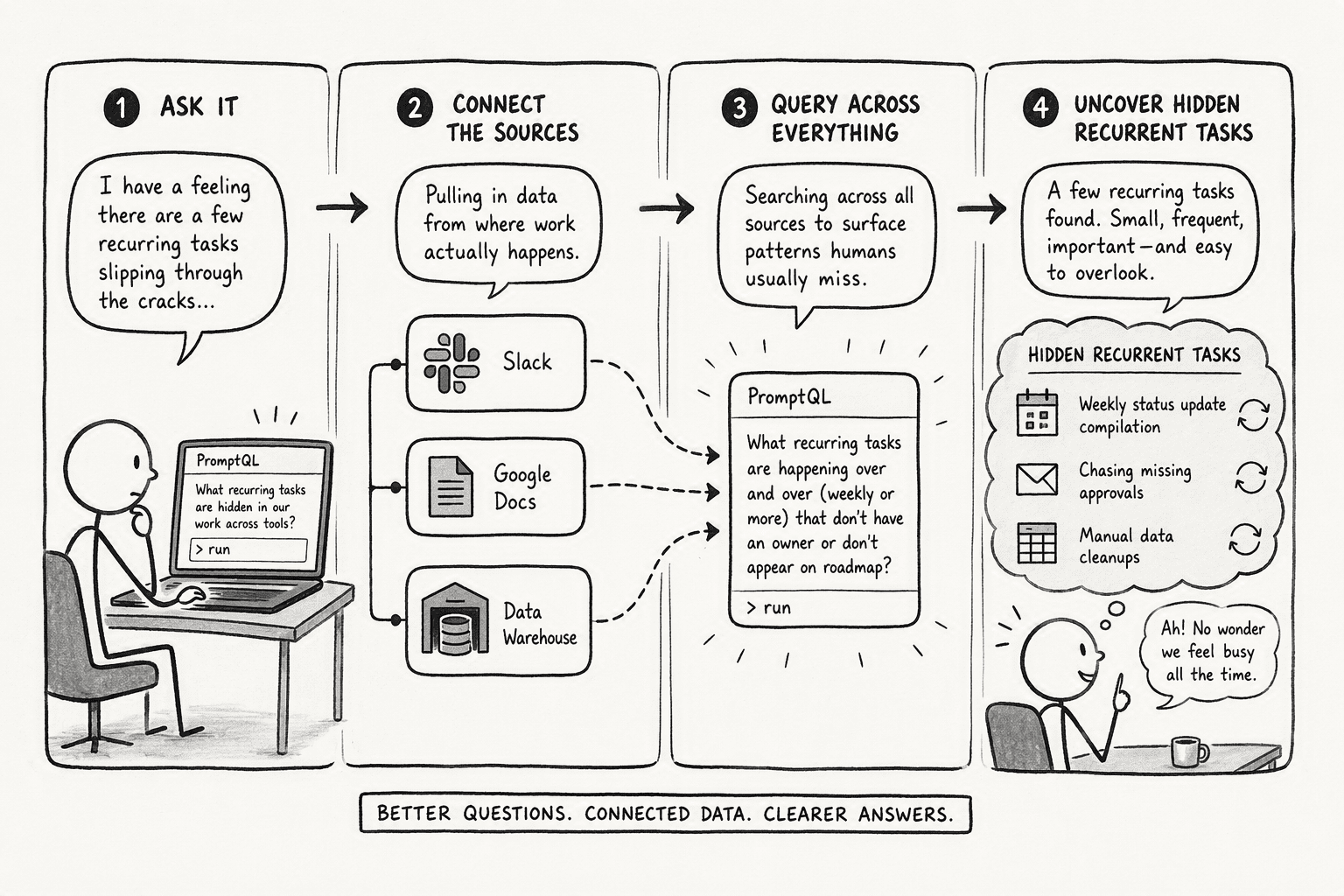
Even a good interview misses things, the one-off command someone runs weekly, the edge case that only shows up at quarter-end. Pointing an AI tool at the actual daily record of someone's work, chat history, documents, tickets, and asking plain-English questions about what it finds can surface patterns nobody thought to mention out loud. That context tends to decay the moment it's written down as a static note, so a tool that can keep reasoning over it directly is worth more than a one-time export.
5. Capture the social graph, not just a contact list
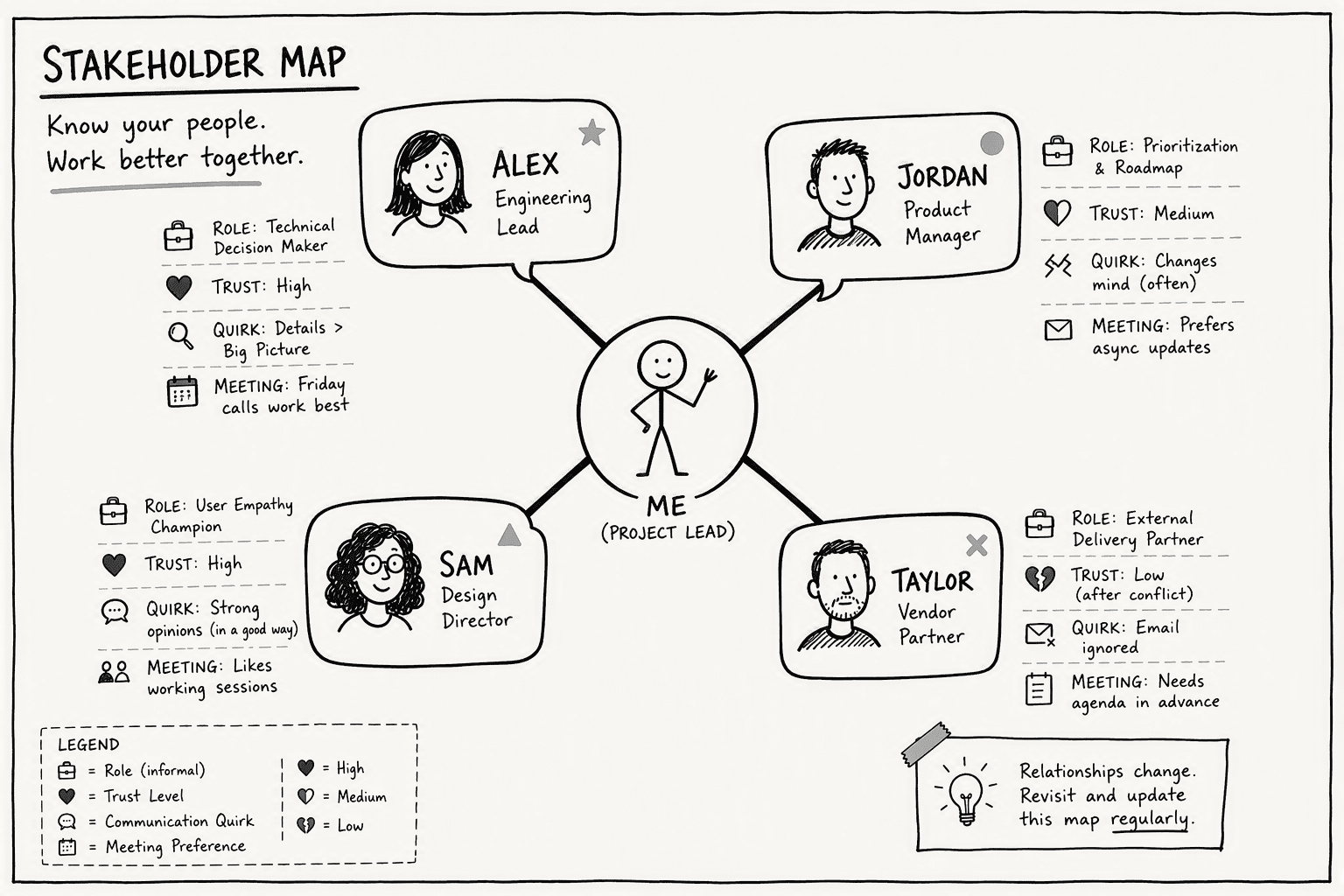
Real relationship handover includes the informal role someone played in a project's history, how they prefer to communicate, and any hard-won advice about working with them, "call on Fridays, he never reads email" is worth more than a name and an email address. This is the operational network that actually gets work done, and it dissolves the day someone leaves unless it's deliberately captured beforehand.
6. Put the result somewhere living, not a folder that goes stale
A knowledge transfer document that lives in a folder nobody opens again is barely better than nothing. It needs to live where the team already works, searchable, updatable, and visible enough that six months later, when a new hire discovers an edge case, they update a genuinely shared source rather than a private document that quietly becomes another dead end.
7. Measure what was actually preserved
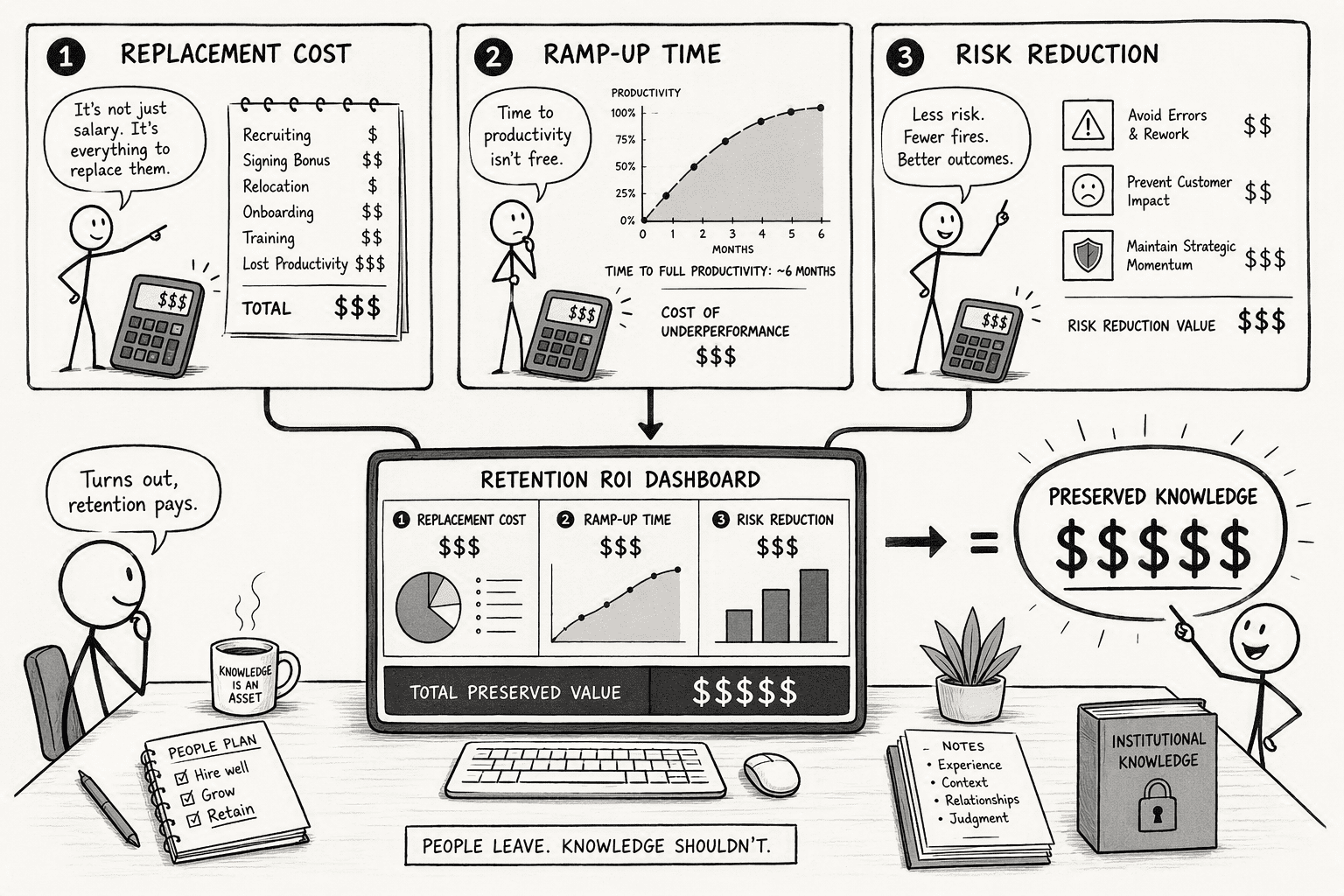
Retention programs that can't show their math tend to get cut. Combine a few figures into one number leadership can actually weigh: the hard cost of replacing the role using standard turnover-cost benchmarks, the value of the documentation that now exists where none did before, the ramp-up time saved for the successor compared to a typical hire, and a rough estimate of the risk avoided by not losing a single-point-of-failure relationship or process. One combined ratio makes the case far better than a vague appeal to "institutional knowledge."
The more seamless way of doing this
Interviews and static documents each catch part of the picture, but nothing connects them, and nothing keeps the result current after the person who "owned" it is gone. A knowledge transfer document is a snapshot. Real knowledge keeps accumulating and changing long after that snapshot was taken.
PromptQL takes a different approach to surfacing what interviews miss and keeping the result somewhere living:
- Connects directly to where knowledge already lives. Slack, Google Docs, a data warehouse, without anyone needing to know the underlying technical schema.
- Answers plain-English questions instead of requiring a separate interview. Point a planning prompt grounded in the right context at a departing colleague's project history and ask something direct, what are the most common troubleshooting patterns in this thread, and who owns the follow-up.
- Shows its work. Every answer comes with the sources it pulled and the assumptions it made, so a misread is easy to catch.
- Makes corrections permanent. Fix a misread once, and it becomes cited, shared context for everyone else going forward, not a fix that only lives in one person's head.
That shared context lives in threads accessible via a public link, with no separate login required, and every thread keeps a full revision history and audit trail. It's a wiki that builds itself from the actual work being done, rather than a document someone has to remember to maintain after the person who understood it best has already left.
See how PromptQL captures shared context as work happens, or explore PromptQL Tag for your team's workspace.
Conclusion
Every departure is a knowledge transfer event, whether it's treated that way or not. Starting early, verifying real assets, extracting the reasoning nobody wrote down, and putting the result somewhere the team will actually keep using it are what separate a real transfer from a rushed handoff. The organizations that get this right aren't the ones with the best documentation, they're the ones where knowledge keeps compounding instead of walking out the door every time someone does.
Frequently Asked Questions
What is organizational knowledge loss and why does it matter when employees leave?
It is the permanent disappearance of critical expertise, unwritten processes, and relationship intelligence when an employee departs. The NASA Knowledge Capture and Transfer Working Group defines it as a continuity risk that damages operations, morale, and service quality because tacit knowledge about decision-making and project history is not stored in any document.
What strategies and frameworks can organizations implement to prevent knowledge loss during employee offboarding?
Implement a phased framework modeled on NASA's three-step sequence: collect initial documentation immediately, conduct structured knowledge transfer interviews for tacit insights, and create a living Knowledge Transfer Plan. Start the process early, separating explicit assets from unwritten decision-making rationale.
How can AI and advanced technologies help capture, organize, and transfer institutional knowledge?
AI can analyze daily communication output to surface hidden workflows. Tools like PromptQL let you query Slack, docs, and databases in plain English to extract troubleshooting patterns and edge cases, then embed the findings in a persistent shared workspace with version history and audit trails.
What process should a company follow to build a proactive knowledge retention plan in 2026?
Follow a 90-day countdown with these phases:
- Audit and compile digital assets and access credentials into a verified snapshot.
- Conduct in-depth interviews targeting failed approaches and decision logic.
- Embed everything into a living, collaborative artifact the team updates, preventing it from becoming a dead archive.
How do you measure the financial impact of lost knowledge and the ROI of retention efforts?
Measure it by combining replacement costs with the monetized value of preserved timelines. Calculate productivity loss during vacancy and ramp-up, quantify the dollar value of avoided project delays, and translate reduced onboarding time-to-productivity into saved salary costs.
What common mistakes do companies make that worsen knowledge drain, and how can they avoid them?
The two biggest mistakes are waiting until the final week to begin capture and relying only on static documentation. Avoid this by starting collection on Day 1 of a notice period and using face-to-face interviews to extract the unwritten 'why' behind decisions that no file contains.
Sources
- PromptQL Tag | The company-wide AI agent for your workspace - promptql.io
- Knowledge loss induced by organizational member turnover - www.sciencedirect.com
- Offboarding Knowledge Transfer Plan 1 2 3 - afd.calpoly.edu