Introduction
When a number in a spreadsheet looks wrong, an analyst knows where to start looking: the source it came from, the filters applied to it, the formula behind it. Each place has its own kind of mistake, and finding which one failed is most of the fix.
Many AI tools hide those steps. A question goes in and a number comes out, so a wrong result gives no clue about which step slipped, even though every step still happened. Something had to interpret the question, settle on a definition, find the data, choose the rows, apply a formula, and do the calculation. This guide walks through those six places in the order a number gets built, so a wrong number can be traced to the step that produced it, with what helps at each.
Key Takeaways
- Six causes, one per stage: The question, the definition, the source, the rows, the formula, and whether any calculation ran at all.
- Benchmarks show where errors cluster: In Spider 2.0's error analysis, formula and planning errors were the largest category and wrong tables and columns the second.
- Language models alone are weak at aggregation: Sums and counts over large tables degrade as the data grows, and code that does the arithmetic restores accuracy.
- Fluent prose hides all of them: A wrong number reads the same as a right one, so the check has to come from somewhere else.
- Each cause has a different fix: A sharper question helps with ambiguity, written definitions help with meaning, and running code helps with calculation.
Why AI gives wrong numbers
A wrong number can enter at six points, in the order a number gets built: the question, the definition, the data, the rows, the formula, and whether anything was calculated. The error figures below come from Spider 2.0, a benchmark that tests AI agents on real enterprise databases. They are benchmark results, not live deployments, but they show where errors cluster.
Now, let's take a look at the reasons why AI would give you the wrong numbers
1. The question is ambiguous
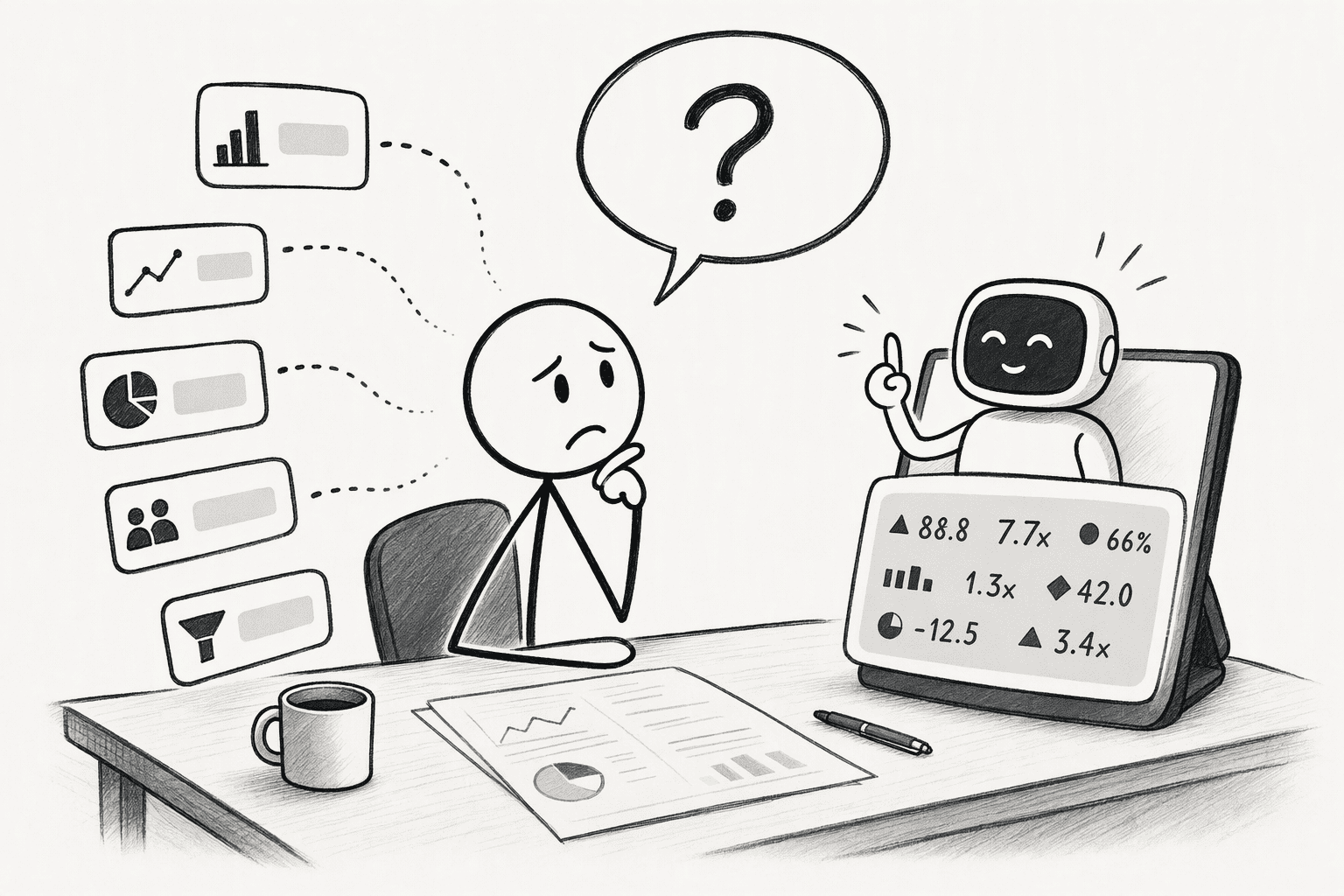
Many wrong numbers start before any data is touched. A question like "how's revenue?" leaves the metric, the period, and the segment to be guessed, and the AI will pick something and answer it confidently. Nothing in the data or the formula is wrong here, because the question simply did not clearly say what it was asking. What helps is spelling out the metric, the time window, the segment, and what the number will be used for.
2. The definition isn't the one you use
Even a precise question depends on what a term means. Teams often compute the same-named metric differently: one may calculate churn over 90 days and another over 60, and a recent paper on shared agent memory describes how an AI can quietly carry one team's definition over to the other. The AI applies a definition faithfully, and the number is still wrong for you.
What helps is writing definitions down once and giving them to the AI, since many wrong numbers in AI-generated reports trace back to unclear definitions.
3. It used the wrong or outdated data
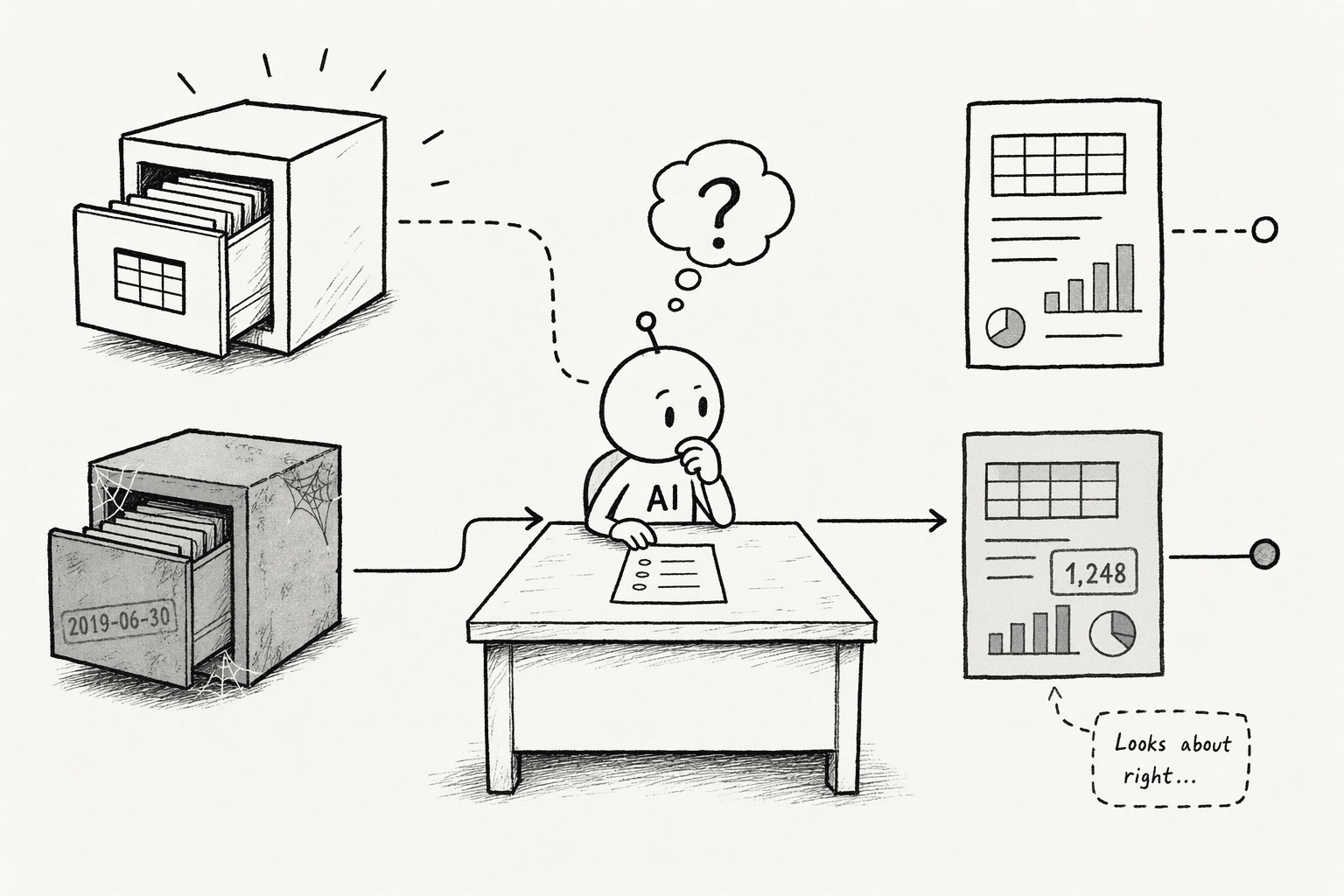
Once the question and the definition are clear, the AI still has to find the right data. In Spider 2.0's analysis of 300 failures, wrong schema linking was 27.6% of errors, split between wrong columns (16.6%) and wrong tables (10.1%), in databases that average over 755 columns. A query against a similar-looking table still runs and returns a number.
Freshness is the other half of this cause: suppose the AI pulls last quarter's forecast instead of the finalized filing, and the answer reads fine until it fails to reconcile. What helps is naming the system of record and keeping a check on the last updated date of the data.
4. The wrong rows went into the calculation
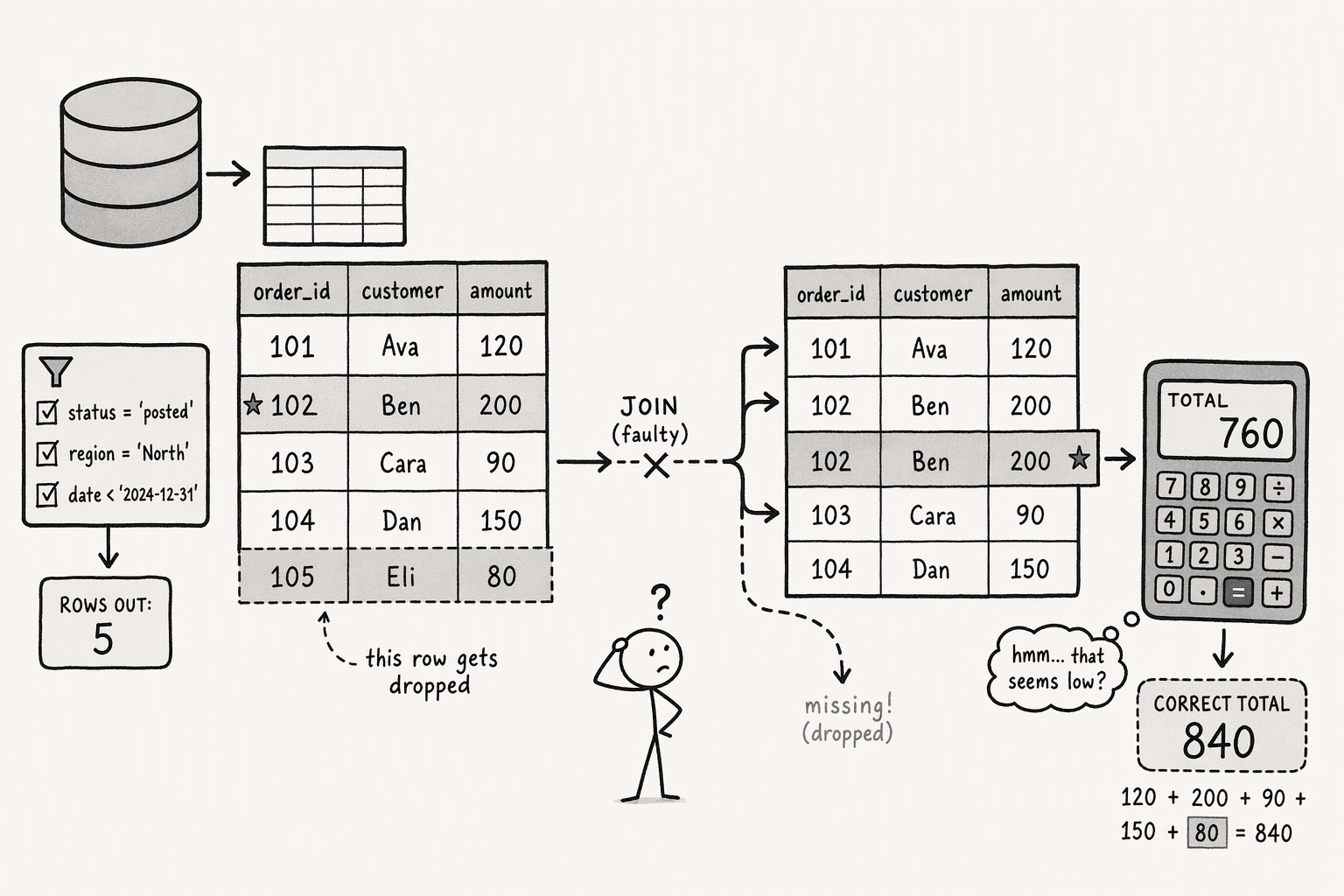
With the right source in hand, the next question is which rows to use. Joins can duplicate or drop rows, which inflates or shrinks a total, and Spider 2.0 puts join errors at 8.3% of errors, noting that BigQuery databases often lack explicit foreign keys, so the model has to infer the join from column names.
Filters fail the same way: test accounts left in, a date range off by a period, a condition missing altogether. A Spider 2.0 follow-up benchmark found that the failures every model shared were driven by filter and schema errors. The formula would be fine, but it ran on the wrong rows. What helps is reading the filters and the row count, and comparing the count with the source.
5. The calculation was set up wrong
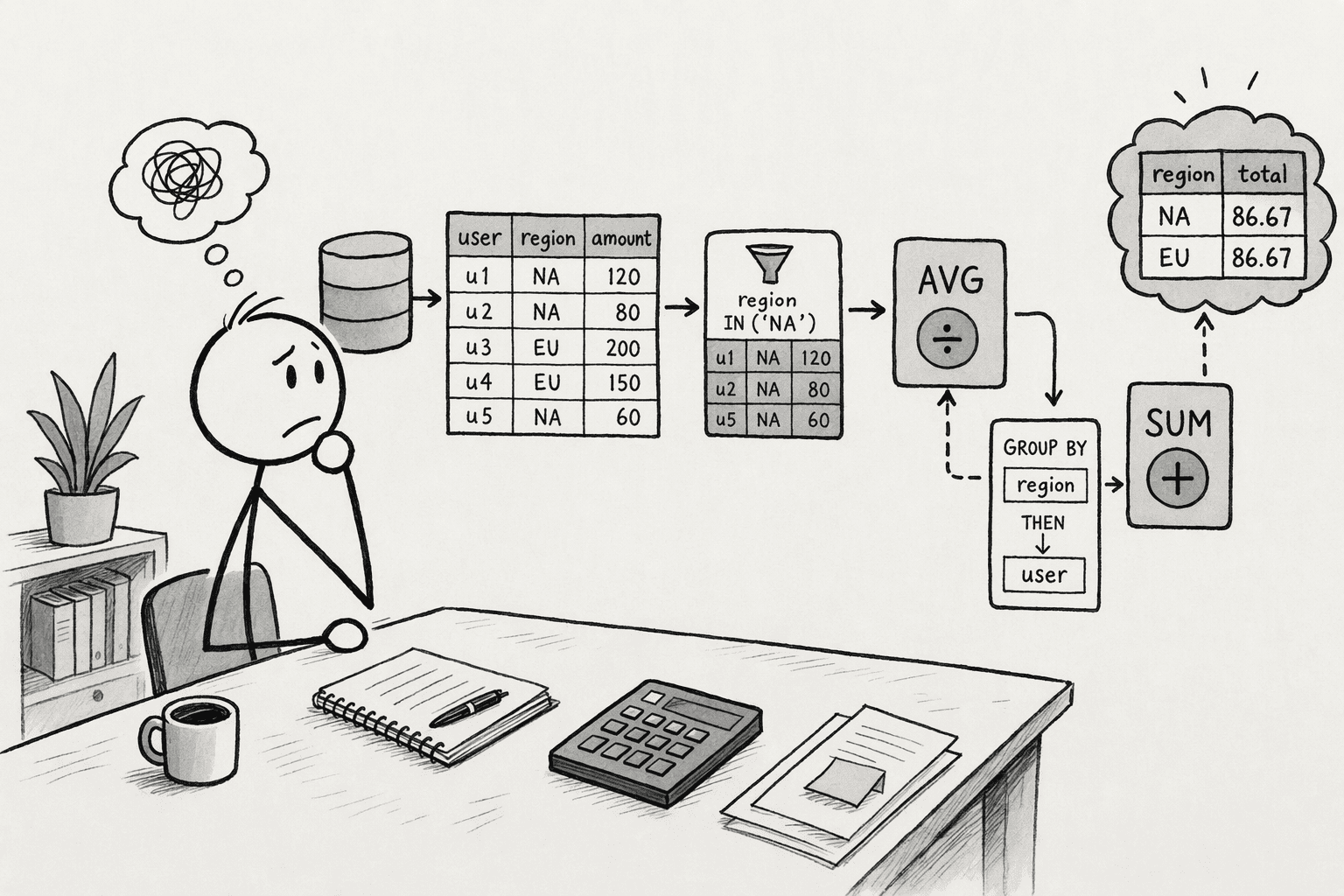
Here the right rows go into the wrong method. The query runs and computes something, just not what was asked: AVG instead of SUM, grouping at the wrong level, a percentage taken of the wrong base, a multi-step plan done in the wrong order, or a date function misused.
Spider 2.0 calls this erroneous data analysis, and at 35.5% it's the largest error category in its analysis, split between intricate query planning (17.7%), dialect function misuse (10.3%), and advanced data calculation (7.5%).
One example is quantiles divided by the number of trips instead of trip duration. What helps is reading the query itself, not just the answer, because the mistake is visible in the logic.
6. No calculation ran at all
The last cause is different in kind, because nothing was computed. When a tool doesn't run code on the data, a language model produces the number as text, or reads figures out of a large table in its context, and it can misread, skip, or miscount rows. Independent studies point the same way.
TQA-Bench found that models fall off more on aggregation than on simple lookups as tables grow, and a study of probabilistic reasoning found that accuracy on a task requiring counting ranged from 28% to 87% across problem sizes when one model counted raw samples itself, and from 97% to 100% when it wrote Python to count. That is one model on one task, but it shows the pattern.
Whether a number is computed or guessed depends on the tool, since some run code on uploaded data and some don't. What helps is a setup where the AI writes the query or code, runs it against the data, and reports the result.
Why wrong numbers go unnoticed
Every cause above produces a number that reads like any other. A language model writes fluent, confident prose whether the figure is right or wrong, so the answer gives no warning, and many tools and reviewers pass it along without checking.
What helps is a check that doesn't rely on the answer's tone: reading the query, comparing the row count with the source, tracing a few records, and confirming that every figure in the written answer appears in the query's output. Seeing what the AI pulled and assumed is what makes those checks possible.
This is why, PromptQL shows its plan before it runs and logs every query, result, and access, so there is something to check against.
Conclusion
Wrong numbers from AI aren't one problem. They come from the question, the definition, the data, the rows, the formula, or from no calculation at all, and they reach you in the same confident prose as right ones. Naming which stage failed points to the fix, and a check catches what a fix misses. With PromptQL, you can ask in plain English, see the plan behind each answer, work from connected systems of record, and have corrections captured so the next answer starts from them.
Frequently Asked Questions
Why does AI give wrong numbers when the data is right?
Because the data is only one of six places an error can enter. The question may have been ambiguous, the AI may have used a different definition than yours, a join or filter may have picked the wrong rows, the formula may have been set up wrong, or nothing may have been calculated at all.
How do AI platforms enforce data access permissions so answers are based only on authorized data?
Platforms use authorization models that either inherit the user's permissions (user-authorized) or run under a broader service identity (self-authorized). The user-authorized approach scopes access to what the individual is permitted to see on every request, with no second permission system.
What is an AI reasoning trace and how does it help validate answer accuracy?
A reasoning trace is the chain of steps, intermediate conclusions, and source references the model followed to reach its answer. It lets you inspect whether each conclusion properly led to the next and whether any claims appeared after the evidence ran out.
Why does the AI sound so sure when it's wrong?
It writes fluent text whether the number is right or wrong, and nothing in the prose reflects how the number was produced. That is why the check has to look at the query, the rows, and the output instead of the tone.
Sources
- Beyond the booth: What is "100% accurate" enterprise AI? - promptql.io
- SourceBench: Can AI Answers Reference Quality Web Sources? - arxiv.org
- RAG best practices for enterprise AI teams | TechTarget - www.techtarget.com
- How Accurate is Legal AI? The Anatomy of a Trustworthy Answer - www.lexisnexis.com
- Grounding verification in AI: LLM techniques and metrics - www.dataiku.com