Introduction
You ship a campaign. Something breaks. The post-mortem thread in Slack is thorough: your team flags the exact broken headline format and tags the channel.
High fives all around. Then three weeks later, you watch someone launch a campaign with that same broken headline format, and it burns down the same way. You want to scream.
The problem is structural. Slack is great at sharing what happened, but it does not make that lesson show up when the next campaign is built.
The mistake loop is an engineering problem. It needs system-policed rules, not another pinned post.
Key Takeaways
The loop isn't a memory problem. It is a structural trap where passive chat archives fail to punch through the noise of a live campaign build.
- The Knowledge, Action Gap is real: Tacit, experiential know-how shared in Slack threads never translates into an active step in your workflow, and according to Slack it is much harder to store within a knowledge management system or database.
- Deadline pressure beats the wiki: When a launch is close, people work from what is in front of them, and a warning buried in an old thread is not.
- Rules must become code: The fix is converting Slack insights into an operational gate (like an n8n workflow or database check) that hardcodes the learning into the campaign request process, stopping errors mid-flight.
- Agents need shared rules: Gartner forecasts that 40% of enterprise applications will be integrated with task-specific AI agents by the end of 2026, and a shared wiki like PromptQL’s gives those tools one set of rules to work from.
- You can get started in 5 days: Audit your top three repeating Slack scars, write each one as a plain-English rule, add a check to your brief process, and you have a system that applies the lesson every time instead of once.
Why Does a Marketing Team Keep Repeating the Same Campaign Mistakes After Sharing Learnings in Slack?
A marketing team keeps repeating the same mistakes because a Slack thread records a lesson but doesn't apply it. The lesson sits in a past conversation, and nothing brings it up when a similar campaign is being built. Fixing this means moving lessons out of chat threads and into a shared place that is checked before a campaign goes live.
The Knowledge, Action Gap: Why Slack's Active Conversations Still Create Passive Archives
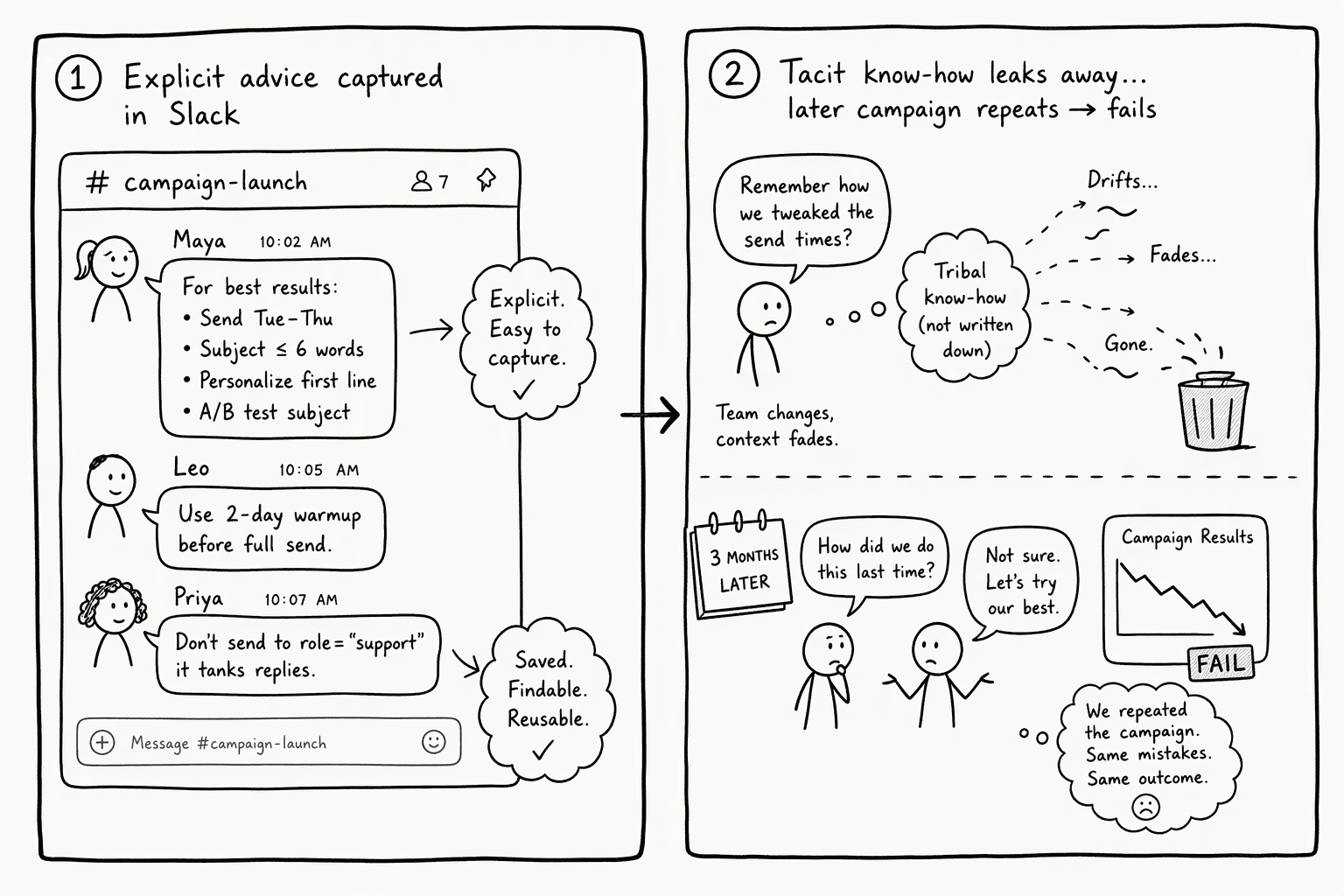
Slack is designed for velocity, not enforcement. A thread fires at you, you solve the problem, and the conversation scrolls into the archive. The painful nuance, the gut feeling, the experiential 'don't do this', is what researchers call tacit knowledge. Here is how the gap widens into a recurring disaster:
- You capture explicit text, not tacit instruction. The thread says 'the headline broke because of character encoding.' But the real lesson, the unease a writer feels building a similar asset, evaporates because, as Slack's own research notes, the most valuable knowledge is experiential and much harder to store within a database.
- Search becomes a barrier, not a prompt. Nobody pauses during a furious launch to grep through a 40-message thread from last quarter. The archive is passive; it waits for you, but your brain is handling a syntax error on a landing page form.
- Confidence is mistaken for compliance. The team feels smart because they 'documented' the learning. That false sense of security is more dangerous than having no post-mortem at all. You confuse writing a message with changing a behavior.
The Psychology of Repetition: Structural Barriers That Override Documented Warnings
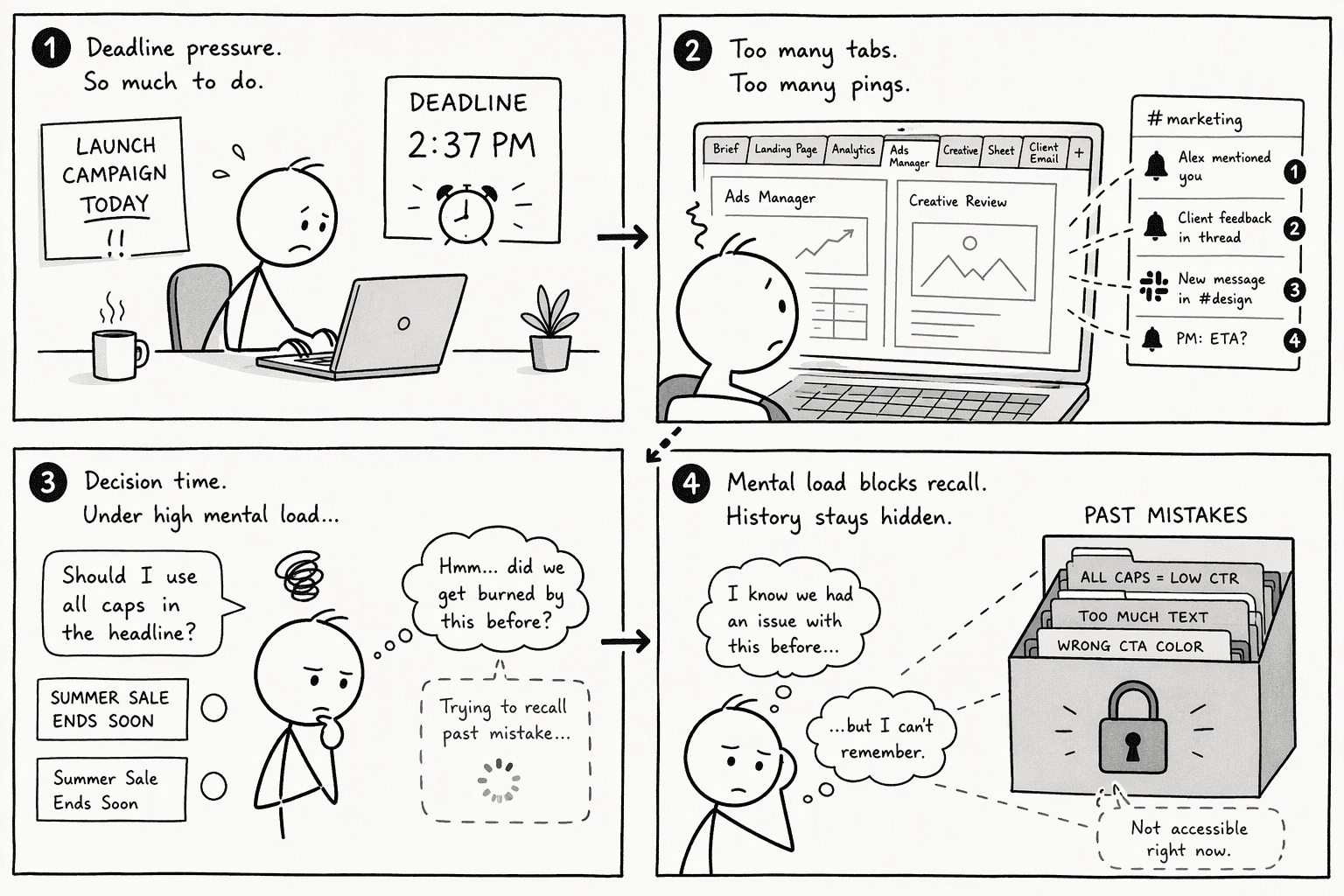
A Slack bookmark doesn't stand a chance against a busy launch week. When a marketer is deep in a campaign build, cross-referencing every choice against a mental list of past mistakes is close to impossible. They are busy juggling forty-six browser tabs about audience segments and pixel implementation, and your pinned post is not one of them.
Deadline pressure is the ultimate memory eraser. The closer the 'launch' button gets, the more the brain rationalizes shortcuts. That's when the 'this-time-it's-different' bias shows up: 'Sure, emojis in the subject line tanked delivery last time, but that was a different audience segment on a Tuesday in Q2.' The logic is fictional, but it feels bulletproof at 11:48 PM.
You need a gate that closes automatically. If you rely on human recall, you will reliably repeat mistakes. The only way to change the outcome is to insert a check between the marketer's intent and the final execution. You don't need a smarter team; you need a gate that doesn't care about the 11:48 PM rush, doesn't believe in magical thinking, and checks the brief against the database of past failures every single time.
From Conversation to Code: How to Convert Tacit Slack Learnings into System-Policed Rules
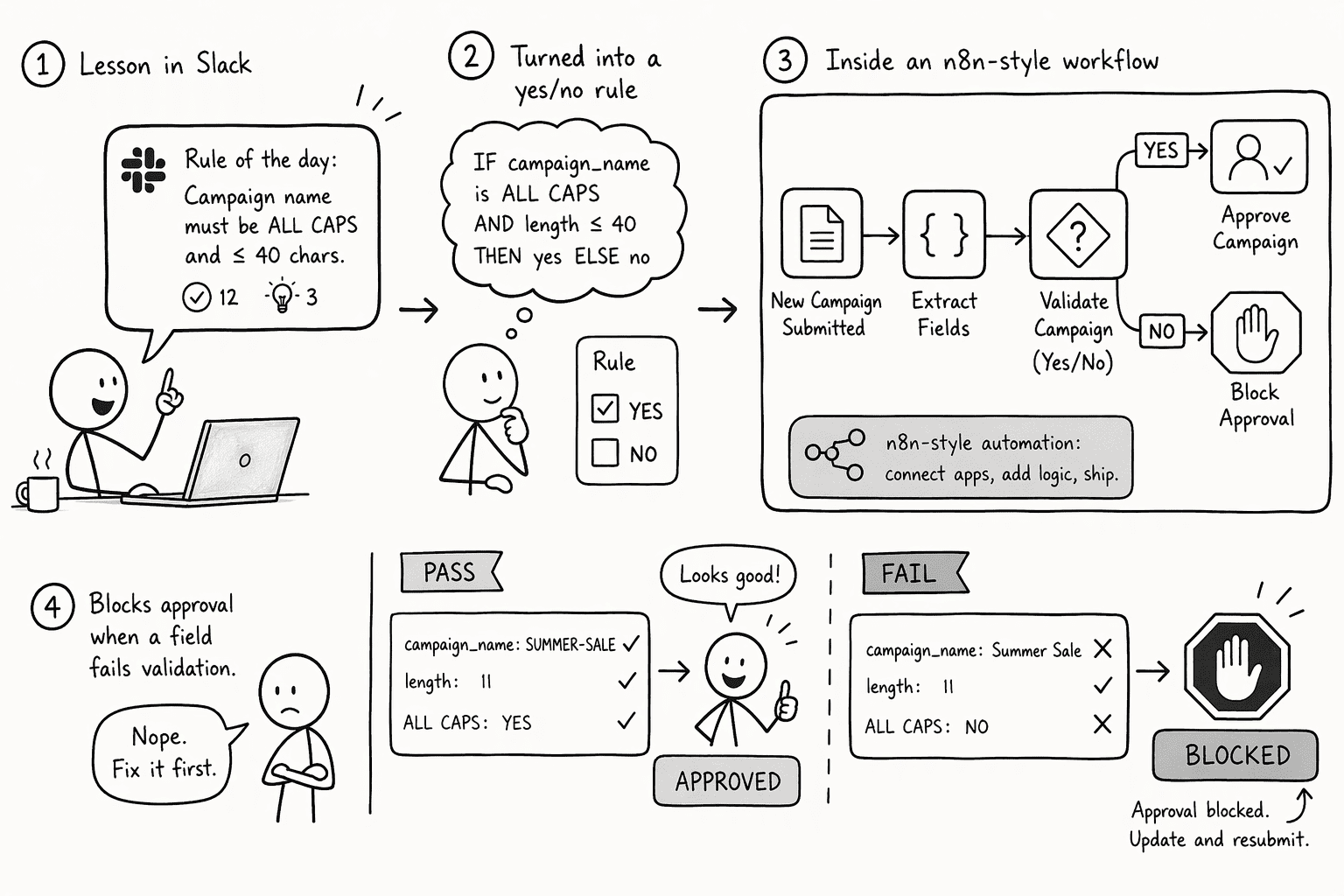
The prison break from the loop is treating every Slack scar as an untapped API call waiting to be written. Instead of 'Hey team, remember to check the UTM casing,' look at that thread and ask: 'What data structure could have stopped this?' The answer is a small, ruthless database of past violations that an automated funnel has to query before approving anything.
At its simplest, you take the collective horror of a broken headline and write a yes/no condition. An n8n workflow fires on a campaign brief submission, crosses the proposed elements against a table of banned terms or broken regex patterns sourced directly from the Slack thread, and rejects the submission with a literal citation from the original post-mortem.
The system snaps back a message: 'REJECTED: This headline relies on a known encoding failure (see Slack thread from Oct 2026).' The learning becomes a gate you physically cannot pass without fixing the error.
Embedding the Gate: How a Shared Wiki Helps Catch Errors Mid-Campaign
Individual rules are good, but they only help if everyone, including the AI tools your team uses, works from the same ones. That matters most for the expensive, multi-system mistakes, the ones where your email copy is fine but your attribution logic is wrong going into the CRM.
This is where a shared wiki stops being a nice-to-have. Gartner forecasts that 40% of enterprise applications will be integrated with task-specific AI agents by the end of 2026, up from less than 5% in 2025. As more tools act on your behalf, they all need one set of rules to work from.
A tool like PromptQL can act as that shared layer. Instead of a human reading a Slack thread doc, your team keeps the rule in PromptQL’s wiki, where corrections from shared threads can be captured as cited entries. During setup, a marketer types, ‘Draft the Facebook copy based on the winning headline character set,’ and PromptQL can answer from the rules in the wiki and show the entries it used.
Here is what else it offers:
It gives your team the rule at the right moment, so you remember not just what you asked, but what you might have forgotten to check. A person still makes the final call.
Beyond the Post-Mortem: Designing Process Checkpoints and Incentives That Reward Compliance
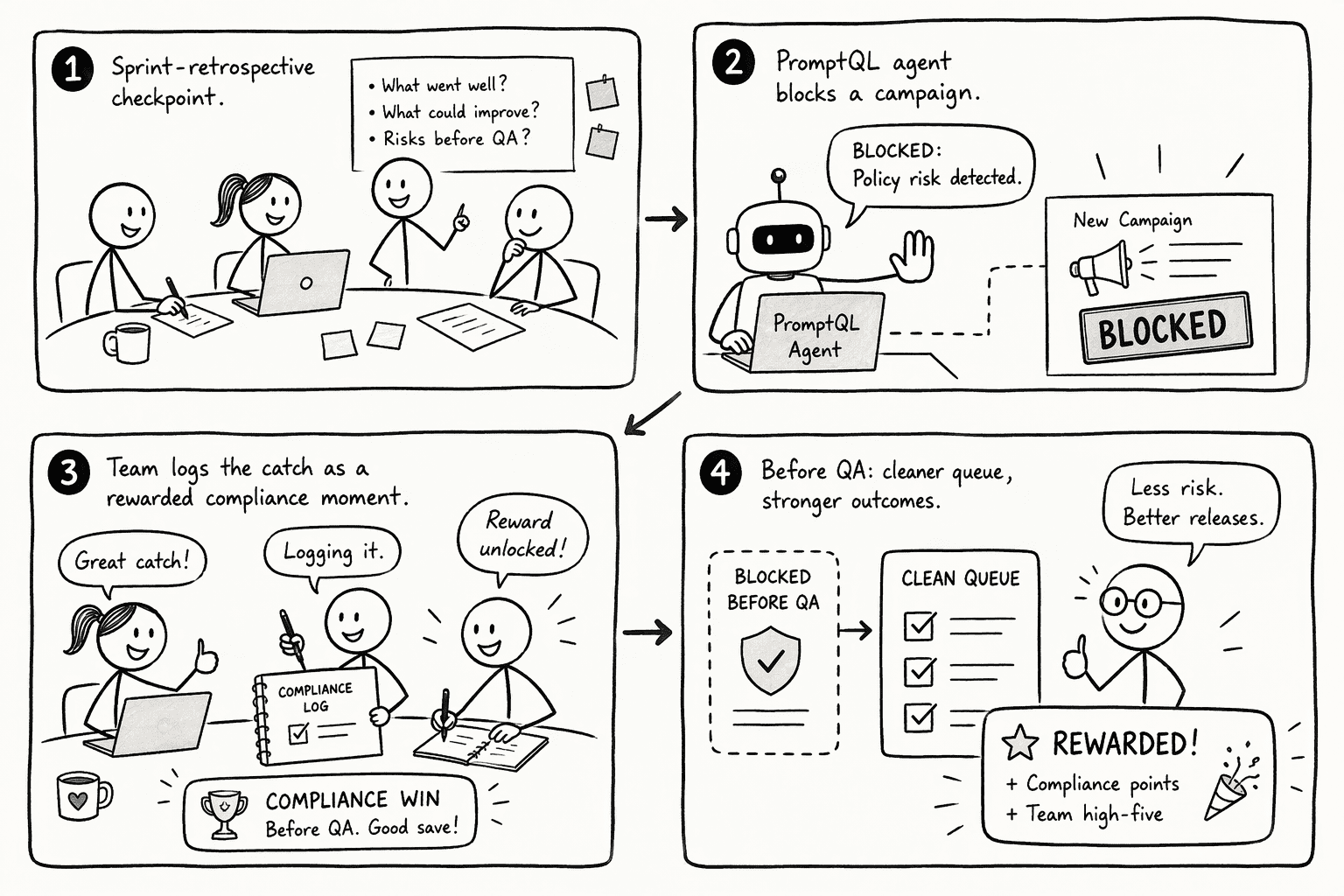
Even the perfect gate is useless if the team culture treats it as a villain to be bypassed. You have to stop rewarding people only when they launch on time, and start celebrating people who slam the brakes on a launch.
Flip the script during your sprint retros. Instead of asking 'Why did the launch fail?', add a checkpoint that asks 'What did the check catch before it even got to QA?' When a team member shares a rule that caught a brief violating a historic UTM rule, treat that as a major win. Share those catches loudly in the same Slack channels that used to house the silent failures. The check becomes the impartial referee, and the human gets recognized for protecting the budget, not just burning through it. Atlassian's guidance on knowledge sharing notes that people share more when they feel valued, and suggests naming the people who helped.
Building a Marketing Nervous System: A 5-Day Implementation Roadmap Using PromptQL and Modern Workflow Tools
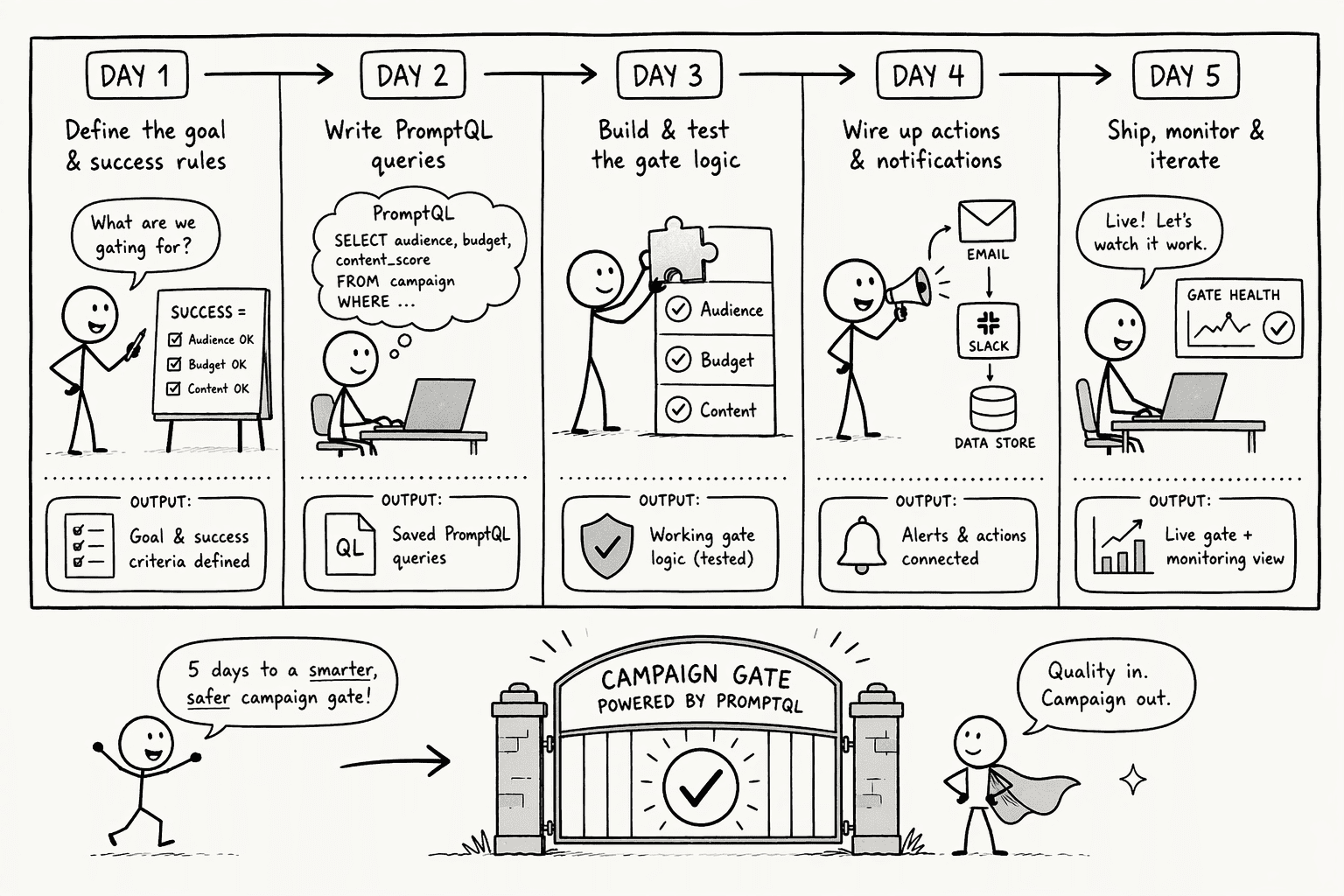
Here is a five-day plan to turn your Slack ghosts into a system-policed check:
- Day 1: Autopsy Audit. Search every campaign channel for the costly, recurring errors the team kept making despite knowing better. Identify the top three. Output: a shortlist of three specific, lethal failure patterns (e.g., 'UTM source casing variations,' 'emoji encoding crashes').
- Day 2: Rule Logic in Plain English. Translate the Slack threads into deterministic rules. Write 'IF the brief contains [bad headline regex] AND audience is [list], THEN block.' Output: a plain-English spec for your enforcement logic, plus a simple database table of banned patterns sourced from the threads.
- Day 3: Put the Rules in One Shared Place. Store the rules in a shared wiki, such as the one in PromptQL, and connect your campaign sources like Google Ads and Google Analytics. Output: a shared rule set that PromptQL can answer from, with the wiki entries it used shown as citations.
- Day 4: Integrate into the Request Process. Make the rule review the first stage of your campaign intake in Asana or your project management tool, using a checklist or by asking PromptQL which rules apply to the brief. Output: an updated intake step that includes the rule review.
- Day 5: Weaponized Testing and Handoff. Attempt to push the exact three bad campaigns from Day 1 through the check. Expect them to be caught. Share the results with the wider team in Slack. Output: a record of successful catches, a shared team wiki, and a celebration channel for prevented disasters.
Conclusion
If your Slack archive is full of brilliant lessons that nobody follows, your problem isn't a knowledge gap. It's a structural collapse. No amount of pinned posts will fix a marketer racing a deadline.
You need to convert those ephemeral cries for help into system-policed checks that catch bad work before it can embarrass you. By embedding last quarter's agony into a shared checkpoint, you give your team a system that feels the pain once and applies the lesson every time. That's the end of the loop.
Frequently Asked Questions
Why does organizational learning fail to translate into behavioral change, even when insights are shared in real-time on platforms like Slack?
Slack is designed for velocity, not long-term enforcement. Real-time chat captures explicit facts, but the most valuable learning, tacit, experiential know-how, is much harder to store in a searchable archive. Without a mechanism to actively force the application of that knowledge during a frantic campaign build, teams mistake written documentation for behavior change, and the same errors simply scroll back up.
What psychological and structural barriers cause marketing teams to repeat known campaign mistakes despite documented learnings?
Under deadline pressure, teams work from what is in front of them, and ‘this-time-it’s-different’ thinking makes shortcuts feel reasonable. Structurally, a passive Slack thread can’t compete with the pressure of a build. The team lacks a physical ‘gate’ to block them before they touch a live audience.
How can marketing teams move from passive knowledge sharing to active, enforced learning that prevents recurring campaign errors?
Teams must convert Slack learnings into system-policed rules. Instead of telling people to check a wiki, you hardcode past failures into a database and build an automated 'enforcement gate.' When a marketer submits a campaign brief, the system checks it against the database and automatically rejects any asset that echoes a previously documented failure.
What role does tooling and system architecture play in bridging the gap between capturing insights and applying them during campaign execution?
Modern workflow automation tools provide the structural 'switchboard' that human memory cannot. Platforms allow you to build operational gates that sit between a marketer’s action and the campaign launch. By connecting business systems to enforcement logic, these tools bring the learning to the person at the moment they need it.
How can AI or workflow platforms help embed learnings directly into a marketing team's operational processes?
PromptQL can capture rules and corrections from shared threads as cited wiki entries, with a person approving each one. You can then ask it which of those rules apply to a brief and see the entries behind its answer. It also works in Asana and connects to tools such as Google Ads and Google Analytics, so your team can work from one shared set of rules.
Sources
- PromptQL for Google Ads - AI-powered advertising analytics - promptql.io
- PromptQL for Google Analytics - AI-powered website analytics insights - promptql.io
- Knowledge Sharing in the Workplace | Slack - slack.com
- All brains on deck: 10 best practices for knowledge-sharing - Inside Atlassian - www.atlassian.com
- AI Workflow Automation 2026: n8n vs Zapier vs Make vs AI Agents | AI Workshop - ai.blocksize.hr