
Have it take action
Pre-authorize the next step. When the trigger trips, PromptQL does the doing — no human in the loop required.
What it is
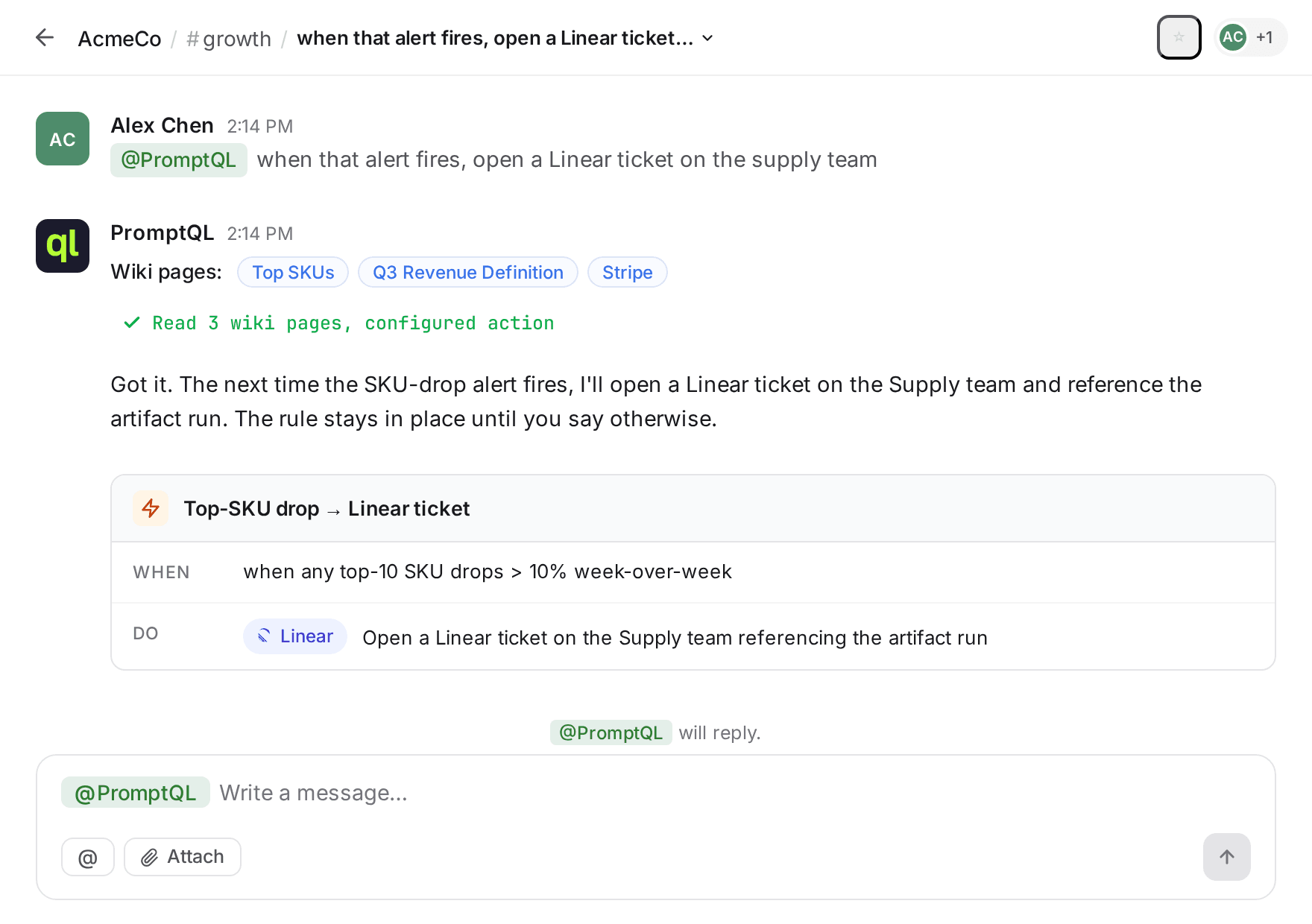
An action is something PromptQL can do in one of your connected systems — open a Linear ticket, send a Slack DM, post a Salesforce note, fire any write endpoint an integration exposes. The shape of the rule is always the same: when X, do Y. You describe both halves in natural language; PromptQL wires the trigger to the call.
Rules are pre-authorized. Once one is in place, PromptQL doesn't stop and ask the next time — it just acts and posts a summary in the thread. That's the fourth hand-off: the doing moves off your plate.
How to do it
- In the thread, describe the rule end-to-end — the trigger and the action together — “when that alert fires, open a Linear ticket on the supply team.” Point at an existing alert or describe a new one inline; PromptQL wires it up.
- PromptQL confirms with an action-rule card — the trigger, the integration it'll call, the specific action. Anyone in the thread can see what's wired.
- When the trigger trips, PromptQL takes the action and posts a summary in the thread — “Opened LIN-2847 on Supply following SKU-G dropping 14%.” No approval prompt; the rule's pre-authorized.
- Tune or pause the rule the same way you set it — “also DM the Supply lead”, “route to the L2 queue instead”, “turn this off”.
What's next
You've handed off the input, the running, the watching, and the doing. The loop runs by itself. But there's one piece that can't be automated — the part where PromptQL learns what your team actually means.
Last in Basics: Approve and collaborate. PromptQL surfaces things it picked up from the way you work — definitions, jargon, business rules — and asks you to confirm. You approve or refine; the semantic layer sharpens. That's how the next loop starts smarter than this one did.